Ch. 23 - Carbohydrates and Nucleic Acids
Wade - Organic Chemistry 9th Edition
Wade9th EditionOrganic ChemistryISBN: 9780135213728Non è quello che usi tu?Cambia libro di testo
Capitolo 23, Problema 23a

Show the products that result from hydrolysis of amygdalin in dilute acid. Can you suggest why amygdalin might be toxic to tumor (and possibly other) cells?

Guida verificata passo dopo passo
1
Step 1: Analyze the structure of amygdalin. Amygdalin is a glycoside composed of two sugar units (glucose) and a cyanogenic aromatic compound (benzyl cyanide group). The glycosidic bond connects the sugar units to the aromatic moiety.
Step 2: Understand the hydrolysis reaction. Hydrolysis in dilute acid involves breaking glycosidic bonds and ester bonds through the addition of water, facilitated by the acidic environment. This reaction will cleave amygdalin into its constituent parts.
Step 3: Predict the products of hydrolysis. The glycosidic bond will break, releasing two molecules of glucose and one molecule of benzaldehyde cyanohydrin (which can further decompose into benzaldehyde and hydrogen cyanide under acidic conditions).
Step 4: Explain the toxicity of amygdalin. The hydrolysis of amygdalin releases hydrogen cyanide (HCN), a potent inhibitor of cytochrome c oxidase in the electron transport chain. This inhibition disrupts cellular respiration, which can be particularly harmful to rapidly dividing cells, such as tumor cells.
Step 5: Summarize the reaction. The hydrolysis of amygdalin in dilute acid yields glucose, benzaldehyde, and hydrogen cyanide. The release of HCN is the primary reason for its potential toxicity to tumor cells and other cells.

Risposta video verificata per un problema simile:

Questa soluzione video è stata consigliata dai nostri tutor come utile per risolvere questo problema.
Durata del video:
1m

Concetti chiave

Ecco i concetti essenziali che devi comprendere per rispondere correttamente alla domanda.

Hydrolysis

Hydrolysis is a chemical reaction involving the breaking of a bond in a molecule using water. In the context of amygdalin, hydrolysis occurs in the presence of dilute acid, leading to the formation of glucose, benzaldehyde, and hydrogen cyanide. Understanding hydrolysis is crucial for predicting the products formed when amygdalin is treated with an acid.
Video consigliato:
Percorso guidato
1:00
Hydrolysis of Thioesters Concept 2

Amygdalin Structure and Function

Amygdalin is a cyanogenic glycoside found in various plants, including almonds and apricots. Its structure consists of a glucose molecule linked to a benzaldehyde and a cyanide group. Recognizing its structure helps in understanding how it can release toxic compounds upon hydrolysis, which is significant in discussing its potential toxicity to cells.
Video consigliato:
02:36
Identifying Functional Groups

Cyanide Toxicity

Cyanide is a highly toxic compound that can inhibit cellular respiration by blocking the electron transport chain in mitochondria. This mechanism is particularly harmful to rapidly dividing cells, such as tumor cells, which may explain why amygdalin could be toxic to them. Understanding cyanide's effects is essential for evaluating the implications of amygdalin's hydrolysis products.
Video consigliato:
03:53
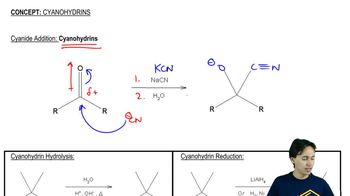
Addition of Cyanide