 Indietro
Applications of Newton’s Laws: Friction, Drag, Strings, Equilibrium, Connected Objects, and Circular Motion
Guida di studio - Note intelligenti
 Appunti personalizzati basati sui tuoi materiali, ampliati con definizioni chiave, esempi e contesto.
Applications of Newton’s Laws
Frictional Forces: Surfaces
Friction is a resistive force that opposes the motion of objects in contact with surfaces or moving through a medium. It arises from microscopic interactions between surfaces and is crucial in many physical situations.
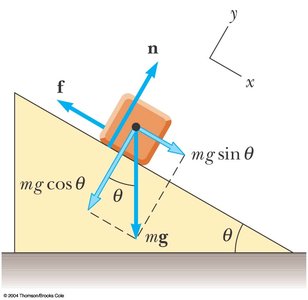
Static Friction (\(f_s\)): Prevents motion between surfaces. It increases with applied force up to a maximum value.
Kinetic Friction (\(f_k\)): Acts when surfaces slide past each other.
Formulas: where \(\mu_s\) and \(\mu_k\) are the coefficients of static and kinetic friction, and \(n\) is the normal force.
Direction: Friction acts opposite to the direction of motion and parallel to the surfaces in contact.
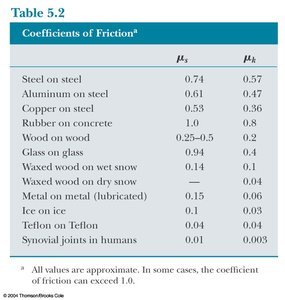
Coefficients of Friction: Depend on the materials in contact and are nearly independent of contact area.
Example: A block sliding down an inclined plane experiences friction up the plane. The coefficient of friction can be determined experimentally using the angle at which the block slips or moves at constant speed.
Typical Coefficients of Friction
Different material pairs have characteristic coefficients of friction, affecting their resistance to motion.
Materials | Static (\(\mu_s\)) | Kinetic (\(\mu_k\)) |
|---|---|---|
Steel on steel | 0.74 | 0.57 |
Rubber on concrete | 1.0 | 0.80 |
Glass on glass | 0.94 | 0.40 |
Teflon on Teflon | 0.04 | 0.04 |
Synovial joints in humans | 0.01 | 0.003 |
Frictional Forces: Drag
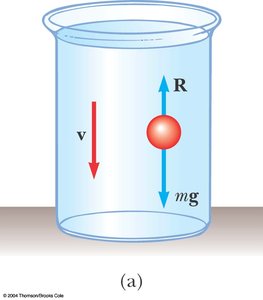
Drag is a resistive force experienced by objects moving through fluids (liquids or gases). The magnitude and nature of drag depend on the speed and properties of the object and medium.
Linear Drag: (good for slow motion or small objects)
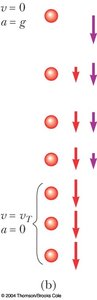
Quadratic Drag: (good for fast motion or large objects)
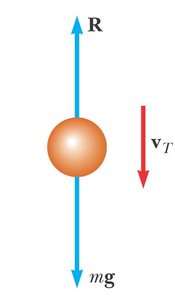
Terminal Speed: The speed at which the drag force equals the gravitational force, resulting in zero acceleration.
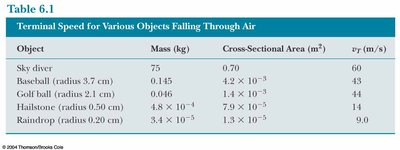
Terminal Speeds for Various Objects
Object | Mass (kg) | Area (m2) | Terminal Speed (m/s) |
|---|---|---|---|
Sky diver | 75 | 0.70 | 60 |
Baseball | 0.145 | 4.2×10⁻³ | 43 |
Golf ball | 0.046 | 1.4×10⁻³ | 44 |
Hailstone | 4.8×10⁻⁴ | 7.9×10⁻⁵ | 14 |
Raindrop | 3.4×10⁻⁵ | 1.3×10⁻⁵ | 9.0 |
Strings and Springs
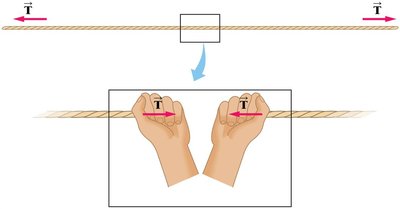
Strings, ropes, and springs transmit forces between objects. Tension is the force transmitted through a string or rope when it is pulled tight. Springs obey Hooke’s law, relating force to displacement.
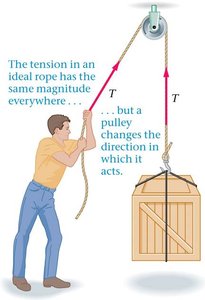
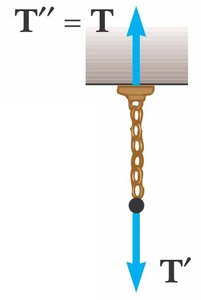
Tension: The force in a taut string or rope, assumed constant for massless strings.
Hooke’s Law: where is the spring constant and is the displacement.
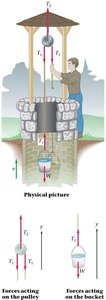
Ideal Pulley: Changes the direction of tension without altering its magnitude.
Translational Equilibrium
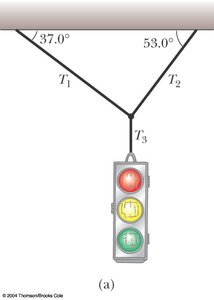
Translational equilibrium occurs when the net force on an object is zero, resulting in constant velocity or rest. This principle is used to solve for unknown forces in static and dynamic systems.
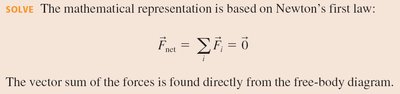
Equilibrium Condition:
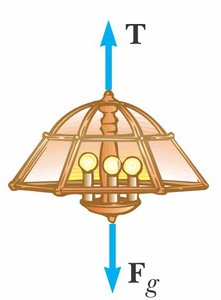
Free-Body Diagrams: Essential for visualizing and solving equilibrium problems.
Applications: Used in analyzing suspended objects, traffic lights, and systems with multiple forces.
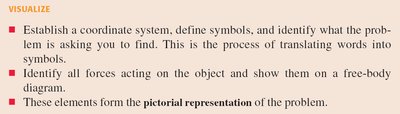
Problem-Solving Strategy for Equilibrium
Make simplifying assumptions and represent the object as a particle.
Establish a coordinate system, define symbols, and identify all forces.
Draw free-body diagrams.
Apply Newton’s first law:

Connected Objects
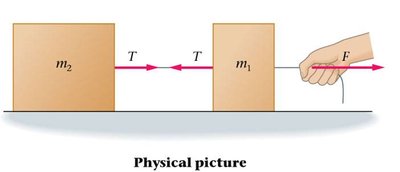
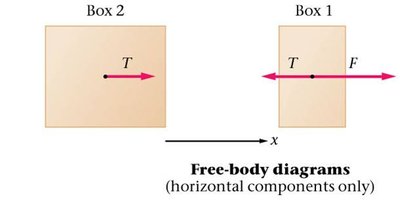
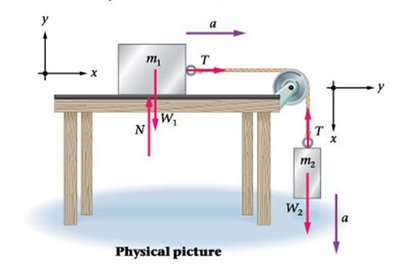
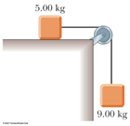
When objects are connected by strings or ropes, their accelerations are linked. Analyzing such systems involves drawing free-body diagrams for each object and applying Newton’s laws.
Same Acceleration: Connected objects share the same acceleration.
Tension: The force transmitted through the connecting string or rope.
Free-Body Diagrams: Used to analyze forces on each object.
Circular Motion
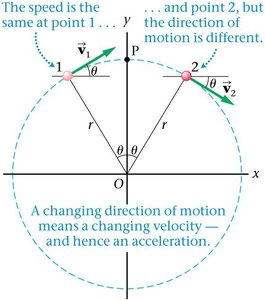
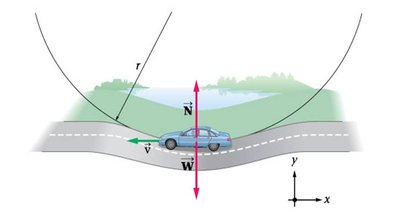
Circular motion involves an object moving along a circular path. A force directed toward the center, called the centripetal force, is required to maintain this motion.
Centripetal Force:
Centripetal Acceleration:
Period:
Tangential Acceleration: Occurs if the speed changes along the path.
Total Acceleration:
Summary
Friction arises from surface roughness and opposes motion.
Drag is a resistive force in fluids, with terminal speed reached when drag equals gravity.
Tension is the force in strings and ropes, and Hooke’s law describes spring forces.
Translational equilibrium occurs when net force is zero.
Connected objects share acceleration and require careful force analysis.
Circular motion requires a centripetal force directed toward the center.
Additional info: These notes expand on brief lecture points to provide a comprehensive, exam-ready summary of Chapter 6 topics in Physics with Algebra.
