Indietro
Chapter 11: Rotational Dynamics and Static Equilibrium - Study Notes
Guida di studio - Note intelligenti
 Appunti personalizzati basati sui tuoi materiali, ampliati con definizioni chiave, esempi e contesto.
Rotational Dynamics and Static Equilibrium
Vector Product (Cross Product)
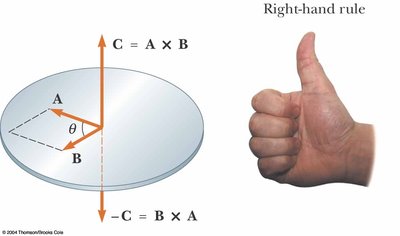
The vector product, also known as the cross product, is a mathematical operation between two vectors that results in a third vector perpendicular to the plane formed by the original vectors. This operation is fundamental in rotational physics, especially for defining torque and angular momentum.
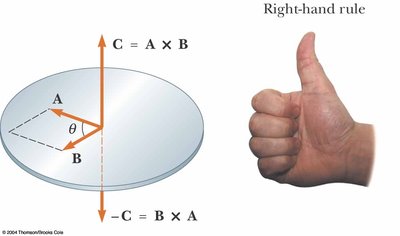
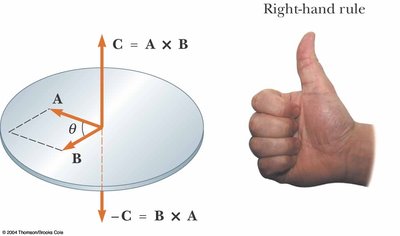
Definition: The cross product of vectors A and B is denoted as C = A × B.
Magnitude: where is the angle between A and B.
Direction: Determined by the right-hand rule; perpendicular to the plane of A and B.
Properties: Not commutative (), distributive over addition, and zero if vectors are parallel.
Unit Vectors: , , .
Determinant Form:
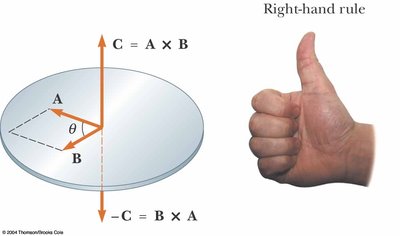
Example: The cross product is used to determine the direction of torque and angular momentum vectors.
Torque
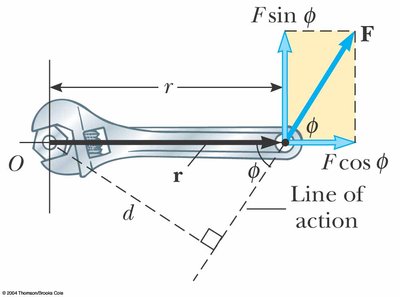
Torque is the measure of the tendency of a force to rotate an object about an axis. It is a vector quantity and is defined as the cross product of the position vector and the force vector.
Definition:
Magnitude: where is the moment arm.
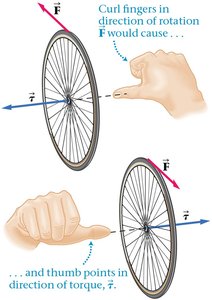
Direction: Determined by the right-hand rule; positive for counterclockwise, negative for clockwise rotation.
Units: Newton-meter (N·m), not Joules.
Example: Calculating the maximum torque exerted by a car's engine without spinning the wheels, using friction coefficients and wheel radius.
Torque and Angular Acceleration
Torque is directly related to angular acceleration through the moment of inertia. This relationship is the rotational analog of Newton's Second Law.
For a particle:
For an object: where is the moment of inertia.
Moment of inertia: for continuous mass distributions.
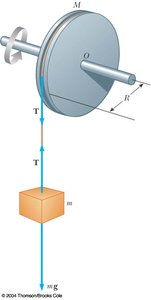
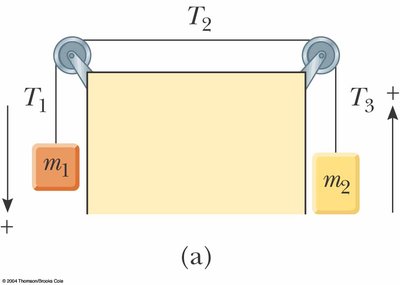
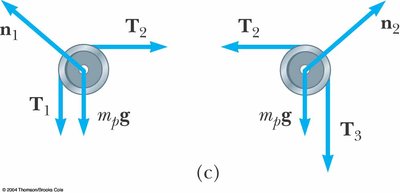
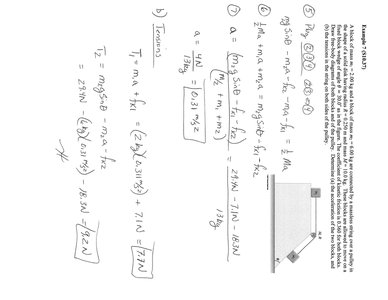
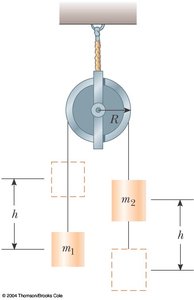
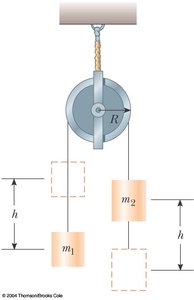
Example: Multi-body systems with pulleys and blocks require simultaneous application of Newton's Second Law and the torque equation.
Static Equilibrium
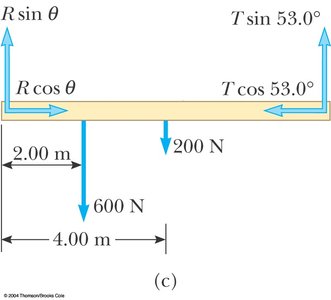
Static equilibrium occurs when an object is at rest or its center of mass moves with constant velocity. Both the net force and net torque must be zero for equilibrium.
Translational Equilibrium:
Rotational Equilibrium:
Coplanar Forces: , ,
Axis of Rotation: Choice of axis is arbitrary; net torque must be zero about any axis.
Problem-Solving Strategy:
Draw a diagram and free-body diagram.
Label all forces and their locations.
Choose a convenient axis for torque calculations.
Apply equilibrium conditions and solve the resulting equations.
Center of Mass and Balance
An object balances when it is supported at its center of mass. The center of mass is the point where the mass of the object can be considered to be concentrated for analysis of translational and rotational motion.
Angular Momentum
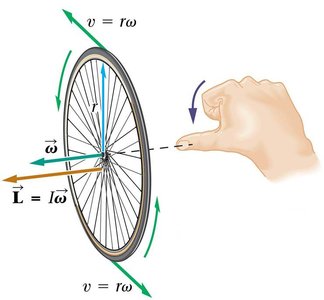
Angular momentum is a measure of the rotational motion of a particle or object. It is defined as the cross product of the position vector and the linear momentum vector.
Definition:
Magnitude:
Units: kg·m2/s
Direction: Perpendicular to the plane formed by and
Example: A particle in uniform circular motion has constant angular momentum about the axis through the center of its path.
Torque and Angular Momentum Relationship
Torque is the time derivative of angular momentum, analogous to force being the time derivative of linear momentum.
Valid for any origin fixed in an inertial frame.
Angular Momentum of a Rotating Rigid Object
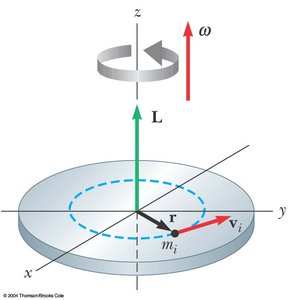
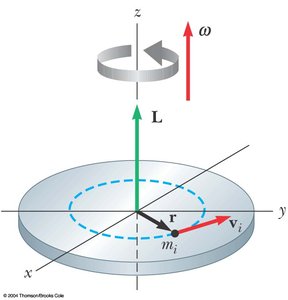
For a rigid object rotating about a fixed axis, the angular momentum is the sum of the angular momenta of all particles.
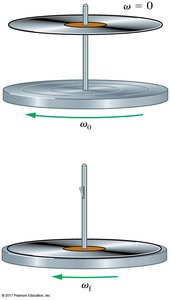
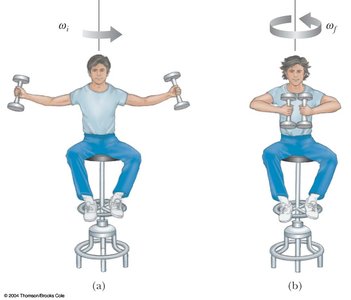
Conservation of Angular Momentum
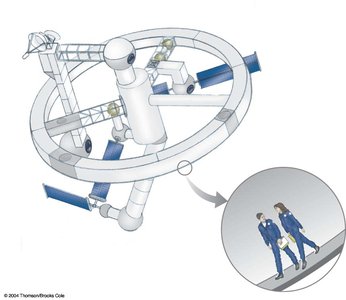
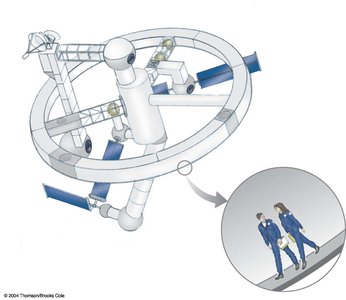
If the net external torque on a system is zero, the angular momentum is conserved. This principle is crucial in analyzing rotational collisions and systems that change shape.
For isolated systems:
Conservation applies to both fixed axis and axis through center of mass.
Rotational Work and Power
Work and power in rotational motion are analogous to their linear counterparts, but involve torque and angular displacement.
Work: ;
Power:
Work-Kinetic Energy Theorem:
Total kinetic energy is the sum of translational and rotational kinetic energies.
Summary of Useful Equations
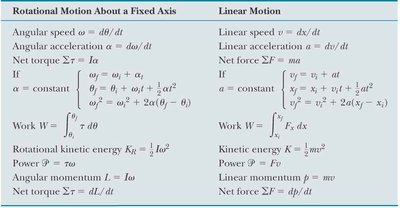
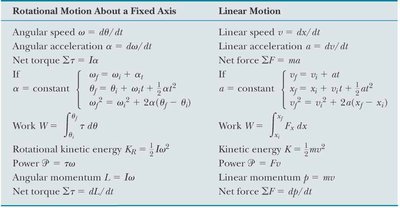
The following table summarizes key equations for rotational and linear motion:
Rotational Motion About a Fixed Axis | Linear Motion |
|---|---|
Angular speed | Linear speed |
Angular acceleration | Linear acceleration |
Net torque | Net force |
Work | Work |
Rotational kinetic energy | Kinetic energy |
Power | Power |
Angular momentum | Linear momentum |
Net torque | Net force |
The Vector Nature of Rotational Motion
Rotational quantities such as angular velocity and torque are vectors that point along the axis of rotation. The direction is given by the right-hand rule.
Angular velocity vector points along the axis of rotation.
Torque vector direction is determined by the right-hand rule.
Conservation of angular momentum ensures stability in gyroscopes.