 Indietro
Chapter 12: Gravity – Structured Study Notes
Guida di studio - Note intelligenti
 Appunti personalizzati basati sui tuoi materiali, ampliati con definizioni chiave, esempi e contesto.
Gravity
Newton’s Law of Universal Gravitation
Newton’s Law of Universal Gravitation describes the attractive force between any two masses in the universe. This force is fundamental to understanding planetary motion, satellite orbits, and the structure of the cosmos.
Definition: Every particle attracts every other particle with a force proportional to the product of their masses and inversely proportional to the square of the distance between them.
Formula:
Universal Gravitational Constant:
Vector Form:
Inverse Square Law: The force decreases rapidly as the distance increases.
Newton’s Third Law: The forces between two masses form an action-reaction pair.
Field Force: Gravitation acts regardless of the medium between the masses.
Example: Calculating gravitational forces between the Sun, Earth, and Moon during a solar eclipse.
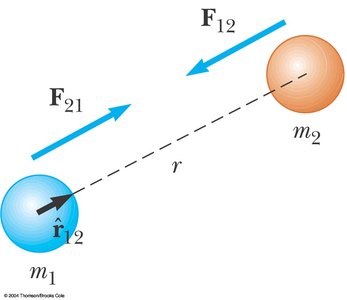
Gravitational Attraction of Spherical Bodies
For spherically symmetric bodies like planets, the gravitational force on an object outside the body is as if all mass were concentrated at the center.
Surface Gravity: where
Altitude Effect: The acceleration due to gravity decreases with altitude.
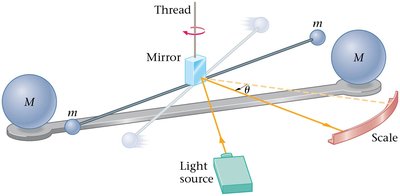
Cavendish Experiment: Measures and allows calculation of Earth's mass.
Distinction: is universal; varies by location.
Mass Distribution: For a particle outside a spherically symmetric mass,
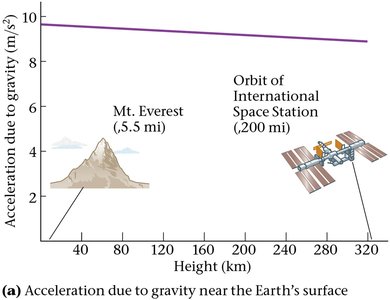
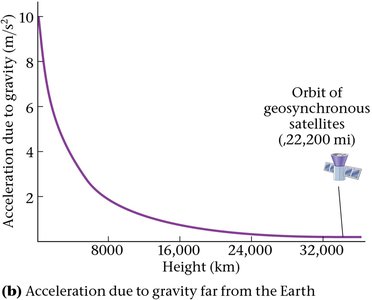
Altitude h (km) | g (m/s2) |
|---|---|
1,000 | 7.33 |
2,000 | 5.68 |
3,000 | 4.53 |
4,000 | 3.70 |
5,000 | 3.08 |
6,000 | 2.60 |
7,000 | 2.23 |
8,000 | 1.93 |
9,000 | 1.69 |
10,000 | 1.49 |
50,000 | 0.13 |
∞ | 0 |
Kepler’s Laws of Orbital Motion
Kepler’s Laws describe the motion of planets and other celestial bodies in orbit around a star or planet.
First Law: Planets move in elliptical orbits with the Sun at one focus.
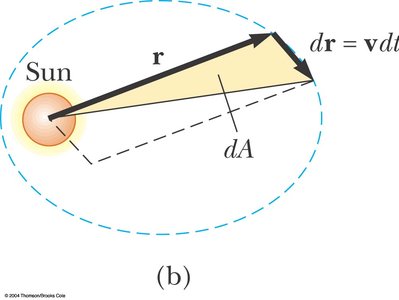
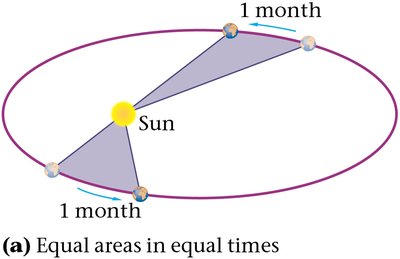
Second Law: The radius vector from the Sun to a planet sweeps out equal areas in equal time intervals.
Third Law: The square of the orbital period is proportional to the cube of the semimajor axis:
Elliptical Orbits: Eccentricity , for ellipses, for circles.
Aphelion/Perihelion: Aphelion is farthest from the Sun (), perihelion is nearest ().
Conservation of Angular Momentum: Second law is a consequence of this principle.
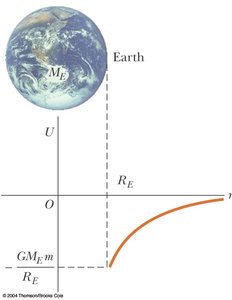
Gravitational Potential Energy
Gravitational potential energy quantifies the energy stored due to the position of an object in a gravitational field.
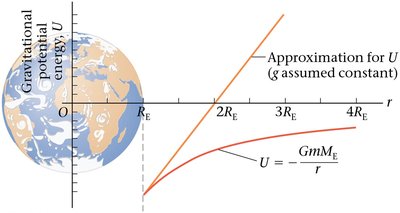
General Formula:
Near Earth’s Surface:
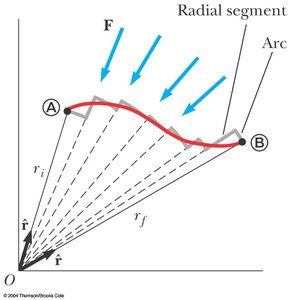
Conservative Force: Gravitational force is conservative and central.
Work Done:
Potential Energy Change:
Zero Reference: at
Binding Energy: The absolute value of potential energy is the binding energy.
Energy Conservation in Gravitational Systems
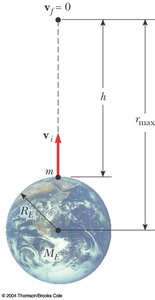
Energy conservation is a fundamental principle in gravitational systems, governing the motion of satellites and celestial bodies.
Total Mechanical Energy:
Bound Systems: for bound orbits.
Circular Orbit:
Elliptical Orbit:
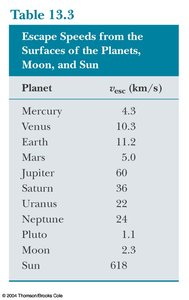
Escape Speed:
Black Holes
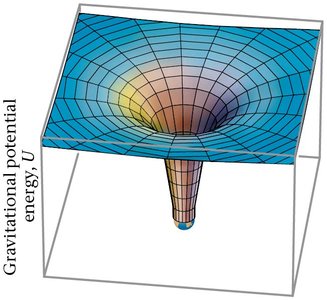
Black holes are regions of space where gravity is so strong that not even light can escape. They are formed from collapsed stars and are characterized by the Schwarzschild radius.
Schwarzschild Radius: The critical radius where escape speed equals the speed of light.
Event Horizon: The boundary beyond which nothing can escape.
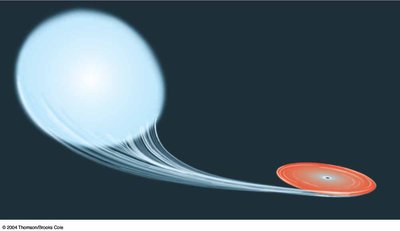
Accretion Disks: Material from nearby stars forms a disk around the black hole, emitting x-rays.
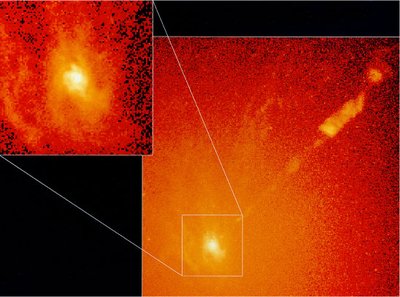
Supermassive Black Holes: Found at the centers of galaxies, often evidenced by jets of material.
Tides
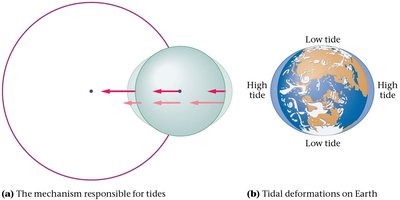
Tidal forces arise due to the variation in gravitational force across an extended body, such as the Earth or Moon. These forces are responsible for phenomena like ocean tides and orbital locking.
Tidal Force: Difference in gravitational force between near and far sides of an object.
Orbital Locking: The Moon always shows the same face to Earth due to tidal forces.
Roche Limit: If a moon gets too close to a planet, tidal forces can tear it apart, forming rings.
Summary Table
Concept | Formula |
|---|---|
Gravitational Force | |
Acceleration of Gravity | |
Gravitational Potential Energy | |
Total Mechanical Energy | |
Escape Speed | |
Kepler’s Third Law |
