 Indietro
Chapter 16: Temperature and Heat – Structured Study Notes
Guida di studio - Note intelligenti
 Appunti personalizzati basati sui tuoi materiali, ampliati con definizioni chiave, esempi e contesto.
Temperature and the Zeroth Law of Thermodynamics
Temperature: Concept and Definition
Temperature is a fundamental physical quantity that describes how hot or cold an object feels. However, our senses are unreliable for measuring temperature, so a technical and reproducible definition is required. Temperature determines whether two objects are in thermal equilibrium, meaning they will not exchange energy if placed in thermal contact.
Thermal Contact: Two objects are in thermal contact if energy can be exchanged between them, typically as heat or electromagnetic radiation.
Thermal Equilibrium: Two objects are in thermal equilibrium if no energy is exchanged between them when in thermal contact.
Zeroth Law of Thermodynamics: If object A and B are each in thermal equilibrium with a third object C (often a thermometer), then A and B are in thermal equilibrium with each other.
Direction of Energy Transfer: Energy always travels from the object at higher temperature to the object at lower temperature.
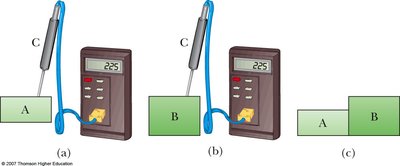
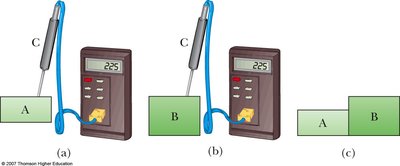
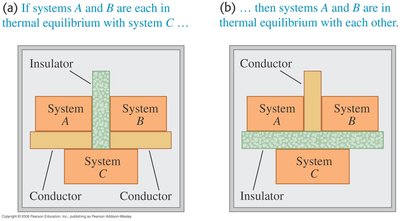
Additional info: The Zeroth Law provides the foundation for the concept of temperature and the use of thermometers.
Temperature Scales and Thermometers
Types of Thermometers and Physical Properties
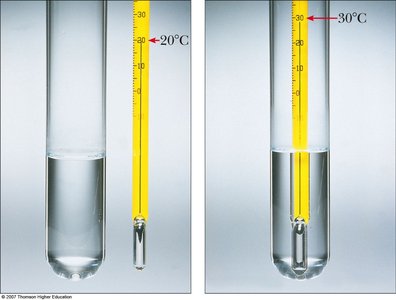
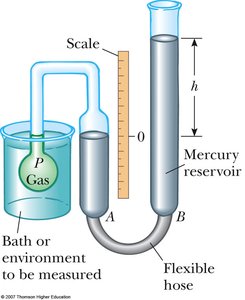
Thermometers measure temperature by exploiting physical properties that change with temperature, such as the volume of a liquid, the pressure of a gas, or the electrical resistance of a conductor.
Liquid-in-Glass Thermometers: Use the expansion of a liquid (mercury or alcohol) in a capillary tube.
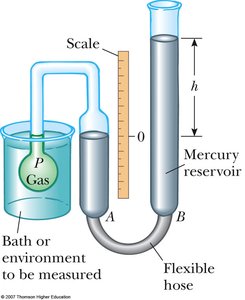
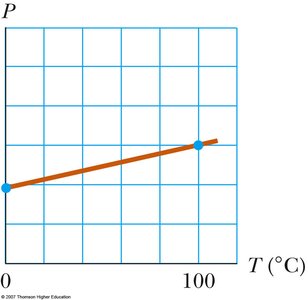
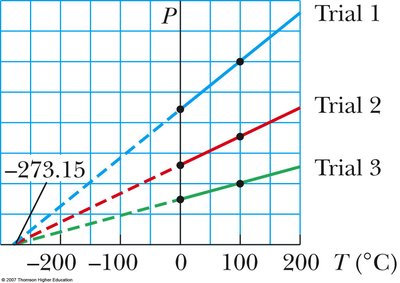
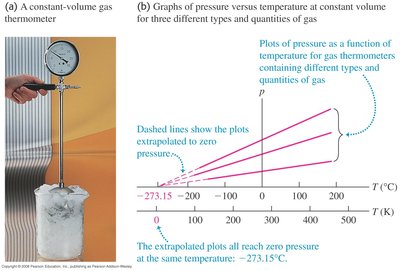
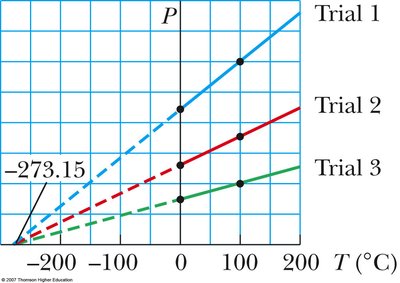
Constant-Volume Gas Thermometers: Measure the change in pressure of a gas at constant volume as temperature changes.
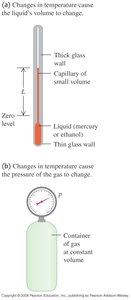
Calibration and Temperature Scales
Thermometers are calibrated using fixed points, such as the ice point and steam point of water. These points define the Celsius and Fahrenheit scales.
Celsius Scale: Ice point is 0°C, steam point is 100°C, divided into 100 increments.
Fahrenheit Scale: Ice point is 32°F, steam point is 212°F, divided into 180 increments.
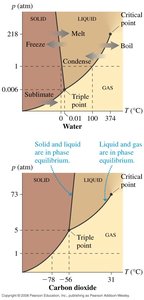
Kelvin Scale (Absolute Temperature): Based on absolute zero (0 K) and the triple point of water (273.16 K).
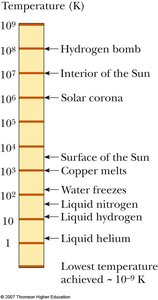
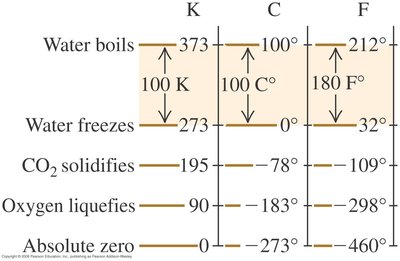
Temperature Scale Conversions
Celsius to Kelvin:
Fahrenheit to Celsius:
Celsius to Fahrenheit:
Thermal Expansion
Linear, Area, and Volume Expansion
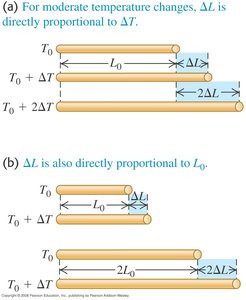
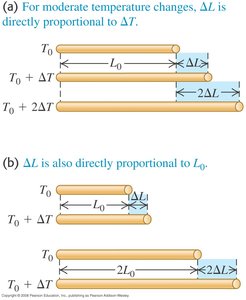
Thermal expansion is the increase in size of an object due to an increase in temperature, caused by increased average separation between atoms.
Linear Expansion:
Area Expansion:
Volume Expansion: , where for solids.
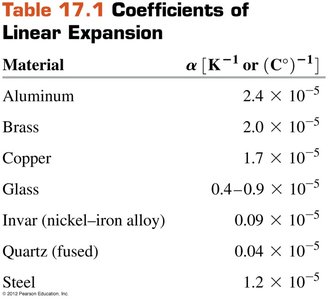
Coefficient of Linear Expansion: (units: or )

Material | Coefficient of Linear Expansion (α) |
|---|---|
Aluminum | 2.4 × 10⁻⁵ K−1 |
Brass | 2.0 × 10⁻⁵ K−1 |
Copper | 1.7 × 10⁻⁵ K−1 |
Glass | 0.4–0.9 × 10⁻⁵ K−1 |
Steel | 1.2 × 10⁻⁵ K−1 |
Heat and Mechanical Work
Internal Energy and Heat
Internal energy is the total energy associated with the microscopic components of a system, including random translational, rotational, and vibrational motion, as well as potential energy between molecules.
Heat: The transfer of energy across the boundary of a system due to a temperature difference.
Work: Energy transfer by mechanical means, such as compressing a gas.
Law of Conservation of Energy: Energy is conserved in all processes, including heat and work.
Units of Heat
Calorie: Amount of energy needed to raise 1 g of water by 1°C.
BTU: British Thermal Unit, used in US customary system.
Joule: SI unit of energy.
Mechanical Equivalent of Heat
James Joule established the equivalence between mechanical energy and heat, showing that mechanical work can be converted into heat energy.
Mechanical Equivalent:
Specific Heats
Heat Capacity and Specific Heat
Heat capacity is the amount of energy needed to raise the temperature of a sample by 1°C. Specific heat is the heat capacity per unit mass.
Heat Capacity:
Specific Heat:
Energy Transfer:
Substance | Specific Heat (J/kg·K) |
|---|---|
Water | 4186 |
Ice | 2090 |
Steam | 2010 |
Aluminum | 900 |
Iron (steel) | 448 |
Copper | 387 |
Silver | 234 |
Gold | 129 |
Lead | 128 |
Additional info: The higher the specific heat, the more energy is required to change the temperature of the substance.
Conduction, Convection, and Radiation
Mechanisms of Heat Transfer
Heat can be transferred by conduction, convection, or radiation.
Conduction: Transfer of energy through collisions between particles in a material. Metals are good conductors due to free electrons.
Convection: Transfer of energy by the movement of a fluid (liquid or gas), either naturally or by forced means.
Radiation: Transfer of energy by electromagnetic waves, does not require physical contact.
Conduction Equations
Heat Current:
Temperature Gradient:
Compound Slab:
R Value:
Radiation Equations
Stefan-Boltzmann Law:
Net Radiation:
Emissivity: ranges from 0 (perfect reflector) to 1 (black body).
Convection Example
Convection occurs in the Sun, where heat moves from the hot core through the radiation zone to the convection zone, setting up convection cells due to temperature and pressure gradients.
Dewar Flask
A Dewar flask (or Thermos bottle) minimizes energy losses by conduction, convection, and radiation, using a vacuum and silvered surfaces.
Summary Table: Key Equations and Concepts
Concept | Equation |
|---|---|
Linear Expansion | |
Area Expansion | |
Volume Expansion | |
Heat Capacity | |
Specific Heat | |
Heat Transfer (Conduction) | |
Heat Transfer (Radiation) | |
Temperature Conversion |
