 Indietro
Chapter 7: Linear Momentum and Collisions – Study Notes
Guida di studio - Note intelligenti
 Appunti personalizzati basati sui tuoi materiali, ampliati con definizioni chiave, esempi e contesto.
Linear Momentum and Its Relation to Force
Definition and Properties of Linear Momentum
Linear momentum is a fundamental concept in physics, describing the motion of an object in terms of its mass and velocity. It is a vector quantity, meaning it has both magnitude and direction, and is symbolized by p.
Definition: Linear momentum is defined as the product of an object's mass (m) and its velocity (v).
Formula:
SI Unit: kilogram meter per second (kg·m/s)
Vector Nature: The direction of momentum is the same as the direction of velocity.
Relation to Force
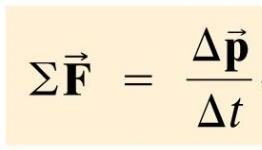
The net force acting on an object is equal to the rate of change of its momentum. This is a restatement of Newton's second law:
Formula:
For constant mass, this reduces to
Conservation of Linear Momentum
Principle of Conservation
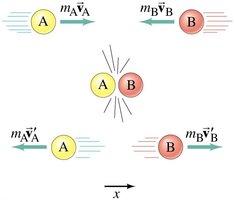
The law of conservation of linear momentum states that the total momentum of an isolated system remains constant if no external forces act on it. This principle is especially important in analyzing collisions.
Mathematical Statement:
Momentum before collision equals momentum after collision.
Applies to all types of collisions (elastic and inelastic).

Collisions and Impulse
Impulse and Its Definition
Impulse is the change in momentum of an object when a force is applied over a period of time. It is a useful concept for analyzing collisions, where forces are often large and act over short intervals.
Definition: Impulse (J) is given by
Impulse is equal to the change in momentum.
Units: Newton-second (N·s), equivalent to kg·m/s.
Types of Collisions
Elastic Collisions
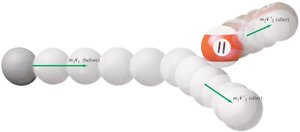
In elastic collisions, both momentum and kinetic energy are conserved. These collisions are idealized and often used to model interactions between billiard balls or atomic particles.
Conservation of Momentum:
Conservation of Kinetic Energy:
Relative Speed:

Inelastic Collisions
In inelastic collisions, momentum is conserved but kinetic energy is not. Some kinetic energy is transformed into other forms, such as heat or deformation. A perfectly inelastic collision occurs when objects stick together after colliding.
Conservation of Momentum:
Kinetic Energy:
Solving Momentum Problems
Problem-Solving Steps
To solve problems involving linear momentum and collisions, follow these steps:
Read the problem carefully and identify key information.
Draw a diagram to visualize the situation.
List known and unknown quantities.
Apply the relevant physics principles (momentum conservation, impulse, etc.).
Carry out calculations and check units.
Assess whether the result is reasonable.




Examples of Momentum Conservation
Railroad Car Collision
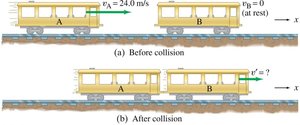
When two railroad cars collide and lock together, their combined momentum after collision equals the sum of their individual momenta before collision.
Formula:
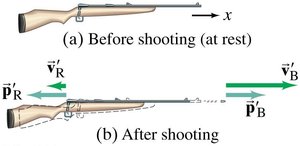
Rifle Recoil
When a rifle fires a bullet, the bullet moves forward and the rifle recoils backward. The total momentum before and after firing is conserved.
Formula: (if initially at rest)
The recoil velocity of the rifle is opposite in direction to the bullet's velocity.
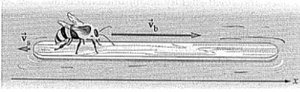
Honeybee and Popsicle Stick
When a honeybee moves on a floating stick, the stick moves in the opposite direction to conserve momentum.
Formula: (if initially at rest)
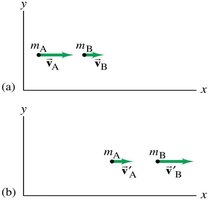
Elastic Collisions in One Dimension
Head-On Collisions
For two objects colliding head-on, the conservation laws allow us to relate their velocities before and after collision.
Relative Speed:
For equal masses, the objects exchange velocities.
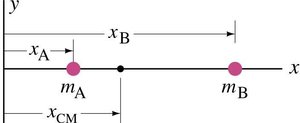
Center of Mass (CM)
Definition and Calculation
The center of mass is the point at which the mass of a system can be considered to be concentrated for purposes of analyzing translational motion.
For two particles:
For n particles:
Examples
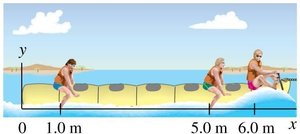
Three people on a raft:
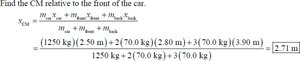
Car with passengers:

Summary Table: Conservation Laws in Collisions
Collision Type | Momentum Conserved? | Kinetic Energy Conserved? | Example |
|---|---|---|---|
Elastic | Yes | Yes | Billiard balls, atomic collisions |
Inelastic | Yes | No | Car crash, clay sticking together |
Perfectly Inelastic | Yes | No | Objects stick together after collision |
Key Equations
Linear Momentum:
Force and Momentum:
Impulse:
Momentum Conservation:
Elastic Collision Relative Speed:
Center of Mass:
Additional info: These notes expand on the original slides by providing full academic explanations, definitions, and context for each topic, ensuring completeness and clarity for exam preparation.
