 Indietro
Chapter 7: Work and Kinetic Energy – Structured Study Notes
Guida di studio - Note intelligenti
 Appunti personalizzati basati sui tuoi materiali, ampliati con definizioni chiave, esempi e contesto.
Work and Kinetic Energy
Introduction to Energy
Energy is a fundamental concept in physics, underlying every physical process in the universe. Although energy is not easily defined, it is essential for understanding motion, interactions, and transformations in physical systems. The energy approach is particularly useful when forces are not constant, and it can be extended to biological, technological, and engineering contexts.
Energy is the capacity to do work or produce change.
Energy can be transferred or transformed within systems.
Conservation of energy is a central principle in physics.
Example: Energy transfer occurs when a moving car collides with another object, converting kinetic energy to other forms.
Systems and Environment
A system is a defined portion of the universe, separated by an imaginary boundary from its environment. Identifying the system is crucial for problem-solving in physics.
A system can be a single object or a collection of objects.
The environment is everything outside the system boundary.
Energy can be transferred across the boundary via work.
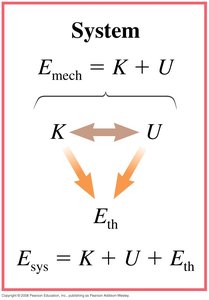
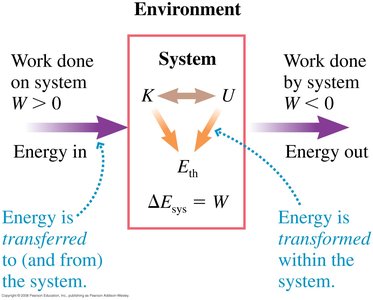
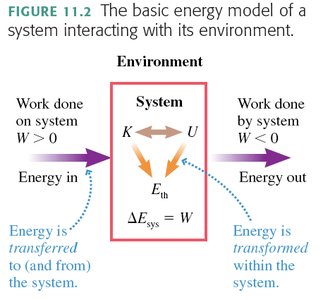
The Basic Energy Model
The basic energy model describes how energy is transferred and transformed:
Work done on the system (W > 0): Energy increases.
Work done by the system (W < 0): Energy decreases.
Energy can be transferred (work) or transformed (between kinetic, potential, and thermal energy).
Key Equations:
(for isolated systems)
Work Done by a Constant Force
Scalar (Dot) Product of Two Vectors
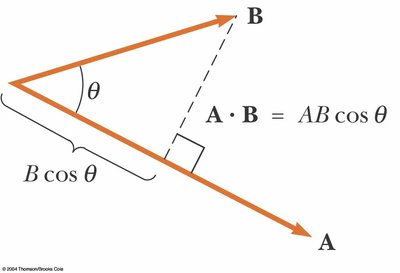
The scalar product (dot product) is used to calculate work when force and displacement are not parallel.
Dot Product:
is the angle between vectors A and B.
Dot product is commutative and distributive.
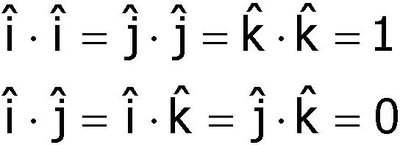
Unit vectors: ;
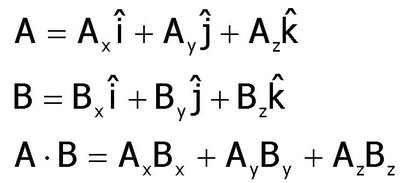
Component form:
Work by a Constant Force
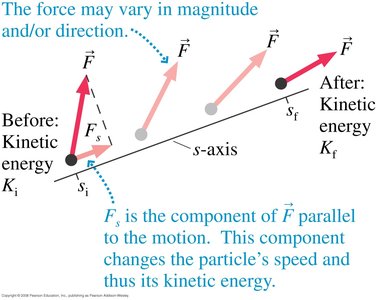
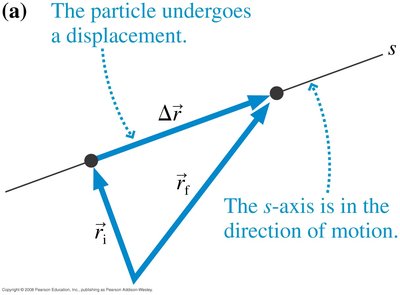
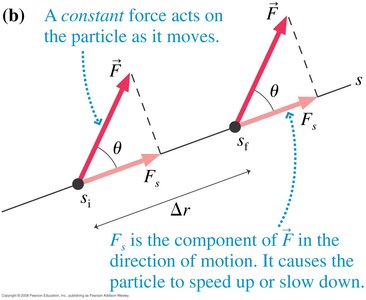
Work is defined as the product of the force, displacement, and the cosine of the angle between them:
Work is only done if the force causes displacement.
If force is perpendicular to displacement, work is zero.
Work Examples and Sign Convention
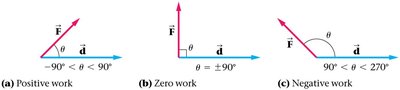
The sign of work depends on the direction of force relative to displacement:
Positive work: Force and displacement in same direction.
Negative work: Force and displacement in opposite directions.
Zero work: Force perpendicular to displacement.
Work as Energy Transfer
Work is a scalar quantity and represents energy transfer. The SI unit is the joule (J):
Positive work transfers energy to the system; negative work transfers energy from the system.
Kinetic Energy and the Work-Energy Theorem
Kinetic Energy
Kinetic energy is the energy of a particle due to its motion:
m = mass, v = speed
Change in kinetic energy results from work done on the system.
Work-Kinetic Energy Theorem
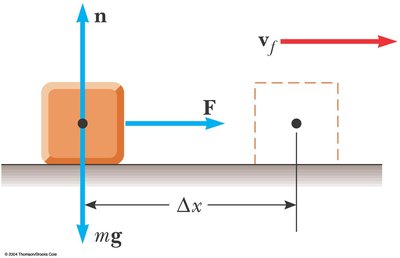
The work done by the net force equals the change in kinetic energy:
Work transfers energy between the environment and the system.
Work Done by a Variable Force
Graphical Interpretation of Work
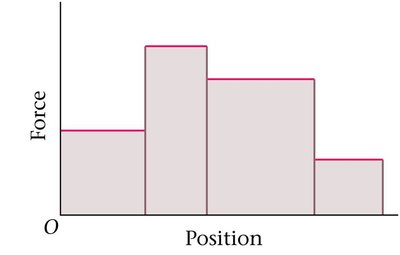
If the force is constant, work is the area under the force vs. position graph:
(area under the curve)
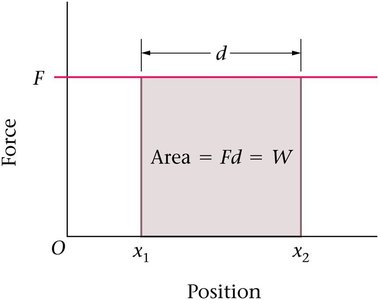
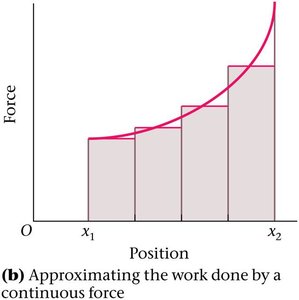
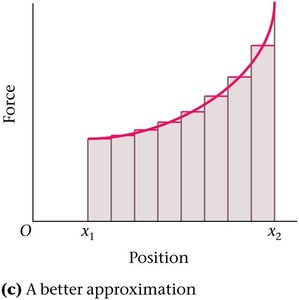
If the force varies, work can be approximated by summing areas of rectangles:
Work Done by a Spring (Hooke's Law)
The force needed to stretch a spring is given by Hooke's Law:
k = spring constant, x = displacement from equilibrium
Work done in stretching the spring:
Power
Definition and Units
Power is the time rate of energy transfer:
Average power:
Instantaneous power:
SI unit: watt (W),
US Customary unit: horsepower (hp),
Summary Table
Concept | Formula | Unit |
|---|---|---|
Work (constant force) | Joule (J) | |
Kinetic Energy | Joule (J) | |
Work-Kinetic Energy Theorem | Joule (J) | |
Work by spring force | Joule (J) | |
Power | Watt (W) |
