 Indietro
Chapter 8: Rotational Motion – Physics with Algebra Study Notes
Guida di studio - Note intelligenti
 Appunti personalizzati basati sui tuoi materiali, ampliati con definizioni chiave, esempi e contesto.
Rotational Motion
Introduction to Rotational Motion
Rotational motion occurs when an object spins around an axis. Everyday examples include amusement park rides such as merry-go-rounds and Ferris wheels, which demonstrate rapid rotation and centripetal acceleration.

Outline of Chapter 8
Angular Quantities
Constant Angular Acceleration
Rotational Dynamics: Torque and Rotational Inertia
Rotational Kinetic Energy
Angular Momentum
Angular Quantities
Definition of Angular Quantities
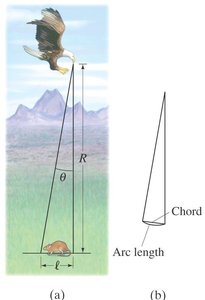
In purely rotational motion, all points on an object move in circles around the axis of rotation. The angle θ in radians is defined as the ratio of arc length ℓ to radius R:
Angle in radians:
Arc length:
Radian: Dimensionless unit, related to degrees: radians = 360°
For a full circle: radians = 360° = 1 revolution.
Examples of Angular Quantities
Conversion: 4.5 revolutions = radians = °
Birds of Prey: A bird can distinguish objects subtending an angle of radians. At a height of 100 m, the smallest object it can see is m = 3 cm.
Angular Displacement, Velocity, and Acceleration
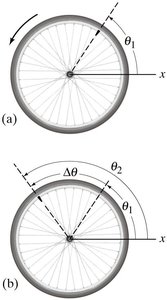
Rotational motion is described using angular displacement (Δθ), angular velocity (ω), and angular acceleration (α).
Angular displacement:
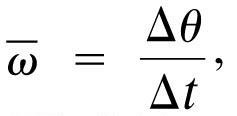
Average angular velocity:
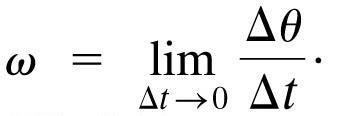
Instantaneous angular velocity:
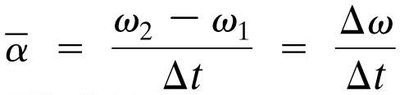
Average angular acceleration:
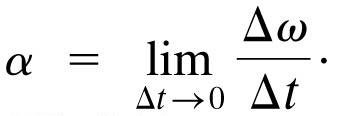
Instantaneous angular acceleration:
Linear and Angular Velocity
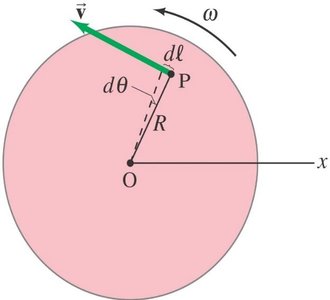
Each point on a rotating body has both angular velocity and linear velocity. The relationship is:
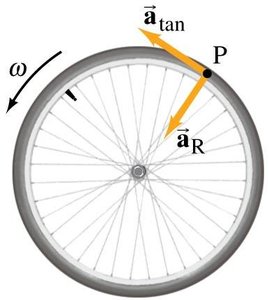
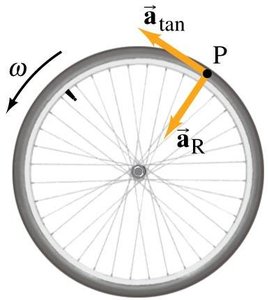
Linear Acceleration Components
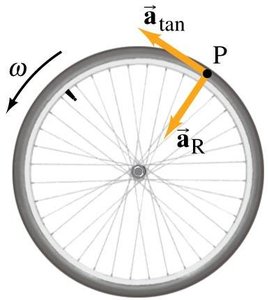
When angular velocity changes, there is tangential acceleration:
Even with constant angular velocity, there is centripetal (radial) acceleration:
Total linear acceleration:
Sign Conventions
Angular displacement: θ > 0 for counterclockwise, θ < 0 for clockwise
Angular velocity: ω > 0 for counterclockwise, ω < 0 for clockwise
Frequency and Period
Frequency (f): Number of revolutions per second, measured in Hertz (Hz)
Period (T): Time for one revolution,
Relationship: ,
Correspondence Between Linear and Rotational Quantities
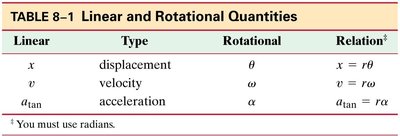
Linear and rotational quantities are related as follows:
Linear | Type | Rotational | Relation |
|---|---|---|---|
x | displacement | θ | x = rθ |
v | velocity | ω | v = rω |
atan | acceleration | α | atan = rα |
Constant Angular Acceleration
Equations of Motion
For constant angular acceleration, the equations mirror those for linear motion:
Rotational Dynamics: Torque and Rotational Inertia
Torque (τ)
Torque is the rotational equivalent of force and is defined as:
Moment of Inertia (I)
Moment of inertia quantifies an object's resistance to changes in rotational motion. For a single particle:
For a system:
Newton's second law for rotation:
Moments of Inertia for Various Objects
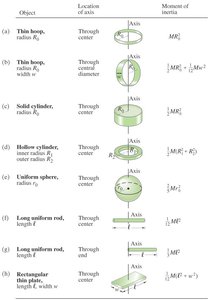
The moment of inertia depends on mass distribution and axis location. Common formulas include:
Thin hoop:
Solid cylinder:
Uniform sphere:
Rod about end:
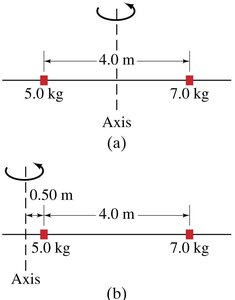
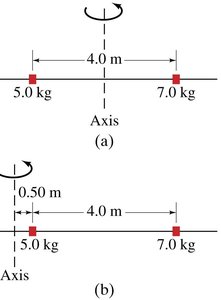
Example: Two Weights on a Bar
Moment of inertia changes with axis location. Masses close to the axis contribute less to total inertia.
Solving Rotational Dynamics Problems
Problem Solving Strategy
Draw a diagram
Identify the system
Draw free-body diagrams
Find axis of rotation and calculate torques
Apply Newton's second law for rotation:
Apply Newton's second law for translation as needed
Solve for unknowns
Check units and order of magnitude


Rotational Kinetic Energy
Rotational and Translational Kinetic Energy
The kinetic energy of a rotating object is:
Translational:
Rotational:
Total:

Work and Power in Rotational Motion
Work Done by Torque
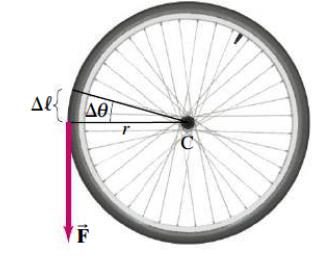
Work done by a torque is:
Power in Rotational Motion
Angular Momentum and Its Conservation
Angular Momentum (L)
Angular momentum is a vector quantity defined as:
SI unit: kg·m2/s
Conservation of Angular Momentum
If net torque is zero, angular momentum is conserved:
Law: or
Example: A figure skater increases spin rate by pulling arms inward, decreasing moment of inertia and increasing angular velocity.
Summary
Angular Quantities: Displacement, velocity, acceleration
Constant Angular Acceleration: Equations of motion
Rotational Dynamics: Torque and moment of inertia
Rotational Kinetic Energy: Translational and rotational components
Angular Momentum: Conservation law
