 Indietro
Chapter 9: Linear Momentum and Collisions – Study Guide
Guida di studio - Note intelligenti
 Appunti personalizzati basati sui tuoi materiali, ampliati con definizioni chiave, esempi e contesto.
Linear Momentum
Definition and Properties
Linear momentum is a fundamental concept in physics that describes the motion of an object as the product of its mass and velocity. It is a vector quantity, meaning it has both magnitude and direction, and its direction is the same as the velocity of the object.
Definition: The linear momentum p of a particle of mass m moving with velocity v is given by:
Vector Nature: Momentum points in the same direction as velocity.
SI Units: kg·m/s
Component Form: Momentum can be expressed in terms of its components:
Momentum and Newton’s Second Law
General Formulation
Newton’s Second Law relates the net force acting on an object to the rate of change of its momentum. This formulation is valid even when the mass of the object changes.
General Form:
Constant Mass:
Interpretation: The net force is the time rate of change of momentum.
Impulse
Impulse-Momentum Theorem
Impulse is the effect of a force acting over a time interval, resulting in a change in momentum. It is a vector quantity and is equal to the area under the force-time curve.
Definition:
Impulse-Momentum Theorem:
Time-Averaged Force:
Dimensions: ML/T (same as momentum)
Impulse is not a property of the particle, but a measure of the change in momentum.
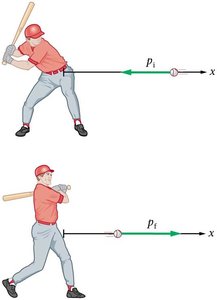
Crash Test Example
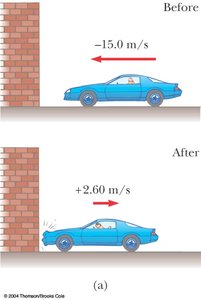
In collisions, such as a car hitting a wall, the impulse delivered to the car can be calculated from the change in momentum.
Momentum before and after:
Impulse:
Force:
Conservation of Linear Momentum
Principle and Applications
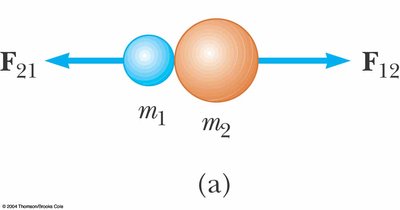
Momentum is conserved in a system if the net external force is zero. Internal forces within the system always sum to zero and cannot change the total momentum.
Conservation Law: ; if , then
System of Particles:
Component Conservation: , ,
Archer Example
An archer standing on frictionless ice demonstrates conservation of momentum: when the arrow is released, the archer moves in the opposite direction.
System: Archer (particle 1) and arrow (particle 2)
Initial momentum: ,
Final momentum: ;

Collisions
Characteristics and Types
Collisions involve two or more particles interacting via forces over a short time interval. The interaction force is typically much greater than any external forces, allowing the use of the impulse approximation.
Direct Contact: Collisions may involve physical contact or just interaction forces.
Momentum Conservation: Momentum is always conserved in collisions.
Types of Collisions
Elastic Collision: Both momentum and kinetic energy are conserved.
Inelastic Collision: Momentum is conserved, but kinetic energy is not.
Perfectly Inelastic Collision: Objects stick together after the collision.
Inelastic Collisions
Definition and Examples
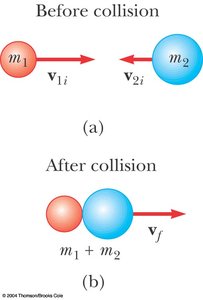
In inelastic collisions, some kinetic energy is lost, but momentum is conserved. If objects stick together, the collision is perfectly inelastic.
Momentum Conservation:
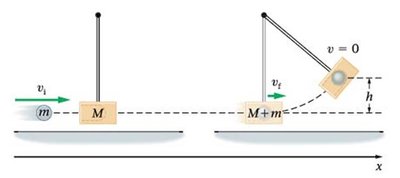
Ballistic Pendulum Example
The ballistic pendulum is a classic example of a perfectly inelastic collision, followed by conservation of mechanical energy to determine the height reached.
Elastic Collisions
One-Dimensional Elastic Collisions
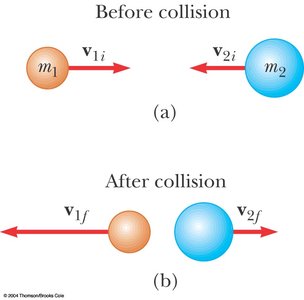
In elastic collisions, both momentum and kinetic energy are conserved. These collisions are often analyzed using two equations to solve for the final velocities.
Momentum Conservation:
Kinetic Energy Conservation:
Special Case: If , the particles exchange velocities.
Two-Dimensional Collisions
Principles and Problem-Solving
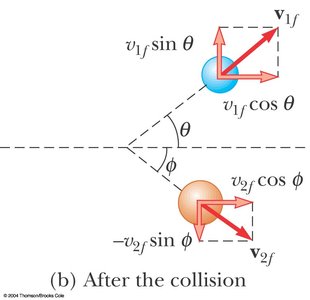
For collisions in two dimensions, conservation of momentum is applied separately along each axis. If the collision is elastic, conservation of kinetic energy is also used.
Momentum Conservation: in x-direction, $0$ in y-direction before collision
After collision: (x-direction), (y-direction)
Center of Mass
Definition and Calculation
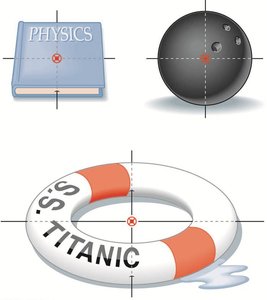
The center of mass of a system is the point where the system can be balanced in a uniform gravitational field. It is calculated as the weighted average of the positions of all particles in the system.
For two objects:
For multiple objects: , ,
Position Vector:
Motion of the Center of Mass
The center of mass moves as if all the mass of the system were concentrated at that point and acted upon by the net external force.
Velocity:
Acceleration:
Newton's Second Law for a System:
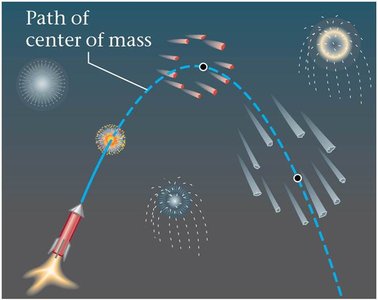
Systems with Changing Mass: Rocket Propulsion
Principles of Rocket Propulsion
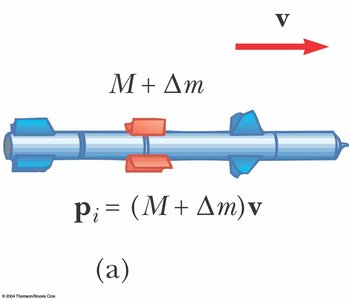
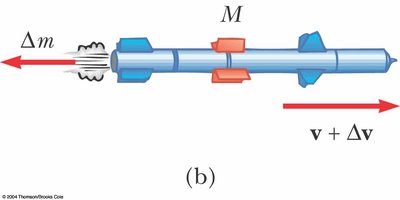
Rocket propulsion is based on the conservation of momentum for a system whose mass changes as fuel is ejected.
Change in Momentum:
Thrust:
Rocket Equation:
Thrust increases with exhaust speed and burn rate.
Summary Table: Types of Collisions
Type | Momentum Conserved? | Kinetic Energy Conserved? | Objects Stick Together? |
|---|---|---|---|
Elastic | Yes | Yes | No |
Inelastic | Yes | No | No |
Perfectly Inelastic | Yes | No | Yes |
Additional info: This table summarizes the main differences between collision types, which is essential for problem-solving in momentum and collision scenarios.
