 Indietro
Energy in Simple Harmonic Motion, Pendulum Motion, and Traveling Waves
Guida di studio - Note intelligenti
 Appunti personalizzati basati sui tuoi materiali, ampliati con definizioni chiave, esempi e contesto.
Energy in Simple Harmonic Motion (SHM)
Mechanical Energy in SHM
Simple harmonic motion (SHM) involves the periodic oscillation of an object, such as a mass on a spring. The total mechanical energy in SHM is conserved and is the sum of kinetic and potential energies.
Elastic Potential Energy (U): The energy stored in the spring when it is compressed or stretched.
Kinetic Energy (K): The energy due to the motion of the mass.
Total Mechanical Energy (E): The sum of kinetic and potential energies, which remains constant.
Angular Frequency (\omega):
Key Points:
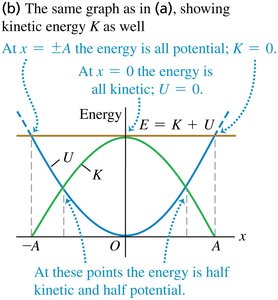
At maximum displacement (), all energy is potential ().
At equilibrium (), all energy is kinetic ().
At intermediate points, energy is shared between kinetic and potential forms.
Pendulum Motion
Simple Pendulum
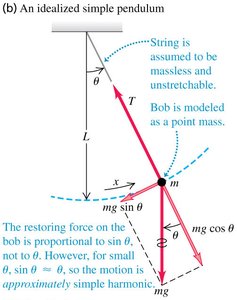
A simple pendulum consists of a point mass (bob) suspended by a massless, unstretchable string. For small amplitudes, its motion is approximately simple harmonic.
Equation of Motion:
Angular Frequency:
Period:
Frequency:
Restoring Force: For small angles, , so the restoring force is proportional to displacement, resulting in SHM.
Physical Pendulum
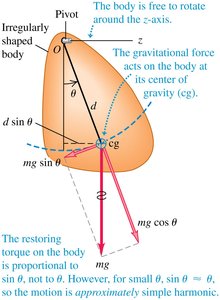
A physical pendulum is any real pendulum with mass distributed over its volume. For small amplitudes, its motion is also simple harmonic.
Equation of Motion:
Angular Frequency:
Period:
Moment of Inertia (I): Calculated with respect to the pivot axis.
Traveling Waves and Sound
The Wave Model
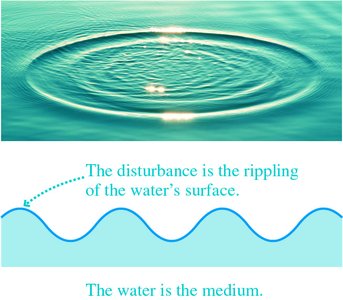
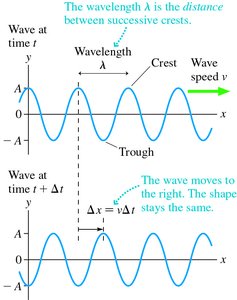
The wave model describes the basic properties of waves, emphasizing behaviors common to all waves. A traveling wave is an organized disturbance that moves with a well-defined speed through a medium.
Mechanical Waves: Require a medium (e.g., water, air, string) to propagate. The disturbance displaces particles of the medium from equilibrium.
Energy Transfer: Waves transfer energy, not matter, from one location to another.
Wave Speed
The speed of a wave depends only on the properties of the medium, not on the wave's shape or how it was generated.
Linear Density (\mu): , where is mass and is length of the string.
Wave Speed on a String: , where is tension.
Mathematical Description of Sinusoidal Waves
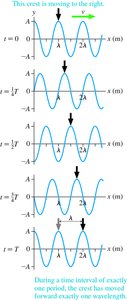
Sinusoidal waves are produced by sources oscillating with simple harmonic motion. The displacement as a function of position and time is given by:
General Equation: for a wave traveling to the right.
Wave Number:
Angular Frequency:
Relationship:
Sound Waves
Nature of Sound Waves
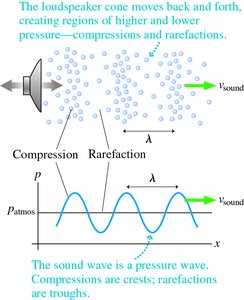
Sound waves are longitudinal mechanical waves that propagate through a medium (such as air) by compressions and rarefactions of the particles.
Compressions: Regions of higher pressure where particles are closer together.
Rarefactions: Regions of lower pressure where particles are farther apart.
Frequency Range: Humans can hear frequencies from 20 Hz to 20,000 Hz.
Energy and Intensity of Waves
Wave Intensity
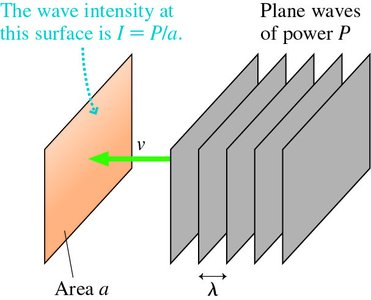
The intensity of a wave is the power transmitted per unit area. It describes how much energy passes through a given area in a certain amount of time.
Intensity Formula:
Units: Watts per square meter (W/m2).
Plane Waves: For a plane wave, intensity is uniform across the wave front.
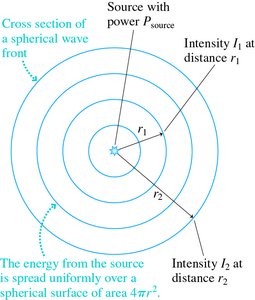
Spherical Waves
For spherical waves radiating uniformly in all directions, the intensity decreases with the square of the distance from the source.
Surface Area of Sphere:
Intensity Ratio:
Example: If a laser emits 1.0 mW of power into a beam 1.0 mm in diameter, the intensity is calculated using the formula above.
Additional info: These notes cover the core concepts of energy in SHM, pendulum motion, traveling waves, sound waves, and wave intensity, as outlined in typical Physics with Algebra college courses.
