 Indietro
Exam 1 Review: Vectors, Kinematics, Projectile Motion, Rotational and Circular Motion, Free Body Diagrams
Guida di studio - Note intelligenti
 Appunti personalizzati basati sui tuoi materiali, ampliati con definizioni chiave, esempi e contesto.
Vectors
Definition and Properties
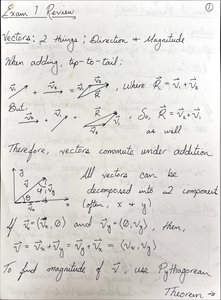
Vectors are quantities that have both direction and magnitude. They are fundamental in describing physical quantities such as displacement, velocity, and force.
Vector Addition (Tip-to-Tail Method): When adding vectors, place the tail of the second vector at the tip of the first. The resultant vector is drawn from the tail of the first to the tip of the last.
Commutativity: Vector addition is commutative: .
Component Decomposition: Any vector can be decomposed into two perpendicular components, typically along the x and y axes.
Magnitude: The magnitude of a vector with components and is given by the Pythagorean theorem:
Vector Decomposition and Trigonometry
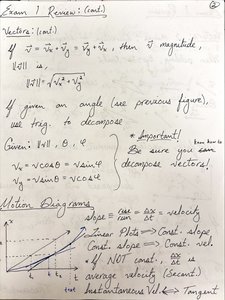
Given a vector at an angle from the x-axis:
Always decompose vectors into components before solving problems.
Motion Diagrams
Position vs. Time Graphs
Motion diagrams help visualize how an object's position changes over time.
Slope of position-time graph: Represents velocity.
Constant slope: Indicates constant velocity.
Changing slope: Indicates changing velocity (acceleration).
Instantaneous velocity: Given by the tangent to the curve at a point.
Kinematics & Projectile Motion
Kinematic Equations
Kinematic equations describe motion with constant acceleration. They relate displacement, velocity, acceleration, and time:
It is important to understand what each equation represents and when to use them.
Projectile Motion
Projectile motion involves two-dimensional motion under constant acceleration due to gravity (). The horizontal and vertical motions are independent:
Horizontal motion:
Vertical motion:
Vertical velocity:
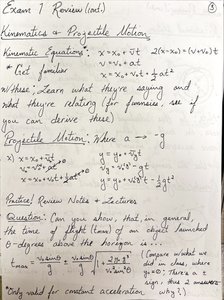
Example: Calculating the time of flight and range for a projectile launched horizontally from a height.
Additional info: These equations are valid only for constant acceleration.
Rotational Motion
Newton's Cannon and Gravity
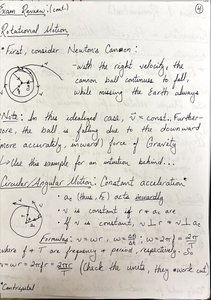
Newton's thought experiment (Newton's Cannon) illustrates that with the right velocity, a projectile can orbit the Earth, continuously falling toward it due to gravity.
In idealized cases, the only force acting is gravity, directed toward the center of the Earth.
Circular/Angular Motion: Constant Acceleration
For objects moving in a circle with constant speed:
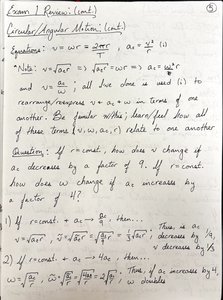
Centripetal acceleration: , always directed toward the center of the circle.
Period and frequency: or , where is the period and is the frequency.
Circular/Angular Motion (cont.)
Equations and Relationships
Be familiar with how these equations relate to one another and how changing one variable affects the others.
If decreases by a factor of 9, decreases by a factor of 3.
If increases by a factor of 4, increases by a factor of 2 (for constant ).
Free Body Diagrams
Steps for Drawing Free Body Diagrams
Set up a coordinate system.
Label forces (ensure they are where they should be).
Decompose forces into components as needed.
Free body diagrams are essential for analyzing forces acting on an object, especially on inclined planes or with friction.
Example: Calculating the acceleration and final velocity of a block sliding down an incline with friction.
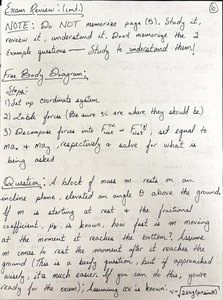
Additional info: Always study and understand the reasoning behind the steps, not just the final answers.
