Indietro
Fluid Dynamics and Oscillatory Motion: Study Notes for Physics with Algebra
Guida di studio - Note intelligenti
 Appunti personalizzati basati sui tuoi materiali, ampliati con definizioni chiave, esempi e contesto.
Fluids in Motion
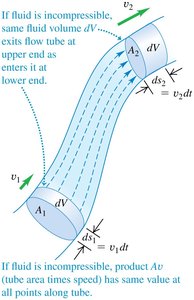
The Continuity Equation
The continuity equation describes the conservation of mass in fluid flow, particularly for incompressible fluids. It states that the product of the cross-sectional area and the fluid velocity at any two points along a flow tube remains constant, ensuring that the same volume of fluid passes through each section per unit time.
Volume Flow Rate (Q): The rate at which fluid volume passes through a cross-section, given by .
Continuity Equation: For incompressible fluids, .
Application: Used to solve problems involving changes in pipe diameter and fluid speed.
Example: If water flows through a pipe and the diameter decreases, the speed increases to conserve volume flow rate.
Bernoulli’s Equation
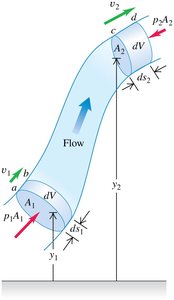
Bernoulli’s equation relates the pressure, velocity, and height at different points in a moving fluid. It is derived from the conservation of energy principle, stating that the sum of kinetic, potential, and pressure energies per unit volume is constant along a streamline for an ideal, incompressible fluid.
Bernoulli’s Equation:
Applications: Used to determine pressure changes, fluid speeds, and effects of elevation in pipes and open channels.
Example: Calculating the pressure at a valve where the pipe area changes, or finding pressure differences at different heights in a pipeline.
Oscillations
Equilibrium and Oscillation
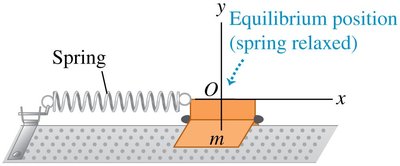
Oscillatory motion occurs when a system is displaced from equilibrium and experiences a restoring force. The interplay between this force and inertia leads to periodic motion, such as a mass attached to a spring.
Restoring Force: The force that acts to return the system to equilibrium.
Equilibrium Position: The point where the net force is zero and the spring is relaxed.
Example: A glider attached to a spring on a frictionless surface.
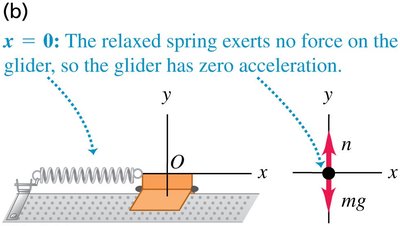
Hooke’s Law and Simple Harmonic Motion (SHM)
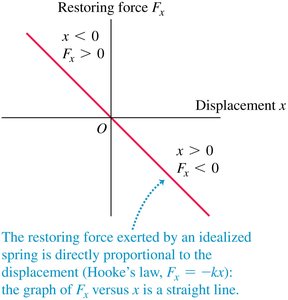
When the restoring force is proportional to displacement, the system exhibits simple harmonic motion (SHM). Hooke’s law describes this relationship, and the motion is characterized by sinusoidal functions.
Hooke’s Law:
SHM Equation:
Angular Frequency:
Period:
Frequency:
Example: Mass-spring systems, pendulums, and other oscillators.
Characteristics of Periodic Motion
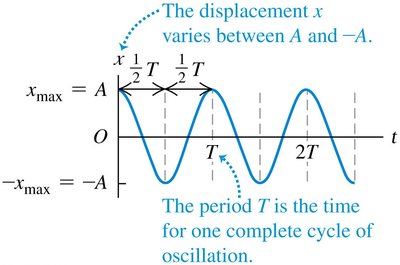
Periodic motion is defined by its amplitude, frequency, period, and phase. The displacement, velocity, and acceleration of an object in SHM can be described mathematically and graphically.
Amplitude (A): Maximum displacement from equilibrium.
Frequency (f): Number of cycles per unit time.
Period (T): Time for one complete cycle.
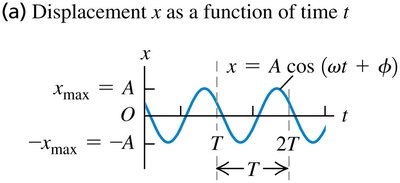
Phase Angle (\phi): Determines initial position at .
Equations:
Displacement:
Velocity:
Acceleration:
Graphical Analysis of SHM
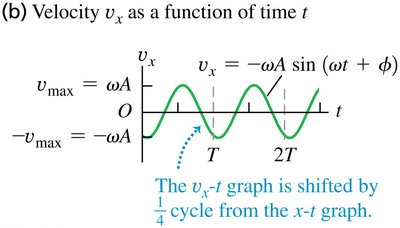
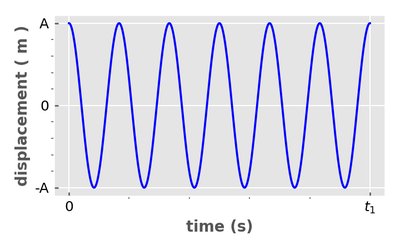
Graphs of displacement and velocity help visualize the periodic nature of SHM. The displacement graph is a cosine function, while the velocity graph is a sine function, shifted by a quarter cycle.
Displacement Graph: Shows oscillation between and .
Velocity Graph: Peaks at and is shifted relative to displacement.
Frequency Calculation: Number of cycles divided by time interval.
Energy in Simple Harmonic Motion
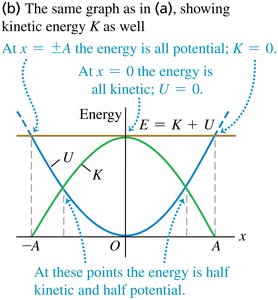
In SHM, mechanical energy is conserved and alternates between kinetic and potential forms. The total energy remains constant, with maximum kinetic energy at equilibrium and maximum potential energy at maximum displacement.
Elastic Potential Energy:
Kinetic Energy:
Total Mechanical Energy:
Energy Exchange: At , all energy is kinetic; at , all energy is potential.
Pendulum Motion
Simple Pendulum
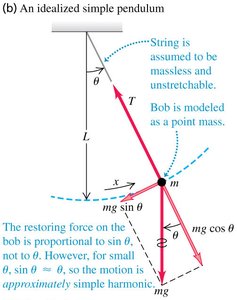
A simple pendulum consists of a point mass suspended by a massless string. For small amplitudes, its motion is approximately simple harmonic, with a period dependent on the length of the string and gravitational acceleration.
Period:
Frequency:
Angular Frequency:
Restoring Force: for small angles.
Example: Calculating period and frequency for pendulums of different lengths and masses.
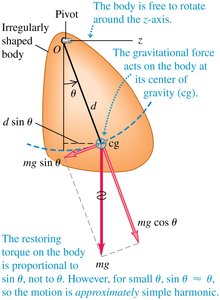
Physical Pendulum
A physical pendulum is any real pendulum with mass distributed over its volume. Its period depends on the moment of inertia and the distance from the pivot to the center of mass.
Period:
Moment of Inertia (I): Depends on the shape and mass distribution.
Restoring Torque: for small angles.
Example: Calculating period for rods, hoops, and irregular bodies.