 Indietro
Fluid Mechanics in Biological Systems: Pressure, Flow, and Applications
Guida di studio - Note intelligenti
 Appunti personalizzati basati sui tuoi materiali, ampliati con definizioni chiave, esempi e contesto.
Bulk Materials: Fluid Mechanics in Biological Systems
Introduction to Fluid Mechanics
Fluid mechanics is essential for understanding the behavior of liquids and gases in biological and physical systems. This chapter focuses on the properties of fluids, pressure, flow, and their applications in health and life sciences.
Pressure, Density, and Pascal’s Principle
Pressure in Fluids
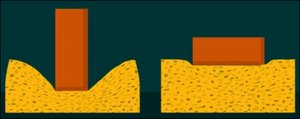
Pressure is defined as the force exerted per unit area. In fluids, pressure at a given depth is the same in all directions and at all points at the same level. The SI unit of pressure is the pascal (Pa), where 1 Pa = 1 N/m2.
Atmospheric Pressure: The pressure exerted by the atmosphere, approximately 100 kPa at sea level.
Fluid Pressure: Increases with depth in a liquid due to the weight of the fluid above.
Formula:
where is pressure, is force, and is area.
Density
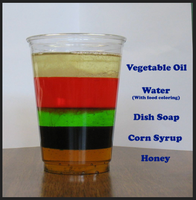
Density (\(\rho\)) is the mass per unit volume of a substance. It determines whether an object will float or sink in a fluid.
Formula:
where is density, is mass, and is volume.
Pascal’s Principle
Pascal’s Principle states that pressure applied to an enclosed fluid is transmitted undiminished throughout the fluid and to the walls of its container. This principle is fundamental in hydraulic systems and pressure measurement devices.
Measurement of Pressure: The Manometer
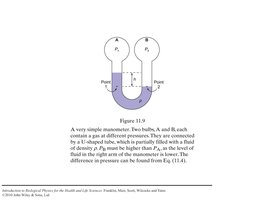
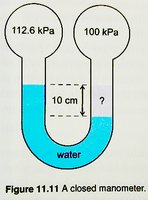
A manometer is a U-shaped tube filled with a fluid, used to measure pressure differences. It operates based on Pascal’s principle, ensuring that pressure at the same level in a stationary fluid is equal.
Surface Tension, Surfactants, and Capillarity
Cohesion, Adhesion, and Surface Tension
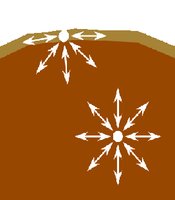
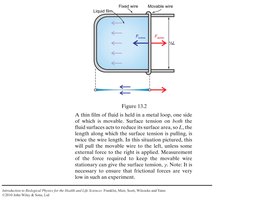
Cohesion is the attractive force between like molecules, while adhesion is the attraction between unlike substances. Surface tension arises from cohesive forces at the surface of a liquid, causing the surface to behave like a stretched elastic membrane.
Surface Tension Formula:
where is surface tension, is force, and is the length over which the force acts.
Surfactants
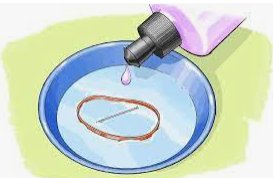
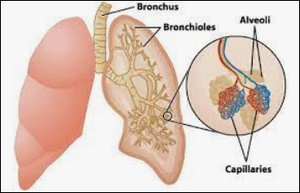
Surfactants are substances that reduce the surface tension of a liquid by concentrating at the surface. They are crucial in biological systems, especially in lung function, where they prevent alveolar collapse.
Capillarity and Interfacial Tension
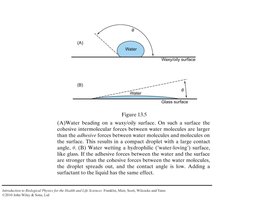
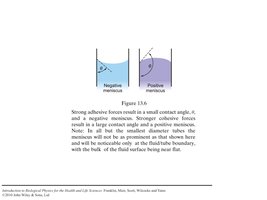
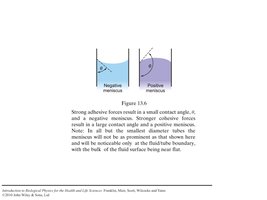
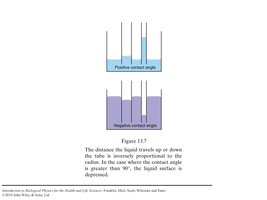
Capillary action is the movement of liquid within narrow spaces due to adhesive and cohesive forces. The behavior of liquids in contact with solids depends on the relative strength of these forces, leading to phenomena such as wetting and beading.
Biological Importance of Capillary Action
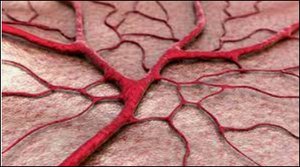
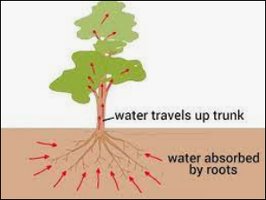
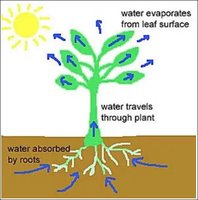
Capillary action is vital in biological systems, such as the movement of water in plants and blood flow in capillaries.
Surfactants and the Lung
In the lungs, surfactants reduce surface tension in alveoli, stabilizing them and preventing collapse, especially in premature infants. This ensures efficient gas exchange and proper lung function.
Volume Flow Rate, Continuity, and Bernoulli’s Equation
Volume Flow Rate
The volume flow rate (Q) is the amount of fluid passing through a cross-section per unit time. For incompressible fluids, the flow rate remains constant along a pipe.
Formula:
where is volume flow rate, is cross-sectional area, and is fluid velocity.
Equation of Continuity
The continuity equation expresses the conservation of mass in fluid flow. For an incompressible fluid:
where and are cross-sectional areas, and and are velocities at different points.
Bernoulli’s Principle
Bernoulli’s equation relates pressure, velocity, and elevation in a moving fluid. It states that an increase in fluid velocity leads to a decrease in pressure and/or gravitational potential energy.
Bernoulli’s Equation:
where is pressure, is density, is velocity, is acceleration due to gravity, and is height.
Poiseuille’s Law, Types of Fluid Flow, and Blood Flow
Poiseuille’s Law
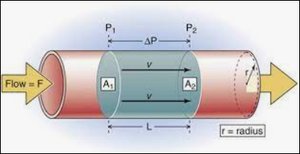
Poiseuille’s Law describes the flow of viscous fluids through a cylindrical pipe. The flow rate is highly sensitive to the radius of the pipe.
Formula:
where is flow rate, is radius, is pressure difference, is viscosity, and is length of the pipe.
Types of Fluid Flow
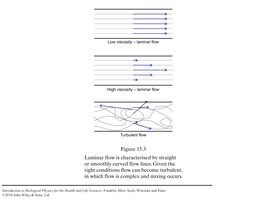
Ideal Flow: No viscosity, all layers move at the same speed (not found in nature).
Laminar Flow: Smooth, orderly flow in parallel layers with different velocities; forms a parabolic velocity profile.
Turbulent Flow: Chaotic, irregular flow with mixing and eddies; occurs at high velocities or with obstructions.
Blood Flow and Viscosity
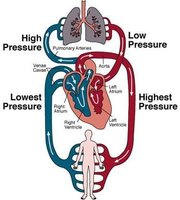
Blood is a heterogeneous, viscous fluid. Its flow can be laminar or turbulent, and its viscosity is not constant due to the presence of cells and plasma. Most resistance and pressure drop occur in smaller arteries, making the radius of blood vessels critical for circulation.
Measurement of Blood Pressure
Sphygmomanometer
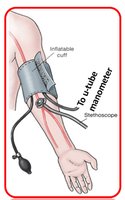
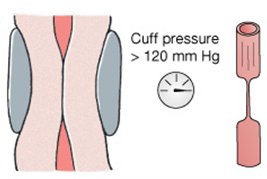
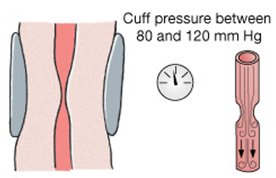
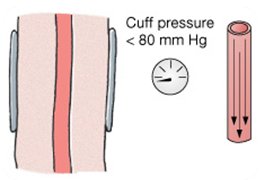
A sphygmomanometer is used to measure blood pressure, typically at the upper arm. It consists of an inflatable cuff, a manometer, and a bulb. Blood pressure readings include:
Systolic Pressure: Maximum pressure during heart contraction.
Diastolic Pressure: Minimum pressure during heart relaxation.
Summary Table: Key Fluid Properties and Equations
Property/Principle | Definition | Equation |
|---|---|---|
Pressure | Force per unit area | |
Density | Mass per unit volume | |
Surface Tension | Force per unit length at liquid surface | |
Volume Flow Rate | Volume per unit time | |
Continuity Equation | Conservation of mass in flow | |
Bernoulli’s Equation | Energy conservation in fluid flow | |
Poiseuille’s Law | Flow of viscous fluid in pipe |
