 Indietro
Fundamental Concepts in Forces, Vectors, and Projectile Motion
Guida di studio - Note intelligenti
 Appunti personalizzati basati sui tuoi materiali, ampliati con definizioni chiave, esempi e contesto.
Forces
Definition and Types of Forces
Forces are fundamental interactions that cause objects to accelerate, deform, or change their state of motion. In physics, a force is defined as a push or pull that acts upon an object as a result of its interaction with another object.
Contact Forces: Forces that arise from physical contact between objects (e.g., friction, tension, normal force).
Non-contact Forces: Forces that act at a distance without physical contact (e.g., gravitational, electric, magnetic forces).
Examples of Forces:
Gravitational Force: The attractive force between two masses, such as the Earth and an object near its surface.
Normal Force: The support force exerted upon an object in contact with another stable object.
Frictional Force: The force that opposes the motion of an object across a surface.
Tension Force: The force transmitted through a string, rope, cable, or wire when it is pulled tight by forces acting from opposite ends.
Spring Force: The force exerted by a compressed or stretched spring upon any object attached to it.
Fundamental Forces: All forces in nature can be classified into four fundamental types:
Gravitational Force
Electromagnetic Force
Strong Nuclear Force
Weak Interaction Force
These forces are responsible for all interactions observed in the universe.
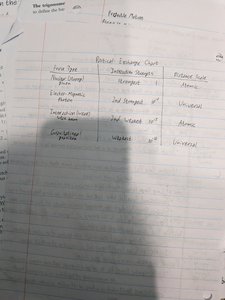
Force Exchange Chart
The following table summarizes the fundamental forces, their exchange particles, and their relative strengths and ranges:
Force Type | Exchange Particle | Relative Strength | Range |
|---|---|---|---|
Gravitational | Graviton (theoretical) | Weakest | Universal |
Electromagnetic | Photon | 2nd Strongest | Universal |
Strong Nuclear | Gluon | Strongest | Atomic |
Weak Interaction | W/Z Bosons | 2nd Weakest | Atomic |
Vectors in Physics
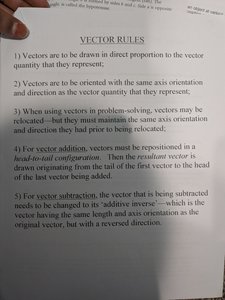
Vector Rules
Vectors are quantities that have both magnitude and direction. They are essential in representing physical quantities such as displacement, velocity, acceleration, and force.
Proportional Representation: Vectors are drawn in direct proportion to the quantity they represent.
Orientation: Vectors must be oriented with the same axis and direction as the quantity they represent.
Relocation: When solving problems, vectors may be relocated but must maintain their axis orientation and direction.
Vector Addition: For addition, vectors are placed head-to-tail. The resultant vector is drawn from the tail of the first vector to the head of the last vector.
Vector Subtraction: The vector being subtracted is reversed in direction and then added to the original vector.
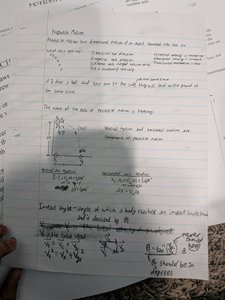
Projectile Motion
Introduction to Projectile Motion
Projectile motion describes the two-dimensional motion of an object launched into the air, subject only to gravity (assuming air resistance is negligible). The path followed by a projectile is called its trajectory, which is typically parabolic.
Horizontal and Vertical Components: The motion can be analyzed by separating it into horizontal (x) and vertical (y) components.
Key Equations:
Horizontal motion (constant velocity):
Vertical motion (constant acceleration):
Where and are the initial velocity components, is the acceleration due to gravity (usually -9.8 or -10.[m/s^2]), and is time.
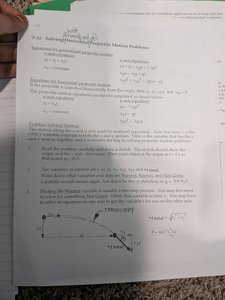
Solving Projectile Motion Problems
Break the initial velocity into horizontal and vertical components using trigonometry:
Use kinematic equations for each direction independently.
Time of flight, maximum height, and range can be found using the following:
Time of Flight:
Maximum Height:
Range:
Trigonometry in Physics
Right Triangle Trigonometry
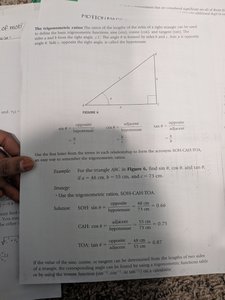
Trigonometric ratios are essential for resolving vectors into components and analyzing projectile motion. The primary ratios are:
Sine:
Cosine:
Tangent:
These ratios are used to find unknown sides or angles in right triangles, which is crucial for vector decomposition.
Free-Body Diagrams (FBDs)
Purpose and Construction of FBDs
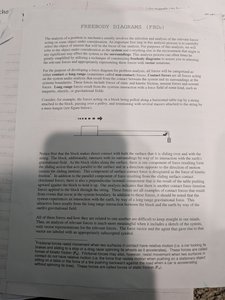
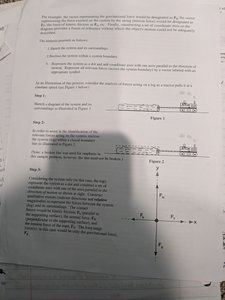
Free-body diagrams are graphical representations used to visualize the forces acting on a single object. They are essential tools for analyzing the dynamics of objects and applying Newton's Laws of Motion.
Identify the object of interest and isolate it from its environment.
Draw all forces acting on the object as vectors originating from the object's center.
Label each force clearly (e.g., gravity, normal, friction, tension).
Use the diagram to set up equations based on Newton's Second Law:
Graphs of Motion
Interpreting Motion Graphs
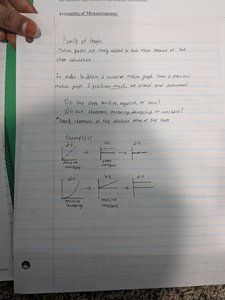
Graphs are powerful tools for visualizing and analyzing motion. The most common types are position vs. time, velocity vs. time, and acceleration vs. time graphs.
Position-Time Graph: The slope represents velocity.
Velocity-Time Graph: The slope represents acceleration; the area under the curve gives displacement.
Acceleration-Time Graph: The area under the curve gives the change in velocity.
Summary
This study guide covers essential concepts in forces, vectors, projectile motion, trigonometry, free-body diagrams, and motion graphs. Mastery of these topics is foundational for success in Physics with Algebra, as they form the basis for understanding more advanced topics in mechanics and beyond.
