 Indietro
Physics with Algebra Exam 2 Practice Guidance
Guida di studio - Note intelligenti
 Appunti personalizzati basati sui tuoi materiali, ampliati con definizioni chiave, esempi e contesto.
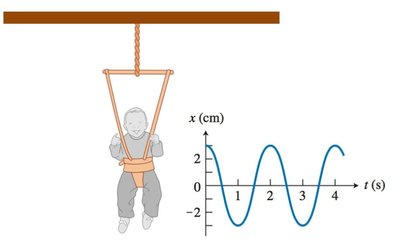
Q3. What is the spring constant of the elastic cable supporting a child in simple harmonic motion?
Background
Topic: Simple Harmonic Motion (SHM) and Spring Systems
This question tests your understanding of how to determine the spring constant () of a spring system using the mass and the period or frequency of oscillation, often from a position vs. time graph.
Key Terms and Formulas:
Spring constant (): Measures the stiffness of the spring.
Period (): Time for one complete oscillation.
Mass (): Combined mass of child and seat.
Formula for period of a mass-spring system:
Formula for spring constant:
Step-by-Step Guidance
From the graph, determine the period () of the oscillation by measuring the time between two consecutive peaks or troughs.
Identify the mass () of the child and seat, which is given as 24 kg.
Write the formula relating period and spring constant:
Rearrange the formula to solve for :
Plug in the values for and (from the graph) into the formula, but do not calculate the final value yet.
Try solving on your own before revealing the answer!
Final Answer: 240 N/m
Using the period from the graph and the mass, the spring constant is calculated as . With s, N/m.
This matches answer choice E.
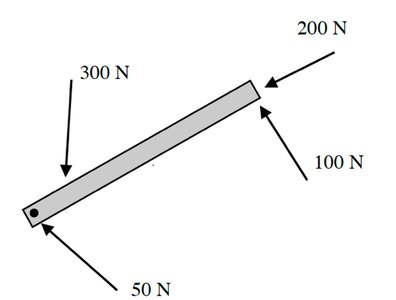
Q7. Which force exerts the greatest magnitude of torque on the bar of length L with the pivot point at the left end?
Background
Topic: Torque and Rotational Equilibrium
This question tests your ability to calculate torque () produced by forces applied at different points along a bar, considering both the magnitude of the force and its distance from the pivot.
Key Terms and Formulas:
Torque (): The tendency of a force to rotate an object about a pivot point.
Formula: (where is force, is distance from pivot)
Direction: Only forces not acting at the pivot and perpendicular to the bar contribute to torque.
Step-by-Step Guidance
Identify the pivot point (left end of the bar).
For each force, determine its distance from the pivot and whether it acts perpendicular to the bar.
Calculate the torque for each force using .
Compare the calculated torques to determine which is largest in magnitude.
Set up the calculation for the 100 N force at length L and the other forces, but do not compute the final values yet.
Try solving on your own before revealing the answer!
Final Answer: The 100 N force at length L
The torque is greatest for the 100 N force applied at the full length L, since and this force is both large and applied at the maximum distance from the pivot.
This matches answer choice B.
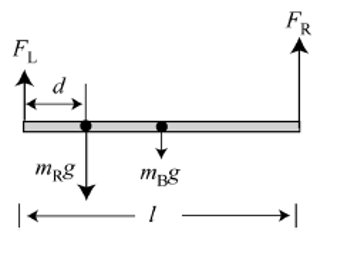
Q8. What are the forces that each cable exerts on the board when Ray stands 1.0 m from the left cable?
Background
Topic: Static Equilibrium and Force Distribution
This question tests your ability to analyze a system in static equilibrium, where a board is supported by two cables and has forces applied at different points. You must use force and torque balance to find the forces each cable exerts.
Key Terms and Formulas:
Static equilibrium: The sum of forces and torques must be zero.
Force balance:
Torque balance:
Variables: (left cable force), (right cable force), (Ray's mass), (board's mass), (Ray's distance from left cable), (length of board), (gravity)
Step-by-Step Guidance
Write the force balance equation:
Write the torque balance equation about the left cable:
Plug in the values: kg, kg, m, m, m/s2
Set up the equations for and but do not solve for the final values yet.
Try solving on your own before revealing the answer!
Final Answer: N and N
By solving the force and torque balance equations, you find the right cable supports most of the weight due to Ray's position. This matches answer choice D.
