 Indietro
Physics with Algebra: Forces, Motion, and Pulley Systems – Step-by-Step Study Guidance
Guida di studio - Note intelligenti
 Appunti personalizzati basati sui tuoi materiali, ampliati con definizioni chiave, esempi e contesto.
Q7. A 1000-N piano is raised at constant speed using a very light rope in a frictionless pulley system (see image). With what force is the mover pulling down on the rope?
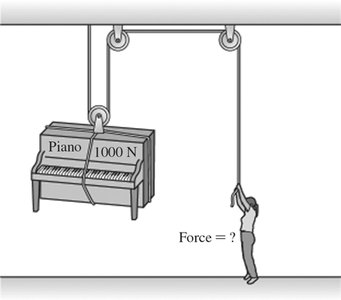
Background
Topic: Newton's Laws, Tension, and Pulley Systems
This question tests your understanding of how forces are distributed in a simple frictionless pulley system, especially when lifting an object at constant speed.
Key Terms and Formulas
Tension (T): The force transmitted through a rope or cable when it is pulled tight by forces acting from opposite ends.
Newton's Second Law:
Constant Speed: Implies , so .
Weight (W):
Step-by-Step Guidance
Recognize that the piano is being lifted at constant speed, so the net force on the piano is zero ().
Identify the forces acting on the piano: its weight (downward) and the tension in the rope (upward).
Set up the force balance equation for the piano: (since ).
Consider the pulley system: In a simple frictionless pulley, the force the mover applies downward on the rope equals the tension in the rope.
Try solving on your own before revealing the answer!
Final Answer: 1000 N
The mover must pull down with a force equal to the weight of the piano, which is 1000 N. This is because, in a frictionless pulley system and at constant speed, the tension in the rope equals the weight being supported.
Q8. Three blocks (A, B, C) are connected by light ropes and a frictionless pulley as shown. An external force P is applied downward on block A, causing it to accelerate downward at 2.5 m/s². The tension in the rope connecting block B and block C is 60 N. (a) What is the magnitude of the force P? (b) What is the mass of block C?
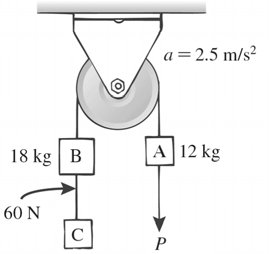
Background
Topic: Newton's Second Law, Tension, and Pulley Systems
This problem involves analyzing forces and tensions in a multi-block system with a pulley, using Newton's laws to relate forces, masses, and acceleration.
Key Terms and Formulas
Newton's Second Law:
Tension (T): The force transmitted through a rope.
Weight (W):
Step-by-Step Guidance
Draw free-body diagrams for each block, labeling all forces (weights, tensions, and applied force P).
Write Newton's second law equations for each block, considering the direction of acceleration and the forces acting on each.
For block B, use the given tension (60 N) and its mass (18 kg) to set up the equation: (for block C), and (for block B).
For block A, relate the applied force P, the weight of A, and the tension in the rope connecting A and B, using .
Combine the equations to express P and in terms of known quantities and solve up to the point where you can substitute values.
Try solving on your own before revealing the answer!
Final Answers:
(a) The magnitude of the force P is 180 N.
(b) The mass of block C is 3.5 kg.
These results come from applying Newton's second law to each block, using the given acceleration and tension, and solving the system of equations.
Q9. A 10-kg block on a perfectly smooth horizontal table is connected by a horizontal string to a 63-kg block hanging over the edge of the table. What is the magnitude of the acceleration of the 10-kg block when the other block is gently released?
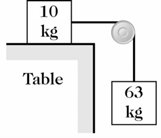
Background
Topic: Newton's Second Law, Atwood Machine (Pulley Systems)
This question tests your ability to analyze a two-mass system connected by a string over a pulley, where one mass hangs and the other is on a frictionless surface.
Key Terms and Formulas
Newton's Second Law:
Atwood Machine Acceleration: (for a frictionless system)
Step-by-Step Guidance
Identify the forces acting on each block: gravity on the hanging block, tension in the string, and gravity/normal force on the block on the table.
Write Newton's second law for each block, considering the direction of acceleration.
Set up the system of equations for the two blocks, using the fact that the tension is the same throughout the string and the acceleration is the same for both blocks.
Combine the equations to solve for the acceleration in terms of the masses and .
Substitute the given masses and m/s² into the formula, but stop before calculating the final value.
Try solving on your own before revealing the answer!
Final Answer: 8.1 m/s²
Using the Atwood machine formula and substituting the given values, the acceleration of the 10-kg block is 8.1 m/s².
Q10. Two packages are connected by a very light string over an ideal pulley. Package A (3.0 kg) can slide along a rough plane inclined at 30° above the horizontal. The string acts on package A parallel to the surface. The coefficient of static friction between package A and the plane is 0.40. What minimum mass should package B have in order to start package A sliding up the ramp?
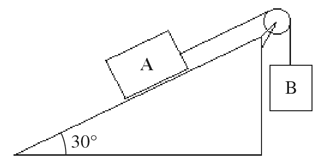
Background
Topic: Static Friction, Inclined Planes, Pulley Systems
This question tests your understanding of the forces acting on an object on an inclined plane, including friction, gravity, and tension, and how to determine the minimum force (or mass) needed to overcome static friction.
Key Terms and Formulas
Static Friction Force:
Normal Force on Incline:
Component of Gravity Down the Ramp:
Force Balance for Motion Up the Ramp: (at threshold of motion)
Step-by-Step Guidance
Draw a free-body diagram for package A, showing all forces: gravity, normal force, friction, and tension from the string.
Calculate the normal force on package A using .
Find the maximum static friction force using .
Set up the force balance equation along the ramp, including the tension from package B and the forces resisting motion up the ramp.
Express the tension in terms of the weight of package B, and solve for the minimum mass needed, but stop before the final calculation.
Try solving on your own before revealing the answer!
Final Answer: 2.6 kg
The minimum mass for package B is 2.6 kg. This is found by balancing the forces so that the tension just overcomes the sum of gravity's component down the ramp and the maximum static friction.
