 Indietro
Physics with Algebra Study Guidance: PHYS 1164 Exam Review
Guida di studio - Note intelligenti
 Appunti personalizzati basati sui tuoi materiali, ampliati con definizioni chiave, esempi e contesto.
Q1. Two identical balls are simultaneously thrown horizontally from the roof of a building. If the initial velocity of ball 1 is twice the initial velocity of ball 2, which one of the following statements is correct? Ignore any effects due to wind or air resistance.
Background
Topic: Two-Dimensional Kinematics (Projectile Motion)
This question tests your understanding of how horizontal and vertical motions are independent in projectile motion, and how initial velocity affects time of flight and final speed.
Key Terms and Formulas:
Projectile motion: The motion of an object thrown or projected into the air, subject only to gravity.
Time of flight: (for horizontal throws, depends only on height and gravity)
Final speed: Combination of horizontal and vertical velocity components at impact.
Step-by-Step Guidance
Recognize that both balls are thrown horizontally from the same height, so their vertical motion is identical.
Recall that the time to reach the ground depends only on the height and gravity, not the horizontal velocity.
Consider how the horizontal velocity affects the final speed: the ball with greater horizontal velocity will have a larger horizontal component at impact.
Combine the horizontal and vertical velocity components to determine the final speed for each ball.
Try solving on your own before revealing the answer!
Final Answer: (D) Both balls reach the ground at the same time but ball 1 has a greater final speed.
The time to reach the ground is determined only by the height and gravity, so both balls land simultaneously. However, ball 1 has a greater horizontal velocity, so its final speed (the vector sum of horizontal and vertical components) is larger.
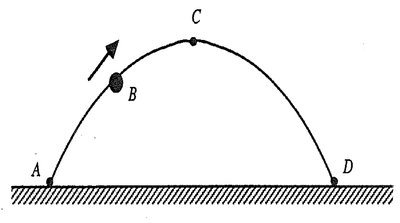
Q2. A ball is projected into the air at point A, passes through points B and C (highest point), and hits the ground at point D. Which one of the following statements is FALSE?
Background
Topic: Projectile Motion and Kinematics
This question tests your understanding of speed, velocity, acceleration, and displacement during projectile motion.
Key Terms and Formulas:
Acceleration due to gravity: (always downward)
Velocity at the highest point: horizontal only, vertical component is zero
Displacement: vector from start to end point
Step-by-Step Guidance
Review the properties of projectile motion: at the highest point, vertical velocity is zero but acceleration is still .
Compare the speed at launch and at landing, considering energy conservation and direction.
Analyze the direction of velocity at point B using the diagram.
Consider how the total time of flight and displacement depend on initial velocity components.
Try solving on your own before revealing the answer!
Final Answer: (C) The ball’s acceleration is zero at point C.
This statement is FALSE. The acceleration due to gravity is always present, even at the highest point (C), so it is not zero.
Q3. In the table shown, which of the choice numbers show a dimensionally correct unit of force?
Background
Topic: Dimensional Analysis and Units
This question tests your ability to identify the correct units for force using dimensional analysis.
Key Terms and Formulas:
Force unit: (mass times acceleration)
SI unit:
Step-by-Step Guidance
Recall the formula for force: .
Check each unit in the table to see if it matches the dimensions of mass times acceleration.
Identify which choices are dimensionally correct for force.
Try solving on your own before revealing the answer!
Final Answer: (D) only 1 and 3
Choices 1 () and 3 () are dimensionally correct units for force.
Q4. An object is moving with a constant velocity in the +x direction, and has a constant and non-zero acceleration in the −y direction. Which one of the following statements is correct?
Background
Topic: Newton’s Second Law and Vector Components
This question tests your understanding of how net force relates to acceleration in different directions.
Key Terms and Formulas:
Newton’s Second Law:
Constant velocity: zero net force in that direction
Constant acceleration: non-zero net force in that direction
Step-by-Step Guidance
Recall that constant velocity in the +x direction means .
Constant, non-zero acceleration in the −y direction means .
Match these conditions to the answer choices.
Try solving on your own before revealing the answer!
Final Answer: (B) and
There is no net force in the x direction (constant velocity), but there is a net force in the y direction (constant acceleration).
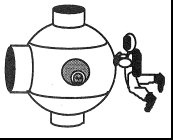
Q5. An astronaut and a spacecraft are located in deep space. The astronaut pushes to the left on the spacecraft. During the push, which one of the following statements is correct?
Background
Topic: Newton’s Third Law (Action-Reaction)
This question tests your understanding of how forces and accelerations relate for objects of different masses.
Key Terms and Formulas:
Newton’s Third Law: For every action, there is an equal and opposite reaction.
Acceleration:
Step-by-Step Guidance
Recall that the force exerted by the astronaut on the spacecraft is equal in magnitude and opposite in direction to the force exerted by the spacecraft on the astronaut.
Compare the masses: the astronaut has much less mass than the spacecraft.
Use to determine which object has greater acceleration.
Consider the direction of acceleration for each object.
Try solving on your own before revealing the answer!
Final Answer: (A) The astronaut has an acceleration to the left with a greater magnitude than the spacecraft’s.
Both experience equal and opposite forces, but the astronaut’s smaller mass means a greater acceleration.
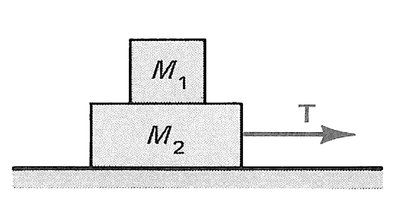
Q6. According to Newton’s third law of motion, which one of the following choices correctly identifies the two forces in an ‘action/reaction’ pair?
Background
Topic: Newton’s Third Law (Action-Reaction Pairs)
This question tests your ability to identify true action-reaction pairs between interacting objects.
Key Terms and Formulas:
Action-reaction pair: Forces that are equal in magnitude, opposite in direction, and act on different objects.
Step-by-Step Guidance
Recall that action-reaction pairs act on different objects.
Identify which forces in the table are acting between two different objects.
Check if the forces are equal and opposite.
Try solving on your own before revealing the answer!
Final Answer: (D) normal force on bottom surface of mass and normal force on bottom surface of mass
These forces are equal and opposite, acting between the two blocks.
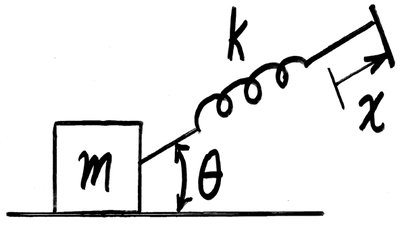
Q7. Just after the mass is released, derive an equation for the magnitude of the kinetic frictional force () on the bottom surface of mass .
Background
Topic: Friction and Spring Forces
This question tests your understanding of how friction depends on the normal force, which may be affected by the spring’s angle.
Key Terms and Formulas:
Kinetic friction:
Normal force: sum of vertical forces, including gravity and vertical component of spring force
Spring force:
Step-by-Step Guidance
Write the expression for kinetic friction: .
Determine the normal force by summing vertical forces: gravity () and vertical component of spring force ().
Combine these to express and substitute into the friction formula.
Try solving on your own before revealing the answer!
Final Answer: (D)
The normal force includes both the weight and the vertical component of the spring force, so the frictional force is the sum of these times the coefficient of kinetic friction.
Q8. Just after the mass is released, derive an equation for the magnitude of its acceleration () along the floor.
Background
Topic: Newton’s Second Law and Spring Forces
This question tests your ability to apply Newton’s second law to a mass acted on by a spring and friction.
Key Terms and Formulas:
Newton’s Second Law:
Spring force component along floor:
Kinetic friction: (from previous question)
Step-by-Step Guidance
Identify the forces acting along the floor: spring force () and kinetic friction ().
Write Newton’s second law: .
Rearrange to solve for acceleration .
Try solving on your own before revealing the answer!
Final Answer: (E)
The acceleration is determined by the net force (spring minus friction) divided by the mass.
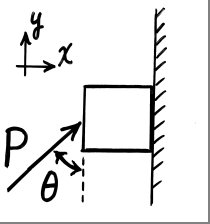
Q9. Which one of the following statements concerning the static frictional force on the block pressed against a vertical wall is correct?
Background
Topic: Static Friction and Force Analysis
This question tests your understanding of how static friction can act in different directions depending on the situation.
Key Terms and Formulas:
Static friction: opposes relative motion, can act in either direction as needed
Force components: resolve applied force into and directions
Step-by-Step Guidance
Consider the forces acting on the block: weight, applied force , normal force, and static friction.
Static friction can act in the or direction depending on whether tries to move the block up or down.
Analyze how the direction of static friction depends on the vertical component of compared to the weight.
Try solving on your own before revealing the answer!
Final Answer: (E) It may be in the −y or +y direction depending on the magnitude of the vertical component of force P compared to the weight w of the block.
Static friction acts to prevent motion, so its direction depends on whether the block is being pushed up or down the wall.
Q10. What is the direction of the normal force acting on the block pressed against a vertical wall?
Background
Topic: Normal Force Direction
This question tests your understanding of how normal force acts perpendicular to surfaces.
Key Terms and Formulas:
Normal force: acts perpendicular to the contact surface
Step-by-Step Guidance
Identify the contact surface: the wall is vertical.
Normal force acts perpendicular to the wall, which is in the direction (away from the wall).
Try solving on your own before revealing the answer!
Final Answer: (B) +x
The normal force acts away from the wall, in the positive x direction.
Q11. What is the magnitude of the normal force acting on the block pressed against a vertical wall?
Background
Topic: Force Components and Normal Force
This question tests your ability to resolve forces and find the normal force magnitude.
Key Terms and Formulas:
Normal force: equal to the horizontal component of applied force
Horizontal component:
Step-by-Step Guidance
Resolve the applied force into components: is the horizontal component.
The normal force is equal to this horizontal component.
Try solving on your own before revealing the answer!
Final Answer: (A)
The normal force is equal to the horizontal component of the applied force.
Q12. Assuming static friction is at its maximum possible value, determine an expression for the maximum force that can be applied before the block begins to move up the wall.
Background
Topic: Static Friction and Force Analysis
This question tests your ability to set up force balance equations and solve for maximum applied force.
Key Terms and Formulas:
Static friction maximum:
Force balance: sum of vertical forces must equal zero for block to remain stationary
Step-by-Step Guidance
Write the force balance equation in the vertical direction: .
Substitute and .
Rearrange to solve for in terms of , , and .
Try solving on your own before revealing the answer!
Final Answer: (C)
This expression gives the maximum force before the block moves up the wall, accounting for static friction and the angle of application.
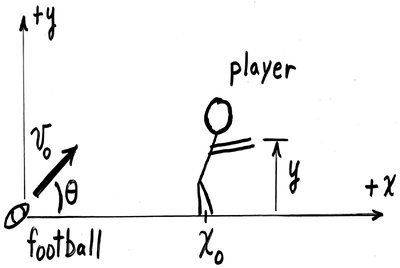
Q13. Two-Dimensional Kinematics: A football is kicked from the ground with unknown initial speed at unknown angle above the horizontal. At the same instant, a player located at m runs with a constant velocity of m/s in the direction. After s, the player catches the football at position m. Calculate:
(a) The -component of the ball’s initial velocity.
(b) The -component of the ball’s initial velocity.
(c) The magnitude and angle of the ball’s initial velocity vector.
Background
Topic: Two-Dimensional Kinematics (Projectile Motion)
This question tests your ability to use kinematic equations to solve for initial velocity components given position and time.
Key Terms and Formulas:
Horizontal motion:
Vertical motion:
Initial velocity components: ,
Step-by-Step Guidance
Set up the horizontal motion equation: .
Set up the vertical motion equation: .
Use the given values for , , , and to solve for and .
Once you have and , use and to find the magnitude and angle.
Try solving on your own before revealing the answer!
Final Answer:
(a) m/s
(b) m/s
(c) m/s,
These values are found by solving the kinematic equations for the given positions and time.
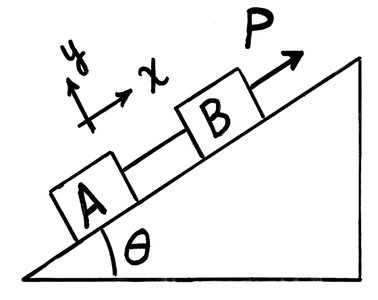
Q14. Newton’s Laws of Motion: Box A (unknown mass) is connected to box B (mass 1.50 kg) by a cable running parallel to a ramp inclined at . Force N pulls box B parallel to the ramp. The coefficient of kinetic friction is . Each box accelerates up the ramp at m/s. Calculate:
(a) Sketch a free-body diagram for each block.
(b) Apply Newton’s laws to box B to calculate the tension force in the rope.
(c) Apply Newton’s laws to box A to calculate its mass.
Background
Topic: Newton’s Laws, Free-Body Diagrams, Friction, and Inclined Planes
This question tests your ability to analyze forces on inclined planes and solve for unknowns using Newton’s laws.
Key Terms and Formulas:
Newton’s Second Law:
Friction force:
Inclined plane: resolve weight into parallel and perpendicular components
Step-by-Step Guidance
Draw free-body diagrams for both boxes, showing all forces: weight, normal, friction, tension, and applied force.
For box B, write Newton’s second law along the ramp: .
Solve for tension using the known values for , , , , and .
For box A, write Newton’s second law along the ramp: .
Use the value of from part (b) to solve for .
Try solving on your own before revealing the answer!
Final Answer:
(b) Tension force N
(c) Mass of box A kg
These values are found by applying Newton’s laws to each box and solving the equations step by step.
