 Indietro
Reflection and Refraction of Light: Study Notes for Physics with Algebra
Guida di studio - Note intelligenti
 Appunti personalizzati basati sui tuoi materiali, ampliati con definizioni chiave, esempi e contesto.
Reflection and Refraction of Light
Ray Approximation in Geometric Optics
Geometric optics simplifies the study of light by treating it as rays that travel in straight lines. This approximation is valid when the wavelength of light is much smaller than the objects or structures it interacts with.
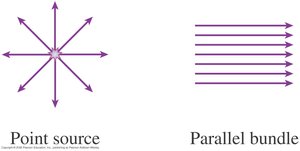
Point Source: Emits rays in all directions.
Parallel Bundle: Rays travel parallel, as from a distant source like the Sun.
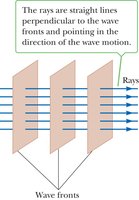
Wave Fronts: Rays are perpendicular to wave fronts and indicate the direction of wave motion.
Light’s Interaction with Matter
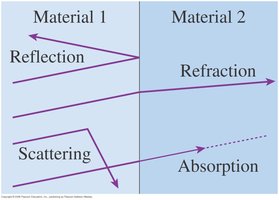
When light encounters a boundary between two materials, it can be reflected, refracted, scattered, or absorbed. The behavior depends on the properties of the materials and the angle of incidence.
Reflection: Light bounces off the surface.
Refraction: Light passes into the second material, changing direction.
Scattering: Light is redirected in many directions.
Absorption: Light energy is absorbed by the material.
Reflection of Light
Types of Reflection
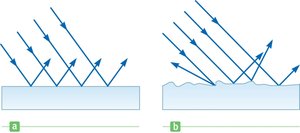
Reflection occurs when light bounces off a surface. The nature of the surface determines the type of reflection:
Specular Reflection: Occurs on smooth surfaces; reflected rays are parallel.
Diffuse Reflection: Occurs on rough surfaces; reflected rays scatter in many directions.
Law of Reflection
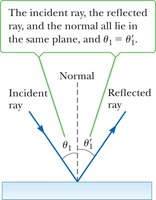
The law of reflection states that the angle of incidence equals the angle of reflection, both measured from the normal (a line perpendicular to the surface at the point of incidence).
Incident Ray: The incoming ray striking the surface.
Reflected Ray: The ray that bounces off the surface.
Normal: Perpendicular to the surface at the point of incidence.
Law of Reflection:
Multiple Reflections
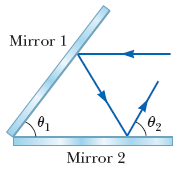
When light reflects off multiple surfaces, such as two mirrors at an angle, the law of reflection applies at each surface. Geometry is used to determine the path of the rays.
Refraction of Light
Light in a Medium
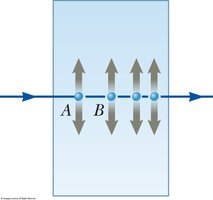
When light enters a medium, it interacts with particles (such as electrons), which absorb and reradiate the light. This process slows the average speed of light in the material.
Speed of Light in Vacuum: m/s
Speed in Medium:
Index of Refraction:
Law of Refraction (Snell's Law)
Refraction is the bending of light as it passes from one medium to another with a different index of refraction. Snell's Law quantifies this behavior:
Snell's Law:
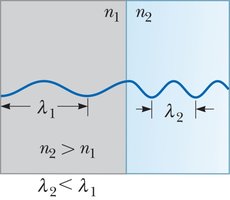
Normal Incidence: If light enters perpendicular to the surface, it does not bend but may change speed and wavelength.
Oblique Incidence: Light bends toward the normal if entering a more optically dense medium (higher n), and away from the normal if entering a less dense medium.
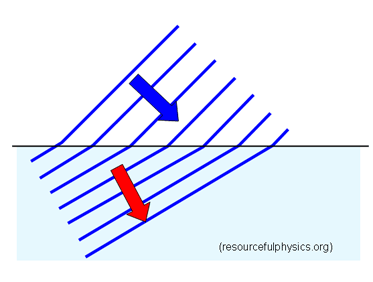
Properties of Light in Different Media
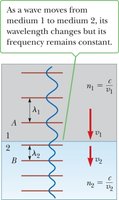
As light moves from one medium to another:
Frequency: Remains constant.
Wavelength: Changes according to the speed in the new medium.
Wave Speed: Changes according to the index of refraction.
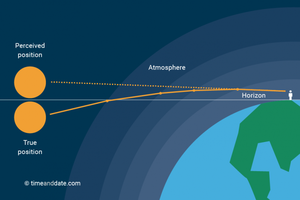
Optical Illusions Due to Refraction
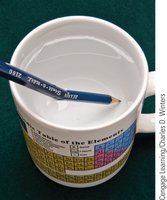
Refraction can cause objects submerged in water to appear bent or at a different depth. This is due to the change in direction of light rays as they pass from water to air.
Apparent Depth: Objects appear closer to the surface than they actually are.
Example: A pencil in a glass of water appears bent at the water's surface.
Dispersion and Total Internal Reflection
Dispersion
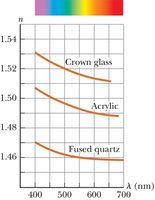
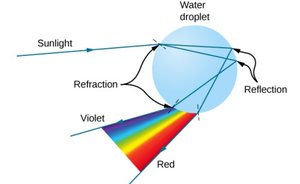
Dispersion occurs when different wavelengths of light are refracted by different amounts, causing separation of colors. This is commonly observed in prisms and rainbows.
Index of Refraction: Varies with wavelength; shorter wavelengths (blue/violet) are refracted more than longer wavelengths (red).
Prism: Disperses white light into its constituent colors.
Rainbow: Formed by dispersion and internal reflection in water droplets.
Total Internal Reflection
Total internal reflection occurs when light attempts to move from a medium with higher index of refraction to one with lower index at an angle greater than the critical angle. No light escapes; it is completely reflected within the medium.
Critical Angle: The minimum angle of incidence for total internal reflection.
Snell's Law for Critical Angle: , where
Applications: Fiber optics, endoscopes.
Summary Table: Index of Refraction for Various Media
The index of refraction varies with wavelength and material. This affects how much light bends and disperses.
Medium | Red (660 nm) | Orange (610 nm) | Yellow (580 nm) | Green (550 nm) | Blue (470 nm) | Violet (410 nm) |
|---|---|---|---|---|---|---|
Water | 1.331 | 1.332 | 1.333 | 1.335 | 1.338 | 1.342 |
Diamond | 2.410 | 2.415 | 2.417 | 2.426 | 2.444 | 2.458 |
Glass, crown | 1.520 | 1.524 | 1.518 | 1.526 | 1.532 | 1.538 |
Glass, flint | 1.662 | 1.665 | 1.667 | 1.673 | 1.684 | 1.698 |
Polystyrene | 1.488 | 1.490 | 1.492 | 1.493 | 1.496 | 1.506 |
Quartz, fused | 1.455 | 1.457 | 1.458 | 1.459 | 1.462 | 1.468 |
Key Equations
Energy of a Photon:
Law of Reflection:
Index of Refraction:
Snell's Law:
Examples and Applications
Optical Illusions: Refraction causes objects in water to appear bent or at a different depth.
Prisms: Used to separate light into its component colors.
Rainbows: Formed by dispersion and internal reflection in water droplets.
Fiber Optics: Use total internal reflection to transmit light efficiently.
