 Indietro
Applying Newton’s Laws: Equilibrium, Dynamics, Friction, and Circular Motion
Guida di studio - Note intelligenti
 Appunti personalizzati basati sui tuoi materiali, ampliati con definizioni chiave, esempi e contesto.
Applying Newton’s Laws
Introduction
Newton’s laws of motion provide the foundation for analyzing the forces acting on objects and predicting their motion. This chapter focuses on applying these laws to solve problems involving equilibrium, dynamics, friction, and circular motion. Mastery of these concepts is essential for understanding both simple and complex physical systems.
Equilibrium and Newton’s First Law
Conditions for Equilibrium
An object is in equilibrium if it is at rest or moving with constant velocity in an inertial frame of reference. According to Newton’s first law, the net force on a body in equilibrium must be zero. This leads to the following mathematical conditions:
Sum of forces in the x-direction:
Sum of forces in the y-direction:
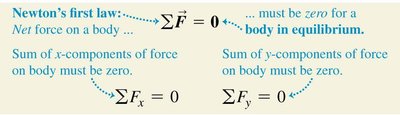
These equations must be satisfied for a body to remain in equilibrium.
Problem-Solving Strategy for Equilibrium
Draw a sketch of the physical situation.
Draw a free-body diagram for each body in equilibrium, showing all forces acting on it.
Identify all forces (contact and non-contact) and use for weight if mass is given.
Choose coordinate axes and resolve forces into components.
Set up equations for the sum of forces in each direction and solve for unknowns.
Dynamics and Newton’s Second Law
Newton’s Second Law of Motion
When the net force on a body is not zero, the body accelerates in the direction of the net force. Newton’s second law is expressed as:
Component form: ,
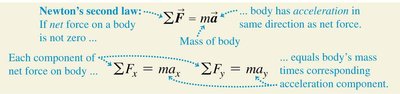
This law is fundamental for analyzing the motion of objects under the influence of forces.
Problem-Solving Strategy for Dynamics
Draw a sketch and a free-body diagram for each moving body.
Label all forces, including weight ().
Choose coordinate axes and resolve forces into components.
Write Newton’s second law for each direction and solve for the target variables.
Free-Body Diagrams: Correct and Incorrect Practices
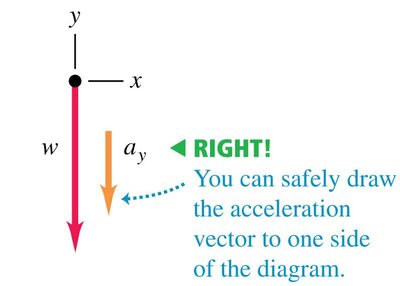
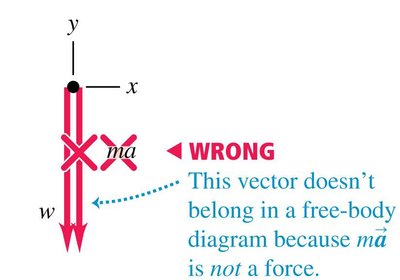
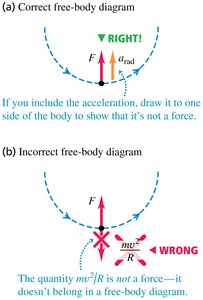
Free-body diagrams are essential tools for visualizing forces. Only actual forces should be included; the vector (mass times acceleration) is not a force and should not appear in the diagram. The acceleration vector can be drawn to the side for reference.

Frictional Forces
Nature of Friction
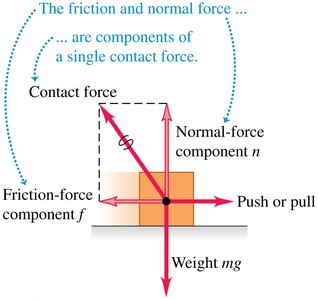
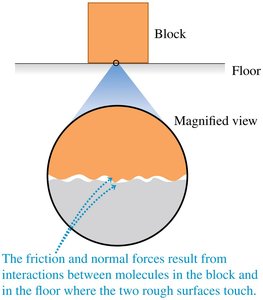
Friction is a force that opposes the relative motion of two surfaces in contact. It arises from molecular interactions at the interface of the surfaces.

Kinetic and Static Friction
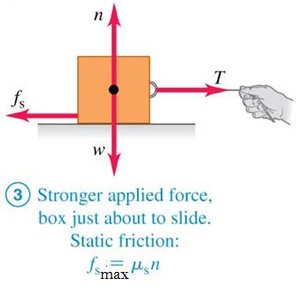
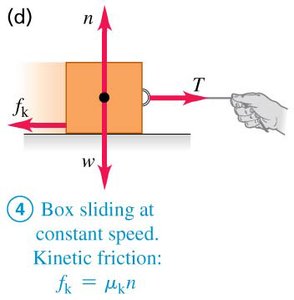
Kinetic friction () acts when a body slides over a surface:
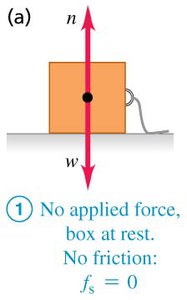
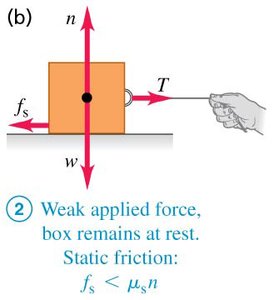
Static friction () acts when there is no relative motion:
and are the coefficients of kinetic and static friction, respectively; is the normal force.
Transition from Static to Kinetic Friction
As the applied force increases, static friction increases up to its maximum value. Once this threshold is exceeded, the object begins to move and kinetic friction takes over.
Coefficients of Friction: Typical Values
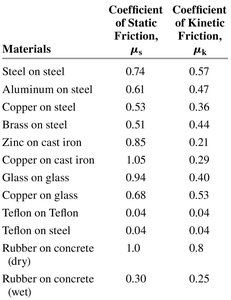
The coefficients of friction depend on the materials in contact. The table below lists typical values for common material pairs.
Materials | Coefficient of Static Friction, | Coefficient of Kinetic Friction, |
|---|---|---|
Steel on steel | 0.74 | 0.57 |
Aluminum on steel | 0.61 | 0.47 |
Copper on steel | 0.53 | 0.36 |
Brass on steel | 0.51 | 0.44 |
Zinc on cast iron | 0.85 | 0.21 |
Copper on cast iron | 1.05 | 0.29 |
Glass on glass | 0.94 | 0.40 |
Copper on glass | 0.68 | 0.53 |
Teflon on Teflon | 0.04 | 0.04 |
Teflon on steel | 0.04 | 0.04 |
Rubber on concrete (dry) | 1.0 | 0.8 |
Rubber on concrete (wet) | 0.30 | 0.25 |
Applications: Stick-Slip Phenomena
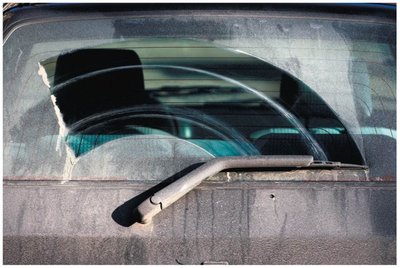
Stick-slip motion, such as the squeak of windshield wipers on dry glass, occurs when static friction alternates with kinetic friction as the force applied to an object overcomes the maximum static friction.
Fluid Resistance and Terminal Speed
Drag Force and Terminal Velocity
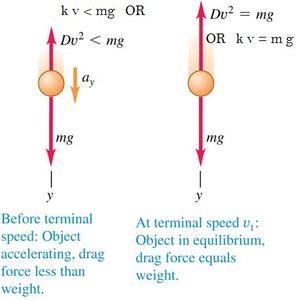
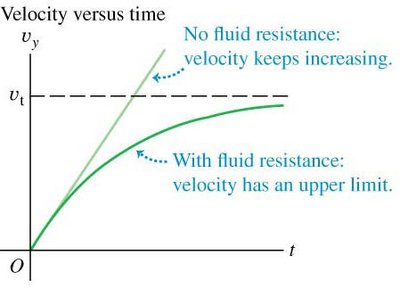
When an object moves through a fluid (like air), it experiences a resistive force (drag) that increases with speed. Eventually, the drag force balances the weight, and the object reaches terminal speed (), moving at constant velocity.
Before terminal speed: or
At terminal speed: or
Dynamics of Circular Motion
Uniform Circular Motion
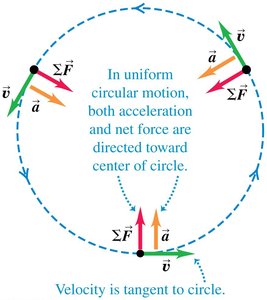
For a particle in uniform circular motion, both the acceleration and the net force are directed toward the center of the circle (centripetal direction). The magnitude of the net force is given by:
What Happens if the Centripetal Force Disappears?
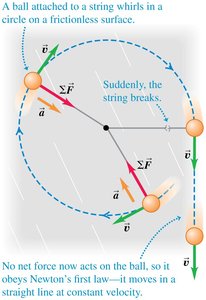
If the force maintaining circular motion (e.g., a string) breaks, the object moves in a straight line tangent to the circle, as per Newton’s first law.
Common Error: The 'Centrifugal Force'
In an inertial frame, there is no real 'centrifugal force.' The correct free-body diagram includes only real forces; the acceleration vector can be shown to the side for clarity, but is not a force and should not be included as such.
The Fundamental Forces of Nature
Overview of Fundamental Interactions
All forces in nature are manifestations of four fundamental interactions:
Gravitational interaction
Electromagnetic interaction
Strong interaction
Weak interaction
Physicists aim to unify these interactions into a comprehensive 'theory of everything.'
