 Indietro
Applying Newton’s Laws: Equilibrium, Dynamics, Friction, and Circular Motion
Guida di studio - Note intelligenti
 Appunti personalizzati basati sui tuoi materiali, ampliati con definizioni chiave, esempi e contesto.
Applying Newton’s Laws
Overview
This chapter explores the application of Newton’s laws of motion to solve problems involving equilibrium, dynamics, friction, and circular motion. Mastery of these concepts is essential for understanding the behavior of physical systems in classical mechanics.
Equilibrium and Newton’s First Law
Definition of Equilibrium
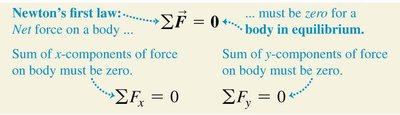
A body is in equilibrium when it is at rest or moving with constant velocity in an inertial frame of reference. Newton’s first law states that the net force on a body in equilibrium must be zero.
Net force: The vector sum of all forces acting on a body.
Equilibrium conditions: The sum of the x-components and y-components of force must each be zero.
Equations:
Problem-Solving Strategy for Equilibrium
Draw a sketch of the physical situation.
Draw a free-body diagram for each body in equilibrium.
Identify all forces acting on the body (e.g., weight ).
Choose coordinate axes and include them in the diagram.
Find force components along each axis and set their sums to zero.
Solve the resulting equations for unknowns.
Dynamics and Newton’s Second Law
Definition of Dynamics
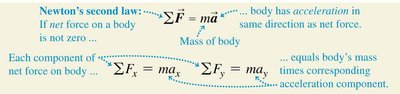
When the net force on a body is not zero, the body accelerates according to Newton’s second law. The acceleration is in the direction of the net force.
Newton’s second law:
Each component: ,
Problem-Solving Strategy for Dynamics
Draw a sketch and free-body diagram for each moving body.
Label all forces, including weight .
Choose coordinate axes and show them in the diagram.
Identify relationships among bodies (e.g., connected by a rope).
Determine force components and write Newton’s second law for each axis.
List knowns and unknowns, solve for target variables.
Free-Body Diagrams: Correct and Incorrect Practices
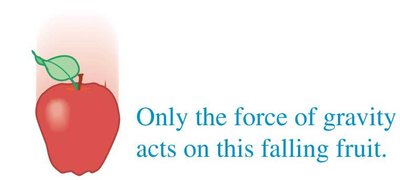
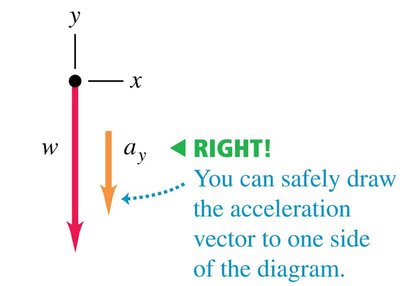
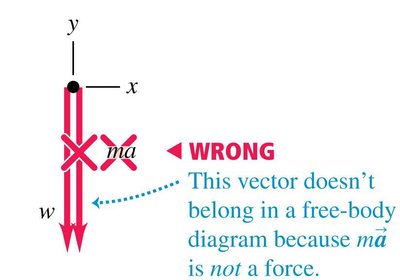
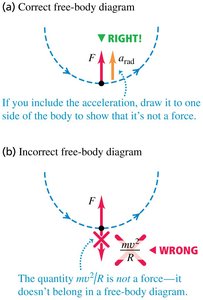
Only forces should be included in a free-body diagram.
Acceleration vectors can be drawn to the side, but is not a force and should not be included as a force vector.
Frictional Forces
Nature of Friction
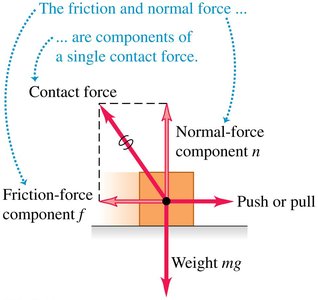
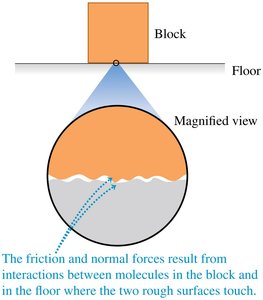
Friction is a force that opposes the relative motion of two surfaces in contact. It is essential for locomotion and many everyday phenomena.
Frictional force: Acts parallel to the surface.
Normal force: Acts perpendicular to the surface.
Both are components of the contact force between surfaces.

Kinetic and Static Friction
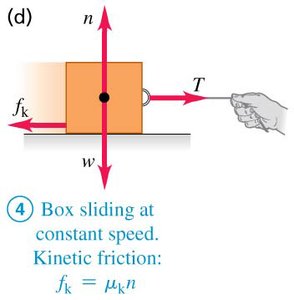
Kinetic friction: Acts when a body slides over a surface.
Static friction: Acts when there is no relative motion.
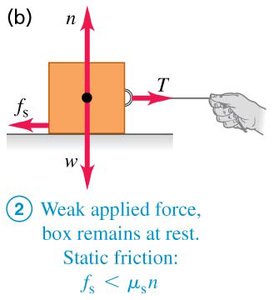
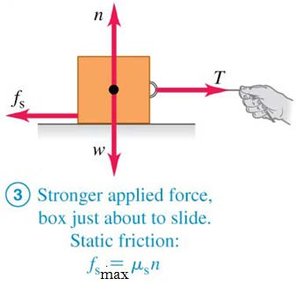
Static friction increases up to a maximum value before motion begins.
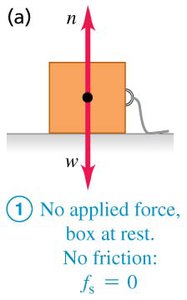
Stages of Friction in Box Motion
No applied force:
Weak applied force:
Stronger applied force:
Box slides:
Coefficients of Friction
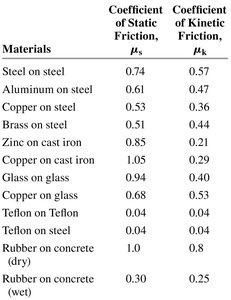
The coefficient of friction depends on the materials in contact. Static friction is usually greater than kinetic friction.
Materials | Coefficient of Static Friction, \(\mu_s\) | Coefficient of Kinetic Friction, \(\mu_k\) |
|---|---|---|
Steel on steel | 0.74 | 0.57 |
Aluminum on steel | 0.61 | 0.47 |
Copper on steel | 0.53 | 0.36 |
Brass on steel | 0.51 | 0.44 |
Zinc on cast iron | 0.85 | 0.21 |
Copper on cast iron | 1.05 | 0.29 |
Glass on glass | 0.94 | 0.40 |
Copper on glass | 0.68 | 0.53 |
Teflon on steel | 0.04 | 0.04 |
Teflon on Teflon | 0.04 | 0.04 |
Rubber on concrete (dry) | 1.0 | 0.8 |
Rubber on concrete (wet) | 0.30 | 0.25 |
Stick-Slip Phenomenon
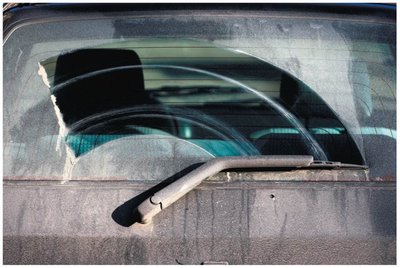
Stick-slip occurs when static friction alternates with kinetic friction, as seen in squeaky windshield wipers on dry glass. Wet surfaces reduce friction and eliminate stick-slip.
Fluid Resistance and Terminal Speed
Fluid Resistance
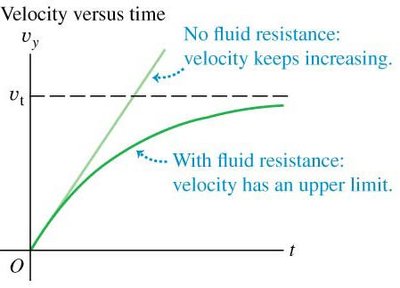
Fluid resistance (drag) opposes the motion of objects through fluids. The resisting force increases with speed and can be linear or quadratic in velocity.
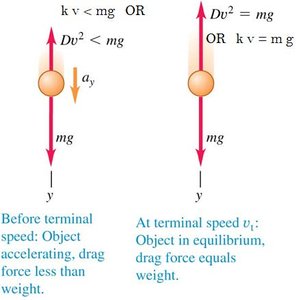
At terminal speed, the drag force equals the weight of the body.
Before terminal speed: or
At terminal speed: or
Velocity vs. Time with Fluid Resistance
With fluid resistance, velocity approaches an upper limit (terminal speed) rather than increasing indefinitely.
Dynamics of Circular Motion
Uniform Circular Motion
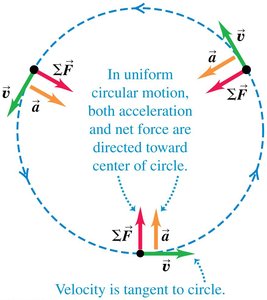
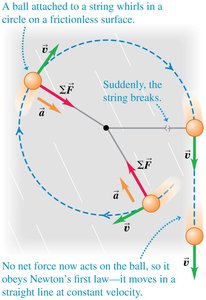
In uniform circular motion, both acceleration and net force are directed toward the center of the circle. The net force is called the centripetal force.
Velocity is tangent to the circle; acceleration and net force point toward the center.
What Happens if the String Breaks?
If the string breaks, no net force acts on the ball, and it moves in a straight line at constant velocity, obeying Newton’s first law.
Avoiding the 'Centrifugal Force' Misconception
In an inertial frame, there is no such thing as 'centrifugal force.' Only real forces should be included in free-body diagrams. The quantity is not a force but the result of the net force required for circular motion.
The Fundamental Forces of Nature
Classification of Forces
All forces in nature are manifestations of four fundamental interactions:
Gravitational
Electromagnetic
Strong interaction
Weak interaction
Physicists aim to unify these interactions into a comprehensive theory of everything.
Summary Table: Types of Friction
Type | Formula | Condition |
|---|---|---|
Static friction | No relative motion | |
Kinetic friction | Sliding motion |
Key Equations
Equilibrium:
Newton’s second law:
Static friction:
Kinetic friction:
Circular motion:
Example Application
Example: A box is pulled across a floor. If the coefficient of kinetic friction is 0.4 and the normal force is 50 N, the frictional force is N.
Example: A ball of mass 0.5 kg moves in a circle of radius 2 m at 3 m/s. The net force required is N toward the center.
Additional info: Academic context and examples were added to ensure completeness and clarity for exam preparation.
