 Indietro
Blackbody Radiation and the Physics of Thermal Emission
Guida di studio - Note intelligenti
 Appunti personalizzati basati sui tuoi materiali, ampliati con definizioni chiave, esempi e contesto.
Blackbody Radiation
Introduction to Blackbody Radiation
Blackbody radiation refers to the electromagnetic radiation emitted by an idealized object that absorbs all incident radiation and re-emits energy according to its temperature. This concept is fundamental in understanding thermal emission and the distribution of energy across wavelengths and frequencies.
Blackbody: An ideal object that perfectly absorbs and emits radiation at all wavelengths.
Thermal emission: The process by which objects emit electromagnetic radiation due to their temperature.
Wavelength and frequency: The emitted radiation covers a range of wavelengths and frequencies, with intensity depending on temperature.
Wavelength Distribution and Temperature Dependence
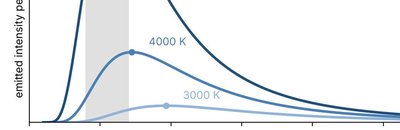
The intensity of blackbody radiation varies with wavelength and temperature. As temperature increases, the peak of the emitted spectrum shifts to shorter wavelengths, and the total emitted energy increases.
Wien's Displacement Law: The wavelength at which the emission is strongest (peak wavelength) is inversely proportional to the temperature: , where is Wien's constant.
Stefan-Boltzmann Law: The total energy emitted per unit area is proportional to the fourth power of the temperature: , where is the Stefan-Boltzmann constant.
Visible region: For temperatures around 3000–5000 K, the peak emission falls within or near the visible spectrum.
Example: As a star's surface temperature increases from 3000 K to 5000 K, its peak emission shifts from the infrared toward the visible spectrum, making it appear brighter and bluer. 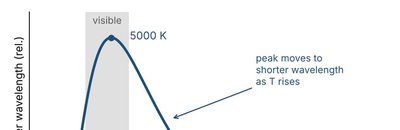

Classical vs Quantum Models of Blackbody Radiation
Rayleigh-Jeans Law and the Ultraviolet Catastrophe
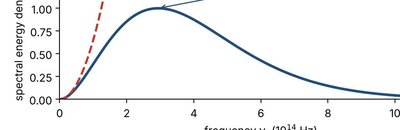
The classical Rayleigh-Jeans law predicted that the energy density of blackbody radiation would increase without bound at short wavelengths (high frequencies), leading to the so-called "ultraviolet catastrophe."
Rayleigh-Jeans Law: , where is the energy density at frequency , is Boltzmann's constant, is temperature, and is the speed of light.
Ultraviolet catastrophe: The classical prediction that energy density diverges as frequency increases, which is not observed experimentally.
Planck's Law and Quantized Energy
Max Planck resolved the ultraviolet catastrophe by proposing that energy is quantized, leading to a new formula that accurately describes blackbody radiation at all wavelengths.
Planck's Law: , where is Planck's constant.
Quantization: Energy is emitted in discrete packets (quanta), not continuously.
Peak frequency: The spectral energy density peaks at a frequency determined by temperature: .
Example: At 5000 K, the Planck curve matches experimental data, while the Rayleigh-Jeans curve diverges at high frequencies. 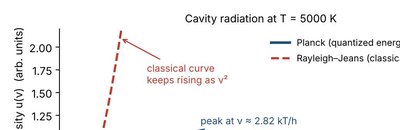
Summary Table: Classical vs Quantum Models
Model | Formula | Prediction at High Frequency | Experimental Match |
|---|---|---|---|
Rayleigh-Jeans (Classical) | Diverges (Ultraviolet Catastrophe) | No | |
Planck (Quantum) | Finite, peaks then falls | Yes |
Additional info: These concepts are foundational for understanding the quantum nature of light and energy, and are directly relevant to college-level Physics with Calculus courses, especially in chapters covering heat, temperature, and electromagnetic waves.
