 Indietro
Calculus Concepts in Physics: Motion, Differentiation, and Integration
Guida di studio - Note intelligenti
 Appunti personalizzati basati sui tuoi materiali, ampliati con definizioni chiave, esempi e contesto.
Concepts of Motion and Calculus in Physics
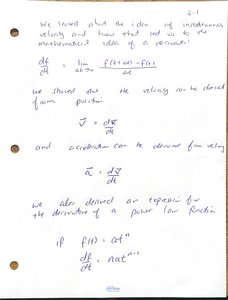
Instantaneous Velocity and Differentiation
Understanding motion in physics requires the use of calculus, particularly differentiation, to describe instantaneous velocity and acceleration. The instantaneous velocity is defined as the derivative of position with respect to time.
Instantaneous Velocity: The rate of change of position with respect to time, given by .
Velocity from Position:
Acceleration from Velocity:
Power Law Function Derivative: If , then
Example: If position is given by , then velocity is .
Chain Rule in Differentiation
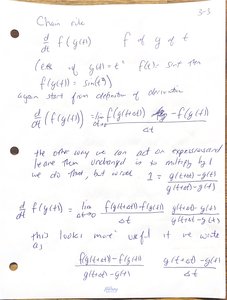
The chain rule is essential for differentiating composite functions, which frequently appear in physics when variables depend on other variables.
Chain Rule Formula:
Example: If , then
Alternative Expression:
Application: Used to differentiate functions where the argument itself is a function of time, such as in kinematics.
Kinematics in One and Two Dimensions
Vector Differentiation and Multidimensional Motion
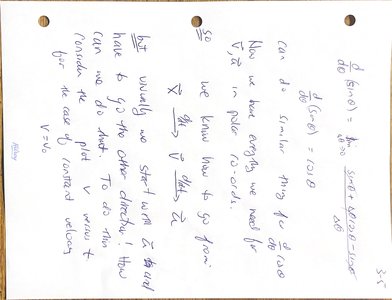
In physics, motion often occurs in more than one dimension. Calculus allows us to extend differentiation to vector quantities, such as position, velocity, and acceleration.
Vector Position:
Velocity Vector:
Acceleration Vector:
Component-wise Differentiation: Each component (e.g., , ) can be differentiated separately.
Example: For , .
Integration and Area Under Curves
Summing Areas and the Definite Integral
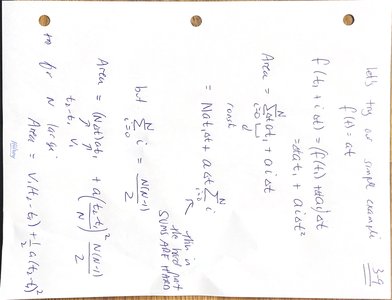
Integration is used in physics to find quantities such as displacement from velocity or area under a curve. The sum of small areas approximates the total area, leading to the concept of the definite integral.
Area Approximation:
Definite Integral: gives the exact area under from to .
Example: For , area from to is
Application: Used to calculate displacement from velocity or work from force.
Fundamental Theorem of Calculus
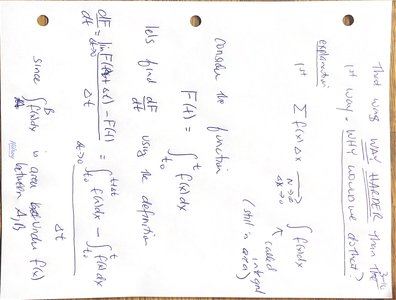
The Fundamental Theorem of Calculus links differentiation and integration, showing that they are inverse operations. This is crucial in physics for solving problems involving motion and change.
Relationship: If , then
Definite Integral as Area: is the area under between and .
Example: If , then and
Application: Used to solve for position from velocity, or velocity from acceleration.
Integration and Differentiation as Inverse Operations
Operators and Antiderivatives
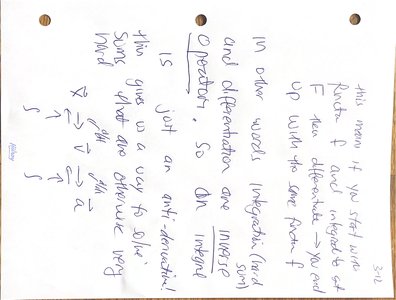
Integration and differentiation are inverse operations. In physics, this allows us to move between position, velocity, and acceleration using calculus operators.
Differentiation Operator:
Integration Operator:
Antiderivative: Integration is the process of finding the antiderivative.
Example: ,
Application: Used to solve kinematic equations and analyze motion.
Additional info: These notes cover foundational calculus concepts as applied to physics, including differentiation, integration, and their use in describing motion, which are directly relevant to chapters such as Concepts of Motion, Kinematics in One and Two Dimensions, and Calculus tools used throughout Physics with Calculus.
