 Indietro
Cell Size, Diffusion, and Simple Harmonic Motion: Physics with Calculus Study Notes
Guida di studio - Note intelligenti
 Appunti personalizzati basati sui tuoi materiali, ampliati con definizioni chiave, esempi e contesto.
Maximum Cell Size and Diffusion
Cell Size: Physical Limits and Biological Context
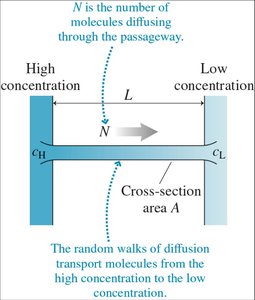
The physical size of biological cells is constrained by the laws of physics, particularly diffusion. Cells must be small enough to allow efficient transport of oxygen and nutrients by diffusion, which is a random molecular process. The following concepts are essential for understanding these limits:
Diffusion: The process by which molecules move from regions of high concentration to low concentration.
Fick's Law: Describes the rate of diffusion across a membrane or within a cell.
Maximum Cell Size: Determined by the balance between the rate of oxygen arrival (by diffusion) and the rate of oxygen consumption (by metabolism).
Fick's Law Equation:
Where: D = diffusion coefficient A = cross-sectional area L = length (distance) = concentration difference
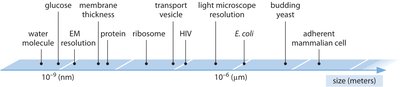
Cell Size Scale and Types
Cells and biological structures vary widely in size, from molecules to large cells. The scale below shows typical sizes:
Distribution of cell sizes among different biological entities:
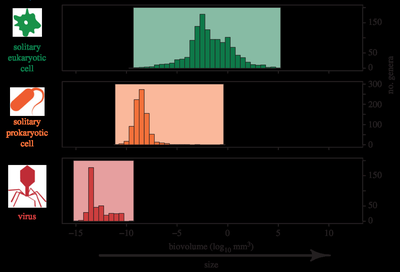
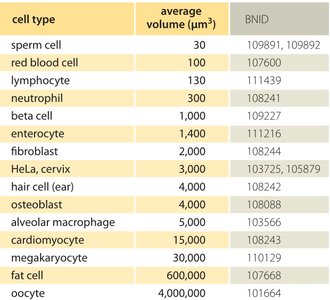
Table of average volumes for various human cell types:
Cell Type | Average Volume (μm3) | BNID |
|---|---|---|
Sperm cell | 30 | 109891, 109892 |
Red blood cell | 100 | 107600 |
Lymphocyte | 130 | 111439 |
Neutrophil | 300 | 108241 |
Beta cell | 1,000 | 109227 |
Enterocyte | 1,400 | 111216 |
Fibroblast | 2,000 | 108244 |
HeLa, cervix | 3,000 | 103725, 105879 |
Hair cell (ear) | 4,000 | 108242 |
Osteoblast | 4,000 | 108088 |
Alveolar macrophage | 6,000 | 135656 |
Cardiomyocyte | 15,000 | 108243 |
Megakaryocyte | 30,000 | 101209 |
Fat cell | 600,000 | 107668 |
Oocyte | 4,000,000 | 101664 |
Maximum Cell Size: Oxygen Diffusion Limit
Cells must be small enough to avoid suffocation, as oxygen must diffuse efficiently to all parts of the cell. The maximum radius R of a cell is determined by equating the rate of oxygen arrival and consumption:
Solving for R:
D: Diffusion coefficient of O2 ( m2/s)
c0: Concentration of O2 in water (10 mg/L)
ρ: Density of the cell (1 g/cm3)
M: Metabolic consumption of O2 ((30 L)/(1 min⋅75 kg))
Typical maximum cell radius is about 100 μm.
Simple Harmonic Motion (SHM)
Introduction to Simple Harmonic Motion
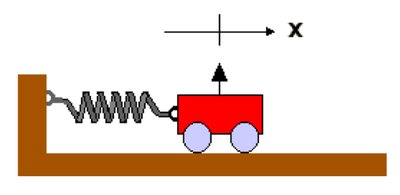
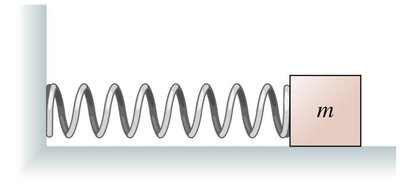
Simple harmonic motion describes the oscillatory motion of objects such as masses on springs. It is characterized by a restoring force proportional to displacement, leading to sinusoidal motion.
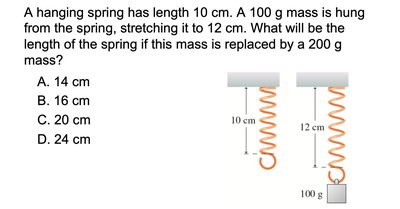
Hooke's Law:
Net Force:
Differential Equation:
Frequency, Period, and Angular Frequency
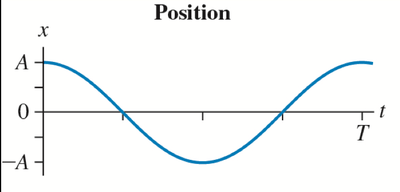
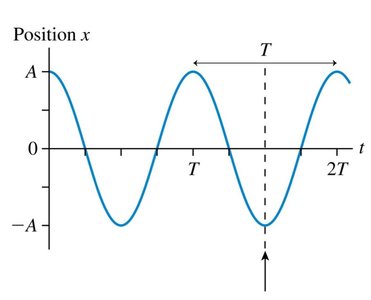
The motion of a mass-spring system can be described mathematically:
Position:
Angular Frequency:
Frequency:
Period:
Velocity and Acceleration in SHM
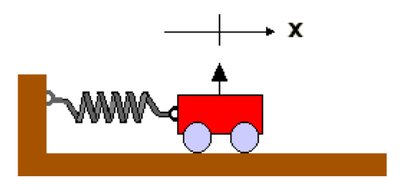
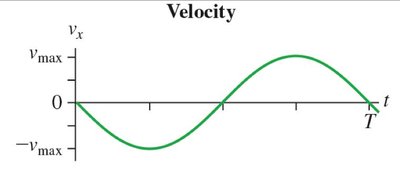
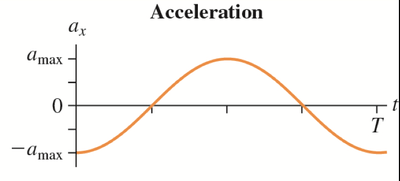
The velocity and acceleration of the mass also vary sinusoidally:
Velocity:
Acceleration:
Physical Interpretation: Equilibrium and Maximum Velocity
The velocity of the mass is highest when it passes through the equilibrium position, where the restoring force is zero. At maximum displacement, the velocity is zero and the force is maximal.
Equilibrium Position: Velocity is maximum, force is zero.
Maximum Displacement: Velocity is zero, force is maximum.
Effect of Amplitude on Period
For ideal simple harmonic motion (no friction), the period is independent of amplitude. Increasing the amplitude does not change the time for one oscillation.
Period: (independent of amplitude)
Real Systems: Friction or damping can cause the period to increase over time, but in ideal SHM, this is not considered.
Applications and Biological Context
While cells do not exhibit simple harmonic motion in the classical sense, oscillatory phenomena can occur at the molecular or structural level within cells. For example, certain cellular components may vibrate or oscillate, but these are not typically modeled as SHM.
Additional info: Oscillations and waves are foundational topics in physics, with applications ranging from mechanical systems to biological processes and electromagnetic waves.
