 Indietro
Chapter 1: Concepts of Motion – Physics with Calculus Study Notes
Guida di studio - Note intelligenti
 Appunti personalizzati basati sui tuoi materiali, ampliati con definizioni chiave, esempi e contesto.
Chapter 1: Concepts of Motion
Introduction to Physics
Physics is the study of the natural world, focusing on discovering and understanding the fundamental laws that govern physical phenomena. These laws are not invented but discovered through careful experimentation and observation. Physics spans from the smallest particles to the largest structures in the universe.
Laws of Nature: Universal principles that describe how the physical world behaves.
Experimental Basis: Physics principles are validated through experiments.
Describing Motion
Before solving motion problems, it is essential to describe motion accurately. This involves using diagrams, graphs, and mathematical representations to track how objects move over time.
Motion Diagrams: Visual representations showing an object's position at successive time intervals.
Graphs: Position, velocity, and acceleration can be plotted as functions of time.
Key Quantities: Position, velocity, and acceleration are fundamental to describing motion.
Vectors and Scalars
Many physical quantities have both magnitude and direction. These are called vectors. Scalars have only magnitude.
Vector Quantities: Position, displacement, velocity, and acceleration.
Scalar Quantities: Speed, distance, mass, and time.
Vector Representation: Arrows indicating direction and magnitude.
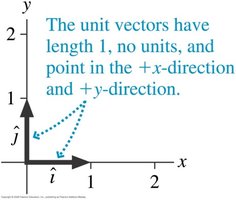
Position and Coordinate Systems
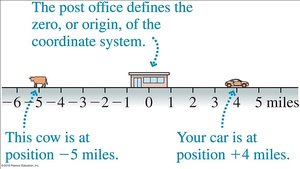
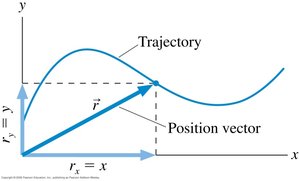
To specify an object's location, a coordinate system is established with a reference point called the origin. The position vector points from the origin to the object's location.
Origin: The reference point (often x = 0 or (0,0)).
Position Vector (\( \vec{r} \)): An arrow from the origin to the object's position.
Displacement
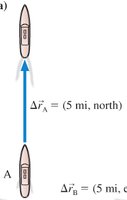
Displacement is the change in position of an object. It is a vector quantity, defined as the difference between the final and initial position vectors.
Formula:
Properties: Displacement depends only on the initial and final positions, not the path taken.
Adding and Subtracting Vectors
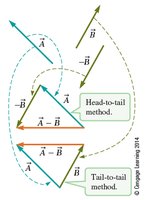
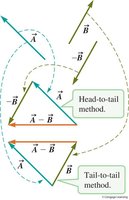
Vectors can be added graphically using the head-to-tail method or analytically using components. Subtraction is performed by adding the negative of a vector.
Graphical Addition: Place the tail of one vector at the head of another.
Subtraction:
Time, Speed, and Velocity
Time intervals are measured to analyze motion. Speed is a scalar, while velocity is a vector describing the rate of change of position.
Average Velocity:
Average Speed:
Instantaneous Velocity: The velocity at a specific instant, found as the slope of the position-time graph.
Acceleration
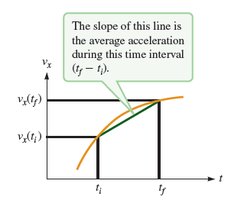
Acceleration is the rate of change of velocity. It is a vector and can be average or instantaneous.
Average Acceleration:
Instantaneous Acceleration: The slope of the velocity-time graph at a point.
Interpreting Motion Diagrams
Motion diagrams help visualize how position, velocity, and acceleration change over time. The spacing of dots indicates speed, and arrows show velocity and acceleration directions.
Constant Speed: Dots are evenly spaced.
Speeding Up: Dots get farther apart; velocity and acceleration point in the same direction.
Slowing Down: Dots get closer; velocity and acceleration point in opposite directions.
Position-versus-Time Graphs
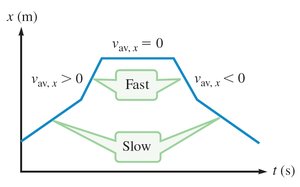
Graphs of position versus time provide a visual representation of motion. The slope at any point gives the instantaneous velocity.
Slope Interpretation: Steeper slopes indicate higher speeds.
Flat Segments: Indicate the object is at rest.
Problem-Solving in Physics
Solving physics problems involves translating words into symbols, diagrams, and equations. A systematic approach improves accuracy and understanding.
Model: Simplify the situation (e.g., use the particle model).
Visualize: Draw diagrams and graphs.
Solve: Use equations to find numerical answers.
Review: Check units, significant figures, and reasonableness.
Units and SI System
Physics uses the International System of Units (SI) for consistency. The basic SI units are the meter (m) for length, kilogram (kg) for mass, and second (s) for time. Prefixes denote powers of ten.
Power of 10 | Prefix | Abbreviation |
|---|---|---|
10-12 | pico | p |
10-9 | nano | n |
10-6 | micro | μ |
10-3 | milli | m |
10-2 | centi | c |
103 | kilo | K |
106 | mega | M |
109 | giga | G |
1012 | tera | T |
Unit Conversions and Dimensional Analysis
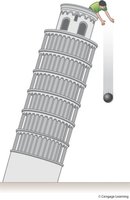
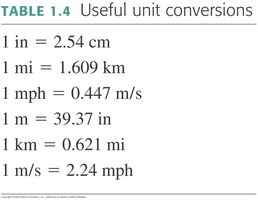
Unit conversions are essential for solving problems and checking answers. Dimensional analysis ensures equations are dimensionally consistent.
Example Conversion:
Dimensional Consistency: Both sides of an equation must have the same dimensions.

Scientific Notation and Significant Figures
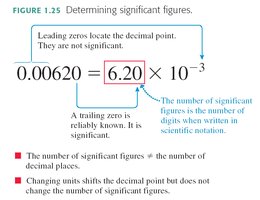
Scientific notation expresses large or small numbers compactly. Significant figures reflect the precision of measurements and calculations.
Scientific Notation:
Significant Figures: The number of reliably known digits in a measurement.
Calculation Rule: The result should have no more significant figures than the least precise measurement.
Accuracy and Precision
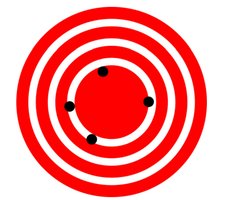
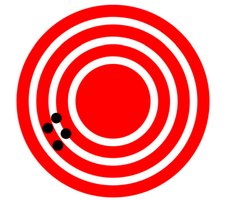
Accuracy describes how close a measurement is to the true value. Precision refers to the repeatability of measurements. Both are important for reliable scientific results.
High Accuracy, Low Precision: Measurements are close to the true value but not to each other.
High Precision, Low Accuracy: Measurements are close to each other but not to the true value.
Estimation and Order-of-Magnitude Calculations
Estimation involves making approximate calculations based on known values. Order-of-magnitude estimates use powers of ten to express approximate values, useful for checking the plausibility of results.
Order of Magnitude: The power of ten closest to a value.
Symbol: indicates an order-of-magnitude estimate.
Summary of Key Concepts
The particle model simplifies objects as points with mass.
Position locates an object in a coordinate system; displacement is the change in position.
Velocity is the rate of change of position; acceleration is the rate of change of velocity.
Use SI units and significant figures for consistency and precision.
Apply dimensional analysis to check equations.
Practice problem-solving strategies for success in physics.
