 Indietro
Chapter 1: Representing Motion – Foundations of Kinematics
Guida di studio - Note intelligenti
 Appunti personalizzati basati sui tuoi materiali, ampliati con definizioni chiave, esempi e contesto.
Chapter 1: Representing Motion
Introduction to Motion
Motion is a fundamental concept in physics, describing the change in an object’s position or orientation with time. Understanding motion is essential for analyzing physical systems and solving real-world problems in mechanics.
Motion: The change of an object’s position or orientation with respect to time.
Trajectory: The path along which an object moves.
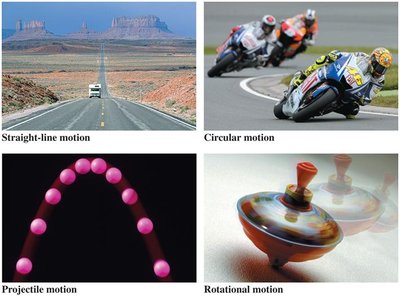
Types of Motion
There are several types of motion commonly encountered in physics:
Straight-line motion: Movement along a straight path.
Circular motion: Movement along a circular path.
Projectile motion: Curved path under the influence of gravity.
Rotational motion: Object rotates about an axis.
Distance and Displacement
Definitions and Differences
Distance and displacement are two key quantities used to describe motion. While both measure how far an object has moved, they differ in their definitions and properties.
Distance: The total length of the path traveled by an object. It is a scalar quantity (has magnitude only).
Displacement: The straight-line difference between the final and initial positions of an object. It is a vector quantity (has both magnitude and direction).
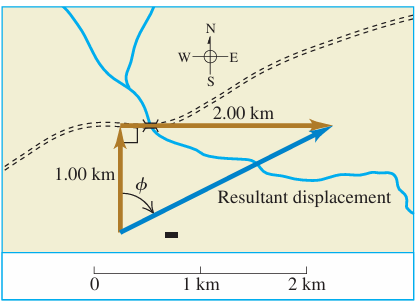
Example: A cross-country skier travels 1.00 km north and then 2.00 km east. The total distance is the sum of the path lengths:
Distance = 1.00 km + 2.00 km = 3.00 km
Displacement is found using the Pythagorean theorem:
Direction: east of north
Average Speed and Average Velocity
Definitions and Calculations
Speed and velocity are related but distinct concepts in kinematics. Both describe how fast an object moves, but velocity also includes direction.
Average speed: The total distance traveled divided by the total time taken. It is a scalar quantity.
Average velocity: The displacement divided by the total time taken. It is a vector quantity.
Formulas:
Average speed:
Average velocity:
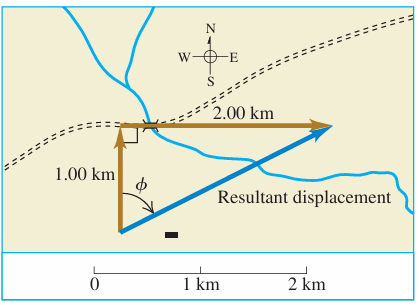
Example: For the skier who travels 3.00 km in 0.5 hours:
Average speed:
Average velocity: at east of north
Instantaneous Speed and Velocity
While average speed and velocity describe motion over an interval, instantaneous speed and velocity refer to the rate of motion at a specific moment in time.
Instantaneous speed: The speed of an object at a particular instant.
Instantaneous velocity: The velocity (including direction) at a particular instant.

Mathematical Tools: The Pythagorean Theorem
Application in Physics
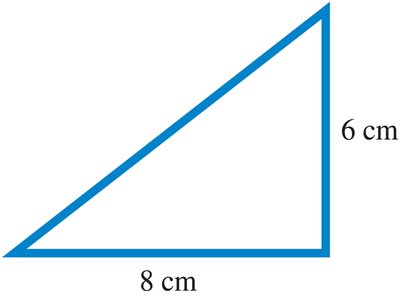
The Pythagorean theorem is essential for calculating displacement and resolving vectors in two dimensions.
For a right triangle with sides and , and hypotenuse :
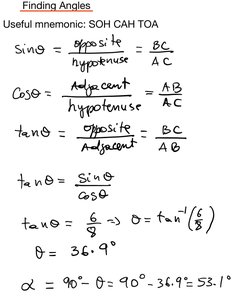
Finding Angles: SOH CAH TOA
Trigonometric ratios are used to find angles in right triangles, which is important for determining the direction of vectors.
To find the angle :
Unit Conversions
Importance and Method
Physics uses the International System of Units (SI), but other unit systems are common. Converting between units is a critical skill for solving physics problems.
Multiply by conversion factors (ratios equal to 1) to change units without altering the value of a quantity.
Cancel units systematically to ensure the final answer is in the desired units.
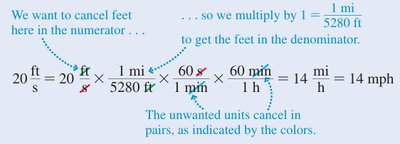
Example: Convert 20 ft/s to mi/h:
Multiply by to convert feet to miles.
Multiply by and to convert seconds to hours.
Result:
General Steps for Unit Conversion
Step | Description |
|---|---|
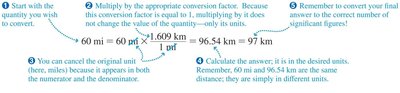
1 | Start with the quantity you wish to convert. |
2 | Multiply by the appropriate conversion factor(s). |
3 | Cancel the original units. |
4 | Calculate the answer in the desired units. |
5 | Round or adjust to the correct number of significant figures. |
Summary Table: Key Quantities in Kinematics
Quantity | Definition | Type | Formula |
|---|---|---|---|
Distance | Total path length traveled | Scalar | Sum of all path segments |
Displacement | Straight-line change in position | Vector | |
Average Speed | Distance / Time | Scalar | |
Average Velocity | Displacement / Time | Vector |
Additional info: These foundational concepts are essential for all subsequent topics in mechanics, including motion in one and two dimensions, forces, and energy analysis.
