 Indietro
Chapter 16: Heat Transfer – Mechanisms, Applications, and Control
Guida di studio - Note intelligenti
 Appunti personalizzati basati sui tuoi materiali, ampliati con definizioni chiave, esempi e contesto.
Heat Transfer
Overview of Heat Transfer Mechanisms
Heat transfer is the process by which thermal energy moves from a region of higher temperature to a region of lower temperature. The direction of heat flow is determined by the temperature difference between objects. There are three primary mechanisms by which heat is transferred: conduction, convection, and radiation.
Conduction: Requires a medium; energy is transferred via molecular collisions and electron movement without bulk movement of the medium.
Convection: Requires a medium; energy is transferred by the bulk movement of fluids (liquids or gases).
Radiation: Does not require a medium; energy is transferred by electromagnetic waves and can occur through a vacuum.
Comparison Table:
Mechanism | Requires Medium? | Bulk Movement? | Example |
|---|---|---|---|
Conduction | Yes | No | Heat through a metal rod |
Convection | Yes | Yes | Boiling water, ocean currents |
Radiation | No | No | Sunlight, heat from a fire |
Conduction
Mechanism and Factors Affecting Conduction
Conduction is the transfer of heat through a material without the movement of the material itself. It occurs due to molecular collisions and electron movement.
Good Conductors: Metals (e.g., copper) have loosely bound electrons, making them efficient at conducting heat.
Poor Conductors (Insulators): Materials like wood and plastic have tightly bound electrons and are poor conductors.
Thermal Conductivity (k): Quantifies how well a material conducts heat. High k means good conductor; low k means good insulator.
R-value: Used in building industry; the inverse of thermal conductivity. High R-value means better insulation.
Formula for Rate of Heat Transfer by Conduction: Where is thermal conductivity, Area is the surface area, Thickness is the wall thickness, and is the temperature difference.
Increasing wall thickness or insulation reduces heat transfer.
Reducing temperature difference between inside and outside also reduces heat transfer.
Convection
Natural and Forced Convection
Convection involves the transfer of heat by the movement of fluids (liquids or gases).
Natural Convection: Occurs due to temperature differences causing fluid movement (e.g., warm air rising above a candle).
Forced Convection: Occurs when an external force (like a fan) moves the fluid (e.g., furnace heating a house).
Convection is the dominant mechanism for heating homes and is responsible for ocean and atmospheric currents.
Radiation
Heat Transfer by Electromagnetic Waves
Radiation is the transfer of heat via electromagnetic waves and does not require a medium.
All objects emit and absorb electromagnetic radiation.
If an object emits more energy than it absorbs, its temperature drops (net emitter). If it absorbs more than it emits, its temperature rises (net absorber).
Objects at thermal equilibrium emit and absorb energy at equal rates.
The wavelength of emitted radiation is inversely proportional to temperature:
The frequency of peak emission is directly proportional to temperature:
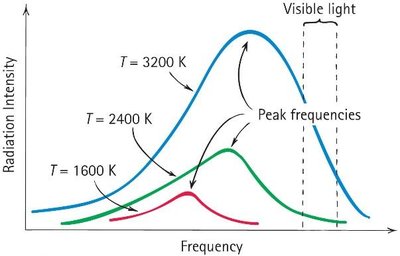 Example: The graph above shows radiation intensity as a function of frequency for three temperatures. Higher temperatures correspond to higher peak frequencies and shorter wavelengths.
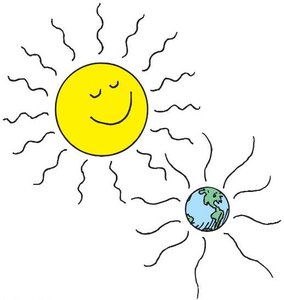 Example: The sun emits radiation at shorter wavelengths due to its higher temperature, while the earth emits at longer wavelengths.
Absorption and Reflection of Radiation
Dark surfaces are good absorbers and emitters of radiation; light surfaces are good reflectors.
Objects that absorb more radiation heat up faster.
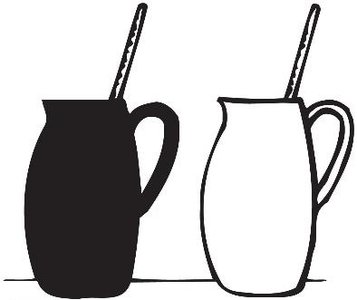 Example: A black pitcher heats up faster in sunlight than a white pitcher due to better absorption of electromagnetic energy.
The Greenhouse Effect
Mechanism and Implications
The greenhouse effect is the process by which the earth's atmosphere traps heat, maintaining a comfortable average temperature.
Short-wavelength radiation from the sun passes through the atmosphere (or glass in a greenhouse).
Objects inside absorb this energy and emit longer-wavelength radiation.
The atmosphere (or glass) blocks the longer-wavelength radiation, trapping heat inside.
Too much greenhouse effect leads to excessive warming, with serious consequences for life on earth.
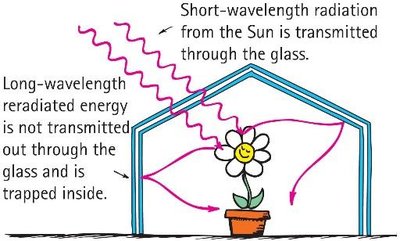 Example: The diagram above illustrates how short-wavelength sunlight enters a greenhouse, but long-wavelength reradiated energy is trapped, causing temperature to rise.
Newton's Law of Cooling
Rate of Cooling and Warming
Newton's law of cooling states that the rate at which an object cools (or warms) depends on the temperature difference between the object and its environment.
The greater the temperature difference, the faster the rate of cooling or warming.
As the object approaches the environment's temperature, the rate slows down.
Formula: Example: A hot pie cools faster in a freezer than on a countertop due to a larger temperature difference.
Controlling Heat Transfer: Thermos Bottles
Design and Function
Thermos bottles are designed to minimize heat transfer, keeping drinks hot or cold for extended periods.
Consist of inner and outer walls separated by a vacuum chamber.
The vacuum prevents heat transfer by conduction and convection.
Shiny surfaces reflect radiation, reducing heat loss by radiation.
The cap is made of insulating material to minimize heat transfer through the opening.
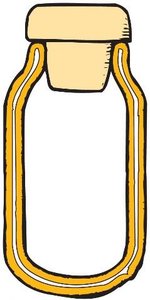 Example: The thermos bottle above uses a vacuum and reflective surfaces to keep drinks hot or cold by minimizing all forms of heat transfer.
Summary Table: Heat Transfer Mechanisms and Control
Mechanism | Medium Required? | Bulk Movement? | Control Method |
|---|---|---|---|
Conduction | Yes | No | Insulation, increase thickness |
Convection | Yes | Yes | Vacuum, block fluid movement |
Radiation | No | No | Reflective surfaces |
Additional info: Academic context was added to clarify formulas, mechanisms, and practical applications for exam preparation.
