 Indietro
Chapter 17: Superposition and Interference of Waves
Guida di studio - Note intelligenti
 Appunti personalizzati basati sui tuoi materiali, ampliati con definizioni chiave, esempi e contesto.
Superposition of Waves
Particles vs. Waves
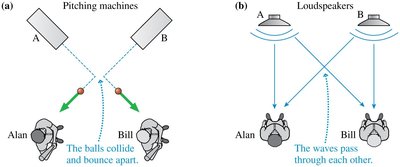
Understanding the difference between particle and wave interactions is fundamental in physics. When two particles occupy the same point in space at the same time, they collide and bounce apart. In contrast, waves can pass through each other without being permanently altered.
Particle Interaction: Collisions result in a change of motion for both particles.
Wave Interaction: Waves overlap and continue traveling as if the other was not present.
Superposition Principle: The displacement of the medium at any point is the sum of the displacements due to each individual wave.
The Principle of Superposition
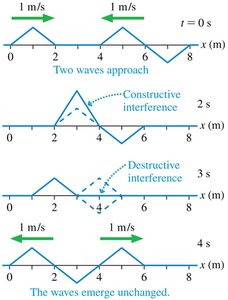
The principle of superposition states that when two or more waves are present at a single point, the resulting displacement is the algebraic sum of the individual displacements. This principle is crucial for understanding interference and standing waves.
Constructive interference occurs when displacements add to produce a larger amplitude.
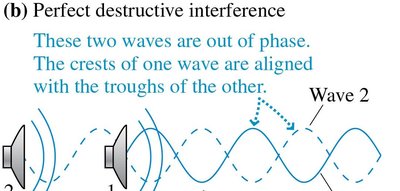
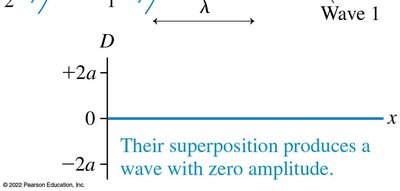
Destructive interference occurs when displacements add to produce a smaller (or zero) amplitude.
Standing Waves
Formation of Standing Waves
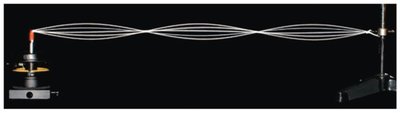
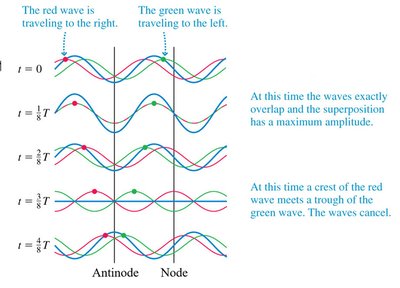
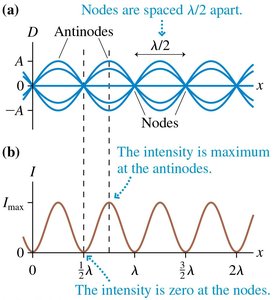
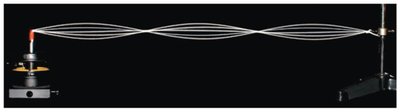
A standing wave is formed by the superposition of two waves of the same frequency, wavelength, and amplitude traveling in opposite directions. The resulting pattern appears stationary, with points of no motion (nodes) and points of maximum motion (antinodes).
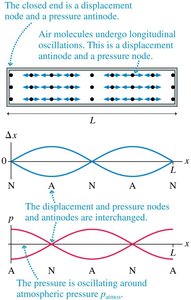
Nodes: Points that never move (zero amplitude).
Antinodes: Points of maximum oscillation.
The distance between adjacent nodes (or antinodes) is half a wavelength ().
Mathematics of Standing Waves
The displacement of a standing wave can be described mathematically as:
Right-traveling wave:
Left-traveling wave:
Net displacement:
Amplitude function:
Nodes occur at , where is an integer.
Energy in Standing Waves
In a standing wave, energy does not flow through the nodes; instead, it oscillates between kinetic and potential forms within each segment of the medium.
Real-World Example: Tacoma Narrows Bridge
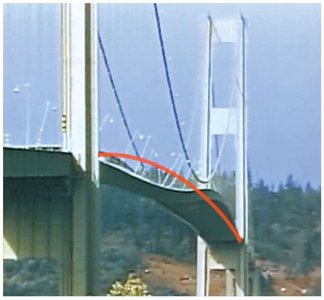
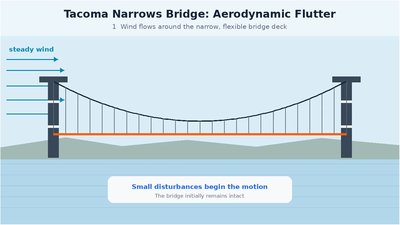
The collapse of the Tacoma Narrows Bridge is a famous example of resonance and standing waves in engineering. Aerodynamic forces caused the amplitude of a standing wave mode to increase dramatically, leading to structural failure.
Waves at Boundaries and Discontinuities
Wave Transmission and Reflection at a Discontinuity
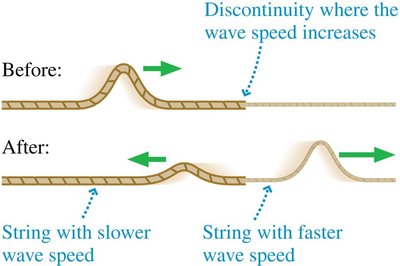
When a wave encounters a boundary between two media with different properties (e.g., different linear densities), part of the wave is transmitted and part is reflected.
If the wave speed increases at the boundary, the reflected pulse is upright.
If the wave speed decreases, the reflected pulse is inverted (phase change of ).
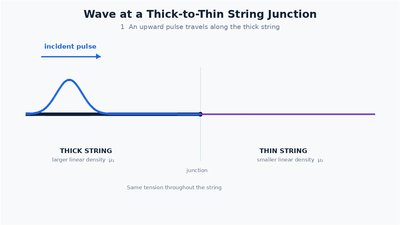
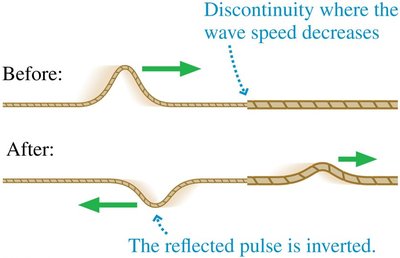
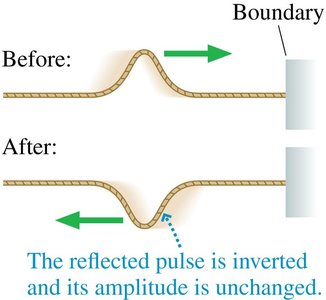
Wave Reflection at a Fixed Boundary
When a wave reflects from a fixed boundary, the reflected wave is inverted but retains the same amplitude.
Standing Waves on a String with Fixed Ends
Standing waves are established on a string fixed at both ends. The allowed wavelengths and frequencies are determined by the boundary conditions:
Allowed wavelengths: , where
Allowed frequencies:
The lowest frequency () is the fundamental frequency:
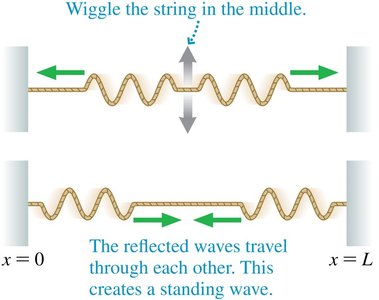
Standing Electromagnetic and Sound Waves
Standing Electromagnetic Waves
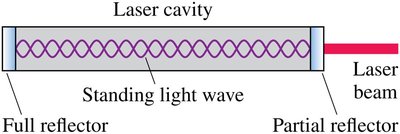
Standing electromagnetic waves can be established between two parallel mirrors, such as in a laser cavity. The mode number is determined by the cavity length and the wavelength of light.
Mode number:
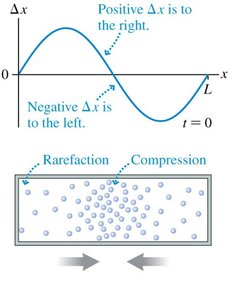
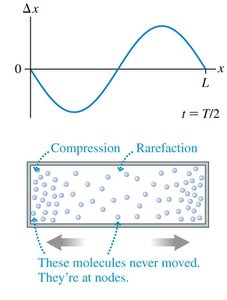
Standing Sound Waves in Tubes
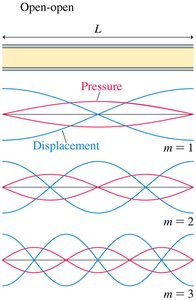
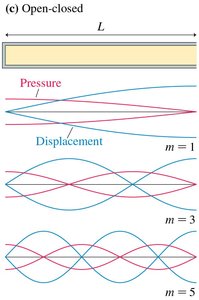
Longitudinal standing sound waves can form in tubes. The boundary conditions depend on whether the ends are open or closed:
Closed end: Displacement node, pressure antinode
Open end: Displacement antinode, pressure node
Modes in Tubes
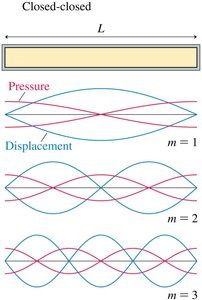
The allowed wavelengths and frequencies for standing waves in tubes depend on the boundary conditions:
Closed-Closed or Open-Open Tube: , ,
Open-Closed Tube: , ,
Applications: Musical Instruments
String Instruments
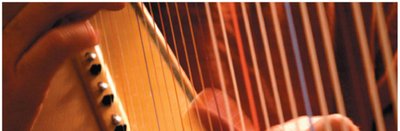
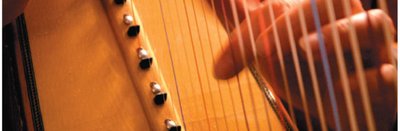
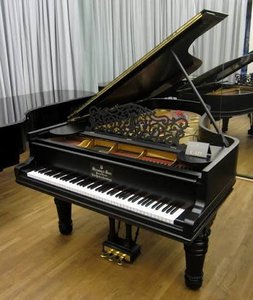
Stringed instruments such as harps, pianos, and violins use standing waves on strings to produce musical notes. The fundamental frequency is determined by the string's length, tension, and linear density:
Wind Instruments
Wind instruments create standing sound waves in tubes. The fundamental frequency depends on whether the tube is open at both ends or open at one end:
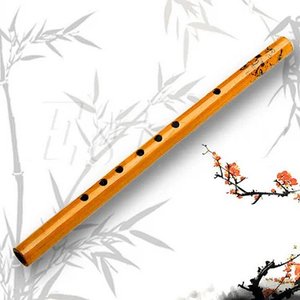
Open-Open Tube (e.g., flute):
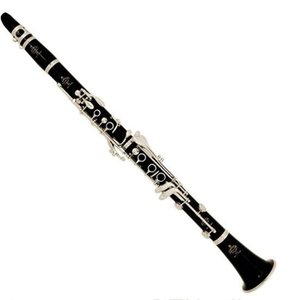
Open-Closed Tube (e.g., clarinet):
Interference of Waves
Interference in One Dimension
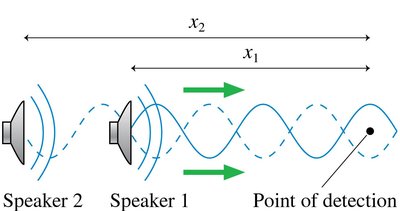
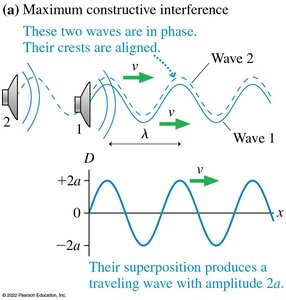
When two waves travel in the same direction, their superposition can result in constructive or destructive interference, depending on their relative phase.
Constructive Interference: Occurs when waves are in phase, resulting in maximum amplitude ().
Destructive Interference: Occurs when waves are out of phase by , resulting in zero amplitude ().
Mathematical Representation
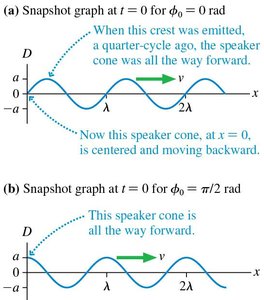
The displacement of a sinusoidal wave can be written as:
The phase constant determines the initial phase at .
Summary Table: Standing Waves in Different Systems
System | Allowed Wavelengths | Allowed Frequencies | Boundary Conditions |
|---|---|---|---|
String fixed at both ends | Nodes at both ends | ||
Open-open tube | Antinodes at both ends | ||
Open-closed tube | (m odd) | (m odd) | Node at closed end, antinode at open end |
