 Indietro
Chapter 25: The Electric Potential – Physics with Calculus Study Notes
Guida di studio - Note intelligenti
 Appunti personalizzati basati sui tuoi materiali, ampliati con definizioni chiave, esempi e contesto.
Electric Potential and Electrical Potential Energy
Conservative Nature of Electric Forces
Electric forces are conservative, meaning the work done by these forces is independent of the path taken. This property allows us to define a potential energy associated with electric forces, similar to gravitational potential energy.
Electrical potential energy is a scalar quantity.
Electrical potential (often called voltage) is defined as electrical potential energy per unit charge.
The voltage between two points is the difference in electrical potential between them.
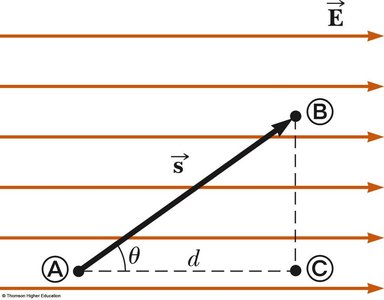
When a test charge q0 is placed in an electric field E, it experiences a force F = q0E. The work done in moving the charge is:
By definition,
This represents the change in electrical potential energy.
Potential Energy of Point Charges
The potential energy required to bring a charge q0 from infinity to a distance r from a point charge q is given by:
Where k is Coulomb's constant,
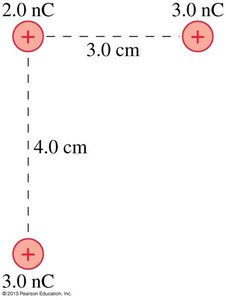
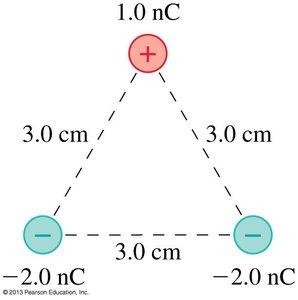
Example: Electric Potential Energy of a Group of Charges
To find the electric potential energy of a system of point charges, sum the potential energies for each pair:
Electrical Potential and Units
Definition and SI Units
Electrical potential (V) is defined as the potential energy per unit charge:
SI unit: volt (V), where
The potential difference is the work per unit charge required to move a test charge from point A to point B:
Electron-Volt
An electron-volt (eV) is a unit of energy commonly used in atomic and nuclear physics:
1 eV is the energy gained by a charge of magnitude e (elementary charge) when moved through a potential difference of 1 volt.
Electric Potential in a Uniform Field
Parallel-Plate Capacitor
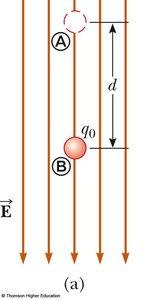
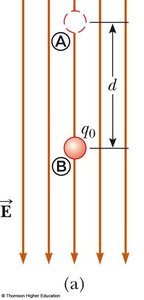
Inside a parallel-plate capacitor, the electric field is uniform and the potential drops linearly in the direction of the field lines.
Potential difference:
Where E is the electric field strength and d is the plate separation.
Equipotential Surfaces
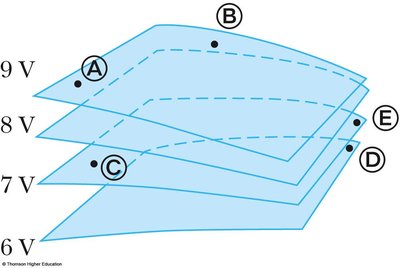
Equipotential surfaces are surfaces where every point has the same electric potential. In a uniform field, planes perpendicular to the field are equipotential surfaces.
Points B and C are at the same potential, lower than point A.
Moving along an equipotential surface requires no work.
Charged Particle in a Uniform Field
Motion and Energy Conservation
A positive charge released from rest in a uniform electric field moves in the direction of the field. The change in potential is negative along the field lines, and conservation of energy can be used to find its speed.
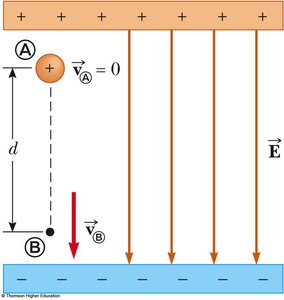
Example: Proton in a Capacitor
A proton fired from the midpoint of a capacitor may not have enough speed to reach the positive plate, but its speed as it collides with the negative plate can be calculated using energy conservation.

Electric Potential Due to Point Charges
Path Independence
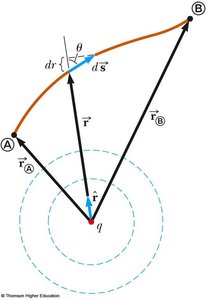
The potential difference between two points due to a point charge is independent of the path taken.
Electric Potential of a Point Charge
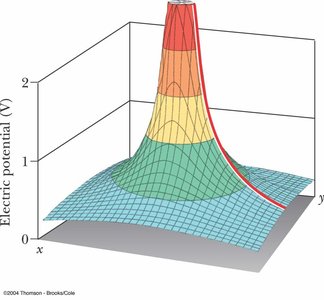
The electric potential at a distance r from a point charge q is:
Superposition Principle: Multiple Charges
The total electric potential due to several point charges is the sum of the potentials from each charge:
Electric Potential of a Dipole
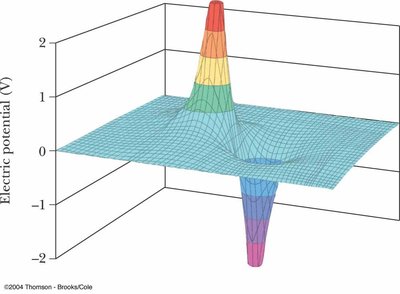
An electric dipole consists of two equal and opposite charges separated by a distance. The potential at a point depends on the positions and the dipole orientation.
Electric Potential from Continuous Charge Distributions
Uniformly Charged Ring
For a continuous charge distribution, the electric potential is calculated by integrating over the charge:
Electric Potential Due to Conductors
Charged Conductors
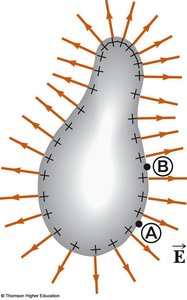
Inside a charged conductor, the electric field is zero and the potential is constant. The potential outside depends on the geometry and charge distribution.
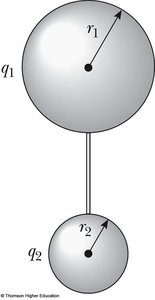
Connected Charged Spheres
When two charged spheres are connected, their potentials equalize. The relationship between their charges and radii is:
Applications and Phenomena
Corona Discharge
If the electric field near a conductor is strong enough, it can ionize air molecules, leading to corona discharge. This process is important in phenomena like lightning and sparks at gas stations.

Millikan Oil-Drop Experiment
Measuring the Elementary Charge
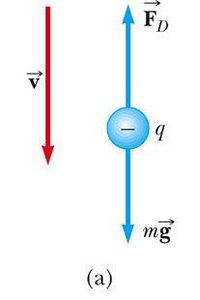
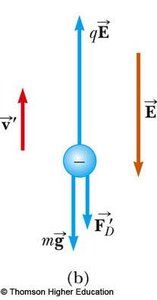
The Millikan oil-drop experiment determined the value of the elementary charge by balancing gravitational and electric forces on tiny oil droplets.
Setup: Oil droplets are sprayed into a chamber, and their motion is observed under the influence of an electric field.
Forces: (electric), (gravitational), and (drag).

Summary Table: Key Concepts in Electric Potential
Concept | Formula | SI Unit |
|---|---|---|
Electric Potential (V) | Volt (V) | |
Potential Difference | Volt (V) | |
Potential Energy (U) | Joule (J) | |
Electron-Volt (eV) | Joule (J) | |
Potential of Point Charge | Volt (V) | |
Superposition Principle | Volt (V) |
Additional info:
Some examples and diagrams were expanded for clarity and completeness.
Images were included only when directly relevant to the explanation.
