 Indietro
Chapter 38: Quantization – Study Notes for Physics with Calculus
Guida di studio - Note intelligenti
 Appunti personalizzati basati sui tuoi materiali, ampliati con definizioni chiave, esempi e contesto.
Quantization
Introduction to Quantization
Quantization is the process by which a continuous variable, such as energy, is restricted to discrete values. In classical physics, energy can take any value, but at the atomic scale, energy is quantized. This chapter explores how both light and matter exhibit quantized behavior, fundamentally changing our understanding of atomic and subatomic phenomena.
The Photon Model of Light
Photons and Energy Quantization
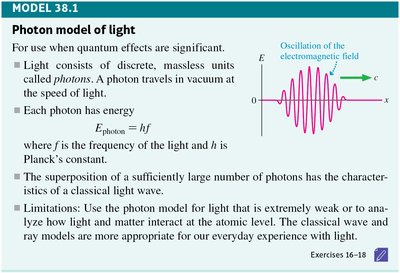
The photon model describes light as consisting of discrete, massless particles called photons. Each photon carries a quantum of energy proportional to the light's frequency:
Energy of a photon:
Planck's constant:
At low intensities, light is detected as individual photon events.
Consequences of the Photon Model
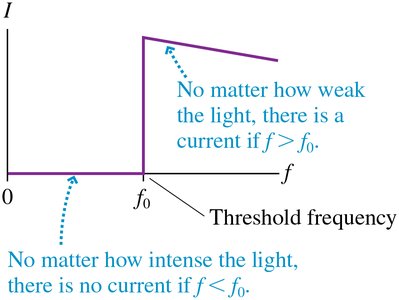
Photoelectric Effect: Short-wavelength light can eject electrons from a metal surface, but long-wavelength light cannot, regardless of intensity.
Compton Scattering: The wavelength of x-rays increases when they scatter from a target, explained by photon collisions.
The Photoelectric Effect
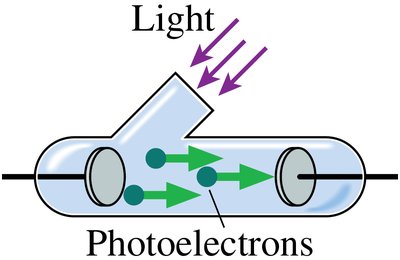
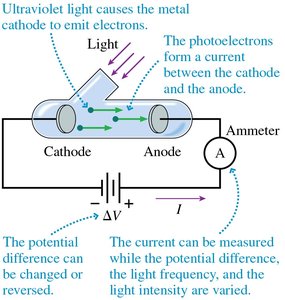
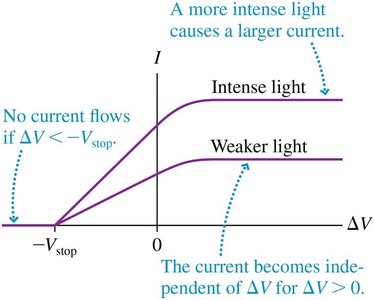
The photoelectric effect is the emission of electrons from a metal surface when illuminated by light of sufficient frequency. Key observations include:
Electrons (photoelectrons) are emitted only if the light frequency exceeds a threshold frequency .
The threshold frequency depends on the metal's work function .
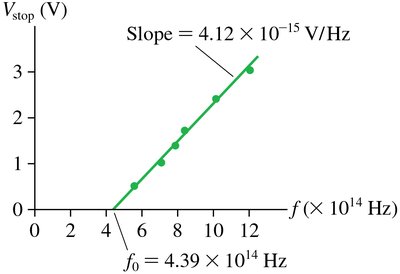
The current of photoelectrons can be stopped by applying a negative voltage (stopping potential ).
The Work Function and Stopping Potential
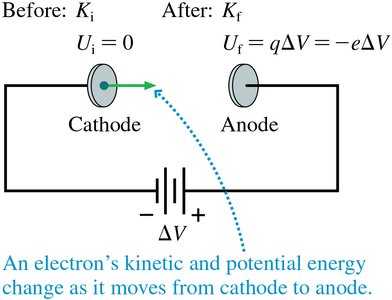
The work function is the minimum energy required to free an electron from a metal. The maximum kinetic energy of emitted electrons is:
The stopping potential is related to the maximum kinetic energy:
Einstein’s Explanation of the Photoelectric Effect
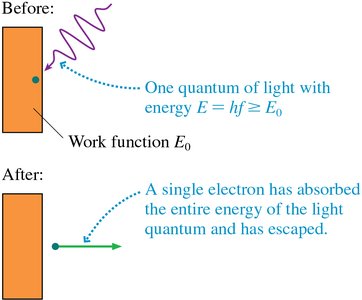
Einstein proposed that light energy is delivered in discrete packets (photons), each with energy . His postulates:
Light of frequency consists of photons, each with energy .
Photons are emitted or absorbed in whole units.
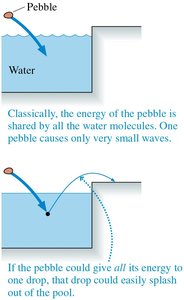
Each photon transfers its entire energy to a single electron.
Experimental Confirmation
Millikan's experiments measured the stopping potential as a function of light frequency, confirming Einstein's predictions and allowing precise determination of Planck's constant.
Summary Table: Work Functions of Selected Metals
Element | Work Function (eV) |
|---|---|
Potassium | 2.30 |
Sodium | 2.36 |
Aluminum | 4.28 |
Tungsten | 4.55 |
Copper | 4.65 |
Iron | 4.70 |
Gold | 5.10 |
Matter Waves and the de Broglie Hypothesis
de Broglie Wavelength
Louis de Broglie proposed that particles of matter, such as electrons, have wave-like properties. The wavelength associated with a particle of mass and velocity is:
de Broglie wavelength:
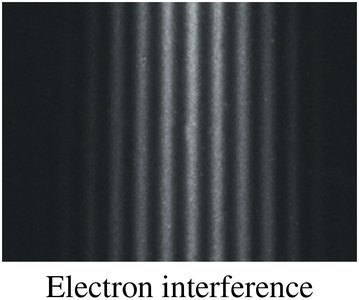
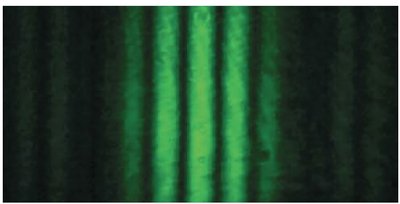
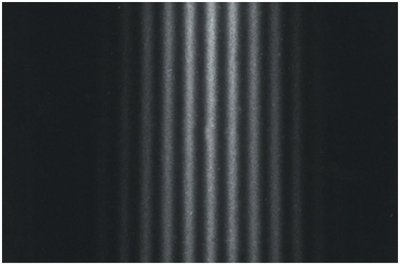
Double-Slit Experiment with Photons and Electrons
Both photons and electrons produce interference patterns in double-slit experiments, demonstrating their wave-like nature.
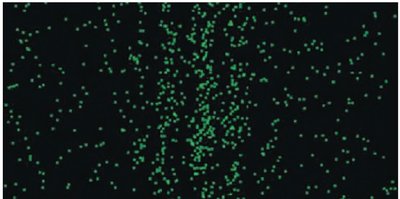
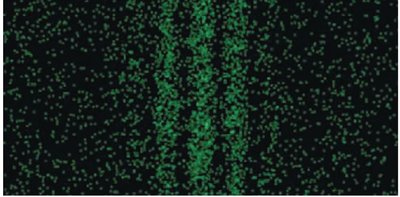
Particle in a Box and Energy Quantization
Standing Waves and Quantized Energy
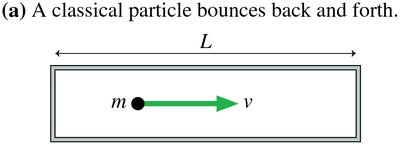
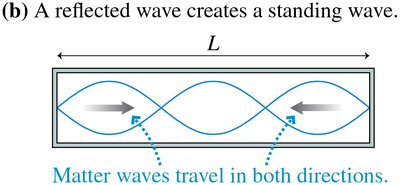
A particle confined in a one-dimensional box of length can only have certain allowed wavelengths and energies, forming standing waves:
Allowed wavelengths: ,
Allowed energies:
The integer is called the quantum number.
The Bohr Model of the Atom
Bohr’s Postulates
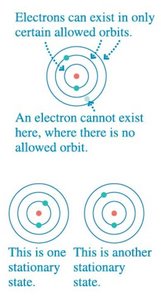
The Bohr model incorporates quantization into the structure of the atom:
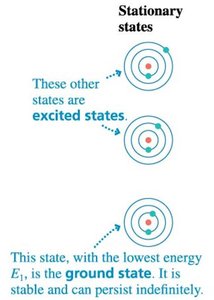
Electrons can only occupy certain allowed orbits (stationary states).
Each stationary state has a discrete energy .
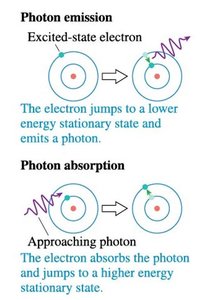
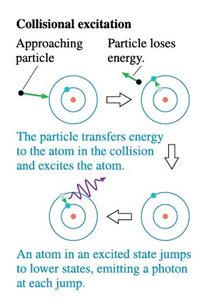
Transitions between states involve emission or absorption of a photon with energy equal to the difference between the states.
Quantization of Angular Momentum
The angular momentum of an electron in a Bohr orbit is quantized:
Bohr Radius and Energy Levels
Allowed orbital radii: , where nm is the Bohr radius.
Allowed energies:
Energy-Level Diagrams and Spectra
Energy-level diagrams show allowed energy states and possible transitions. The frequency and wavelength of emitted or absorbed photons are determined by the energy difference between states:
, where is the Rydberg constant
Summary of Key Equations
Photon energy:
de Broglie wavelength:
Photoelectric effect (maximum kinetic energy):
Stopping potential:
Particle in a box energies:
Bohr energy levels:
Applications
Photoelectric effect: Used in photodetectors and solar cells.
Atomic spectra: Basis for identifying elements in stars and laboratory plasmas.
Electron microscopy: Relies on the wave nature of electrons for high-resolution imaging.
