 Indietro
Chapter 39: Wave Functions and Uncertainty – Quantum Mechanics Foundations
Guida di studio - Note intelligenti
 Appunti personalizzati basati sui tuoi materiali, ampliati con definizioni chiave, esempi e contesto.
Wave Functions and Uncertainty
Introduction to Quantum Mechanics
Quantum mechanics is the branch of physics that describes the behavior of light and matter at the atomic and subatomic scale. Unlike classical mechanics, quantum mechanics relies on probabilistic predictions and introduces concepts such as wave functions and uncertainty. This chapter provides the foundational understanding necessary for later studies of atomic and nuclear physics.
Quantum mechanics explains phenomena that cannot be described by classical physics.
Its predictions are experimentally verified with remarkable precision.
Key concepts include the wave function, probability density, and the Heisenberg uncertainty principle.
Wave Function: Definition and Interpretation
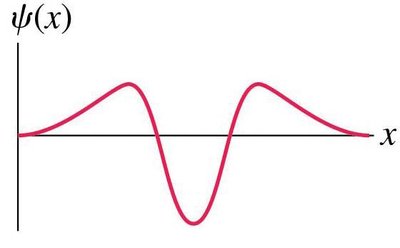
The wave function \( \psi(x) \) is a mathematical function describing the quantum state of a particle. It is oscillatory and can be used to make probabilistic predictions about the location of a particle, but nothing is physically waving.
\( \psi(x) \) is continuous and oscillatory.
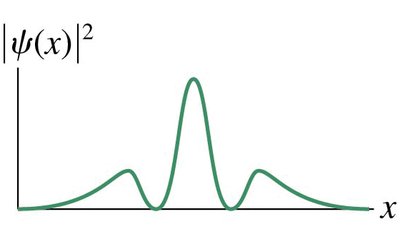
The probability density is given by \( |\psi(x)|^2 \).
The particle is most likely to be found near the maxima of \( |\psi(x)|^2 \).
Probability in Quantum Mechanics
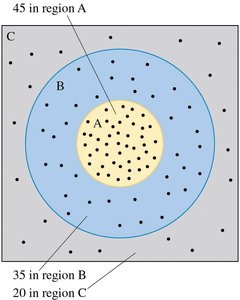
Quantum mechanics deals with probabilities rather than certainties. The probability of finding a particle in a region is determined by the wave function.
For N particles, if \( N_A \) are detected in region A, the probability is \( P_A = N_A / N \).
The sum of probabilities for all possible outcomes must equal 1.
The expected value for the number of particles in region A is \( N_A = N P_A \).
Wave-Particle Duality and the Double-Slit Experiment
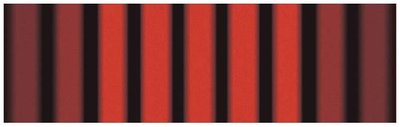
The double-slit experiment demonstrates the dual nature of light and matter. Both photons and electrons exhibit interference patterns, indicating wave-like behavior, but their detection is particle-like.
Interference patterns are observed for light, electrons, and neutrons.
Arrival at the detector is a discrete, particle-like event.
Interference is explained by the wave properties of the wave function.

Mathematical Description of Double-Slit Interference
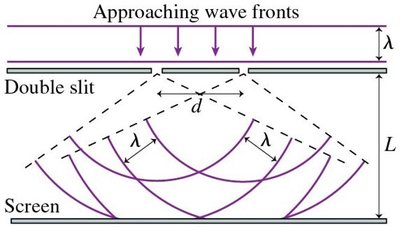
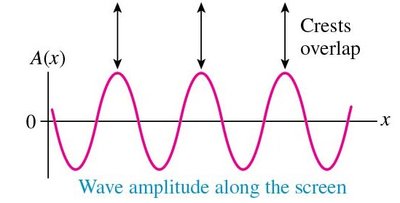
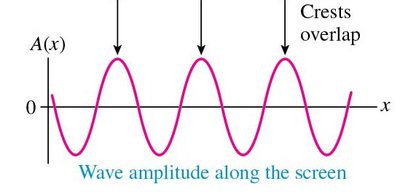
When light passes through a double slit, cylindrical wave fronts emanate from the slits. The amplitude and intensity at the screen are described mathematically:
Amplitude:
Intensity: , where C is a proportionality constant.
Probability Density and Its Analogy
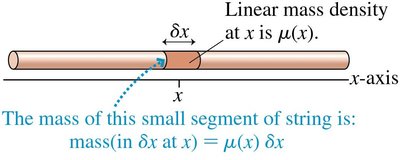
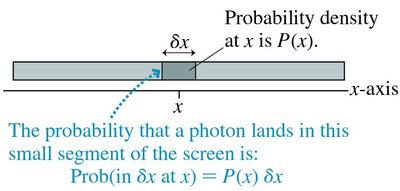
The probability density \( P(x) \) is analogous to linear mass density \( \mu(x) \) in classical physics. It describes the likelihood of finding a particle at position x.
Probability that a photon lands in a segment \( \delta x \) is \( P(x) \delta x \).
For mass density: mass in \( \delta x \) is \( \mu(x) \delta x \).
Example: Calculating Probability Density
Suppose 6000 out of 600,000 photons are detected in a 1.0-mm-wide strip at x = 50 cm. The probability density at this position is:
Probability:
Probability density:
Double-Slit Experiment with Electrons
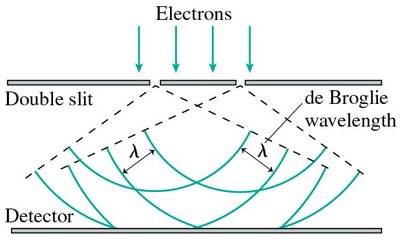
Electrons passing through two slits also produce interference fringes, confirming their wave-like nature. The probability density for finding an electron at x is:

Normalization of the Wave Function
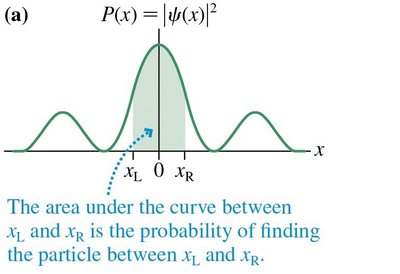
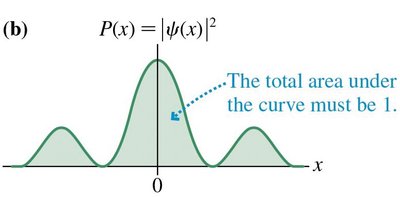
For the probability interpretation to be valid, the wave function must be normalized. The total probability of finding the particle somewhere on the x-axis must be 1.
Normalization condition:
Probability in interval :
Wave Packets
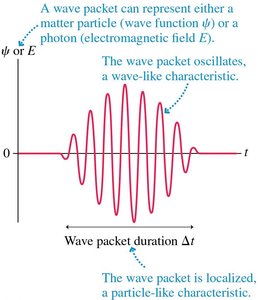
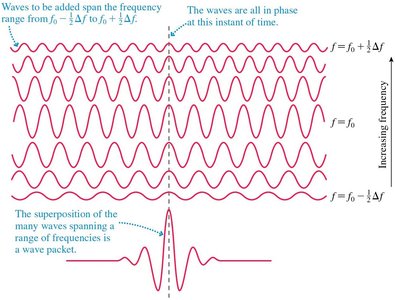
A wave packet is a localized wave formed by the superposition of many component waves. It exhibits both particle-like localization and wave-like oscillations.
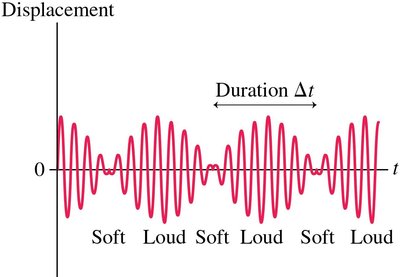
Superposition of waves with similar frequencies creates a beat pattern (wave packet).
Duration of one beat:
Bandwidth and Pulse Duration
Short-duration pulses used in digital communication must obey the relationship . The bandwidth is the range of frequencies that can be transmitted through a medium.
Shorter pulses require a larger range of frequencies.
Minimum pulse duration:
Uncertainty Principle: Frequency and Time
The uncertainty in frequency and time for a wave packet is governed by . This means it is impossible to specify both the exact frequency and exact arrival time simultaneously.
Narrow wave packets (localized in time) require a wide range of frequencies.
Wide wave packets (localized in frequency) are spread out in time.
The Heisenberg Uncertainty Principle
The Heisenberg uncertainty principle states that the position and momentum of a particle cannot both be known precisely. The uncertainties are related by:
As you try to pin down one quantity, the uncertainty in the other increases.
Example: Uncertainty of an Electron
If an electron is confined to a 0.1-nm-wide region, the uncertainty in its velocity is:
For nm, m/s
This uncertainty is about 1% of the speed of light, illustrating the significant effect at atomic scales.
Summary Table: Key Quantum Concepts
Concept | Definition | Equation |
|---|---|---|
Wave Function | Quantum state of a particle | |
Probability Density | Likelihood of finding a particle at x | |
Normalization | Total probability equals 1 | |
Heisenberg Uncertainty Principle | Limits precision of position and momentum | |
Wave Packet | Localized superposition of waves |
General Principles
The wave function \( \psi(x) \) is used to predict the probability of finding a particle in a region.
Probability density \( P(x) = |\psi(x)|^2 \) must be normalized.
The uncertainty principle sets fundamental limits on measurement precision.
