 Indietro
Currents, Resistance, and Ohm’s Law: Study Notes for Physics with Calculus
Guida di studio - Note intelligenti
 Appunti personalizzati basati sui tuoi materiali, ampliati con definizioni chiave, esempi e contesto.
Chapter 22: Currents, Resistance, and Ohm’s Law
Electric Potential and Electric Field
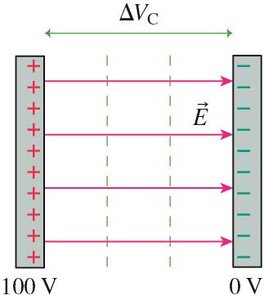
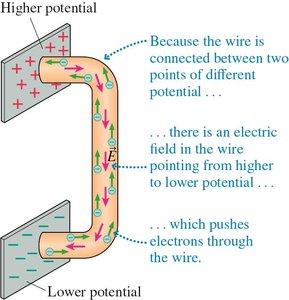
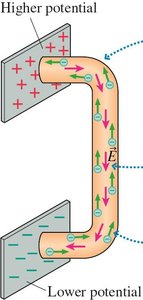
The electric potential and electric field are fundamental concepts that describe how charges move in conductors. The electric field always points from higher to lower potential, as seen in a parallel-plate capacitor.
Electric Potential (V): The energy per unit charge at a point in space.
Electric Field (\(\vec{E}\)): The force per unit charge, pointing “downhill” from higher to lower potential.
Relationship: \(\vec{E} = -\nabla V\)
Application: In a parallel-plate capacitor, the field is uniform between plates.
A Model of Current
Current is the movement of charge through a conductor, typically a metal wire. In metals, electrons are the charge carriers. The analogy of pushing an object across a table illustrates how friction (or resistance) opposes motion, requiring continuous force to maintain constant speed.
Conductor: Material through which charge easily moves.
Current: The flow of charge, usually electrons in metals.
Analogy: Like pushing an object against friction, maintaining current requires a continuous potential difference.
Creating a Current
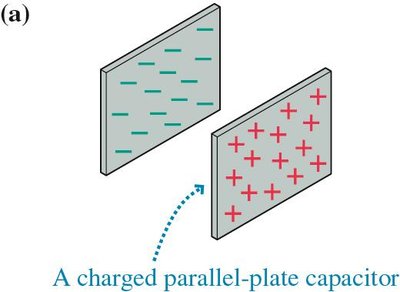
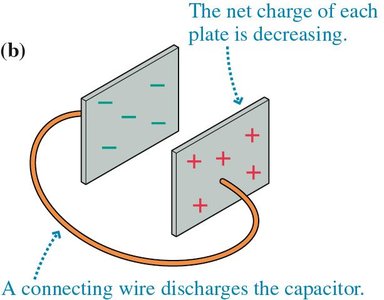
A potential difference across a wire creates an electric field that drives current. When the potential difference is gone, the field and current cease.
Potential Difference (\(\Delta V\)): Drives the electric field and current.
Discharging Capacitor: As plates discharge, potential difference decreases, stopping current.
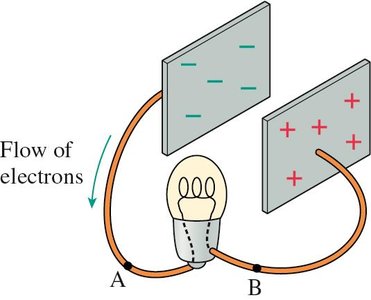
Law of Conservation of Current
The current entering any point in a circuit is equal to the current leaving that point. This is a statement of conservation of charge.
Conservation Law: Current is conserved at every point in a circuit.
Application: The current entering and leaving a lightbulb is the same.
Direction and Definition of Current
By convention, current is defined as the flow of positive charge, even though electrons (negative charges) are the actual carriers in metals. The direction of current is from higher to lower potential, or in the direction of the electric field.
Current Direction: From higher to lower potential.
Convention: Current is the flow of positive charge.
Definition of Current
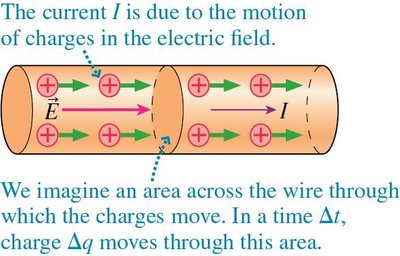
Current is the rate at which charge moves through a wire, measured in coulombs per second (ampere).
Formula: \(I = \frac{\Delta q}{\Delta t}\)
Unit: 1 ampere (A) = 1 coulomb/second (C/s)
Example: If 120 C of charge flows through a wire in one minute, the current is \(I = \frac{120\ \text{C}}{60\ \text{s}} = 2\ \text{A}\)
Conservation of Current at a Junction (Kirchhoff’s Junction Law)
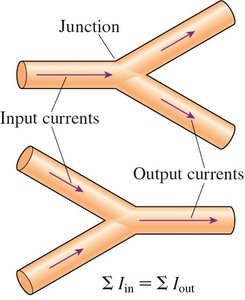
At any junction in a circuit, the sum of currents entering equals the sum of currents leaving. This is known as Kirchhoff’s junction law.
Kirchhoff’s Junction Law: \(\sum I_{\text{in}} = \sum I_{\text{out}}\)
Application: Used to analyze complex circuits.
Example: Currents in a Junction
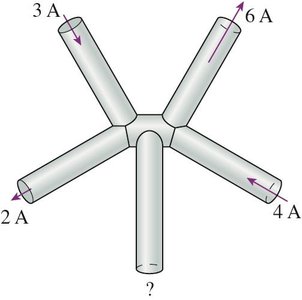
Given four wires with known currents at a junction, the fifth wire’s current can be found using Kirchhoff’s law.
Example: If three wires bring in 3 A, 2 A, and 6 A, and one wire takes out 4 A, the fifth wire must take out 7 A to conserve current.

Batteries and Electromotive Force (emf)
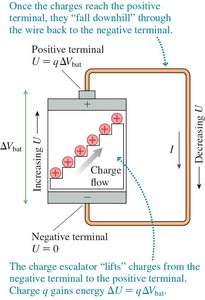
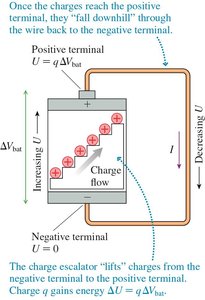
Batteries maintain a continuous flow of charge by separating positive and negative ions through chemical reactions. The potential difference provided by a battery is called electromotive force (emf).
Electromotive Force (\(\mathcal{E}\)): The potential difference a battery provides.
Unit: Volts (V)
Example: A 1.5 V battery has an emf of 1.5 V.
Batteries in Series
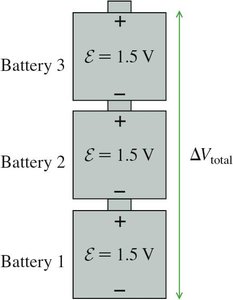
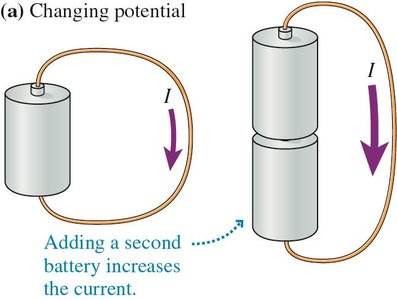
When batteries are connected in series, their potential differences add up to give a larger total potential difference.
Formula: \(\Delta V_{\text{total}} = \mathcal{E}_1 + \mathcal{E}_2 + \mathcal{E}_3\)
Example: Three 1.5 V batteries in series provide 4.5 V total.
Connecting Potential and Current
The current in a wire is determined by the potential difference across it and the wire’s properties. Increasing the potential difference increases the current.
Current Proportionality: Current increases with potential difference.
Wire Properties: Resistance affects how much current flows for a given potential difference.
Resistance and Ohm’s Law
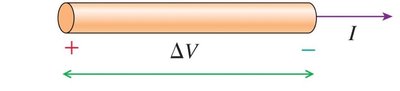
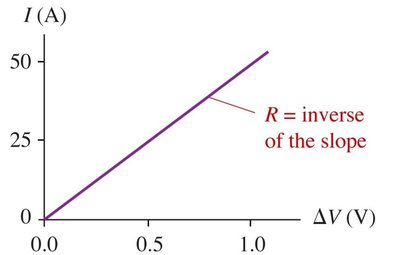
Resistance is a measure of how difficult it is to push charges through a wire. Ohm’s Law relates current, potential difference, and resistance.
Ohm’s Law: \(I = \frac{\Delta V}{R}\)
Resistance Formula: \(R = \frac{\Delta V}{I}\)
Unit: 1 ohm (Ω) = 1 V/A
Resistivity
Resistivity (\(\rho\)) is a property of materials that characterizes their ability to conduct electricity. Good conductors have low resistivity, while insulators have high resistivity.
Resistivity: \(\rho\) (Greek letter rho)
Good Conductors: Low \(\rho\) (e.g., copper)
Poor Conductors: High \(\rho\) (e.g., insulators)
Resistance of a Wire: Dependence on Dimensions and Material
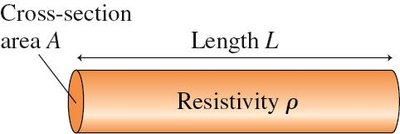
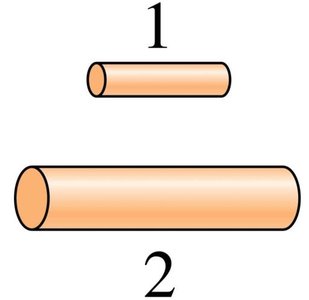
The resistance of a wire depends on its length, cross-sectional area, and the material’s resistivity.
Formula: \(R = \rho \frac{L}{A}\)
Length (L): Longer wires have higher resistance.
Area (A): Thicker wires have lower resistance.
Material: Different materials have different resistivities.

Summary Table: Key Relationships
Quantity | Symbol | Formula | SI Unit |
|---|---|---|---|
Current | I | A (ampere) | |
Potential Difference | \(\Delta V\) | — | V (volt) |
Resistance | R | Ω (ohm) | |
Resistivity | \(\rho\) | Ω·m | |
Electromotive Force | \(\mathcal{E}\) | — | V (volt) |
Additional info: These notes expand on the original slides by providing full academic explanations, formulas, and examples for each concept. All images included are directly relevant to the adjacent paragraphs and reinforce the educational content.
