 Indietro
Electric Charge and Coulomb’s Law: Foundations of Electrostatics
Guida di studio - Note intelligenti
 Appunti personalizzati basati sui tuoi materiali, ampliati con definizioni chiave, esempi e contesto.
Chapter 21: Electric Charge and Electric Field
21.1 Properties of Electric Charges
Electric charge is a fundamental property of matter that gives rise to electric forces and interactions. There are two types of electric charges: positive and negative. Like charges repel each other, while opposite charges attract. The study of how charges interact is called electrostatics.
Charge Conservation: The total electric charge in an isolated system remains constant. Charge can be transferred but not created or destroyed.
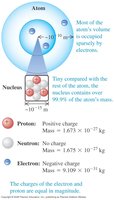
Quantization of Charge: Electric charge exists in discrete packets, with the elementary charge C being the smallest unit observed in isolation (carried by protons and electrons).
Structure of Matter: Atoms consist of a positively charged nucleus (protons and neutrons) surrounded by negatively charged electrons. The electric attraction between protons and electrons holds the atom together.
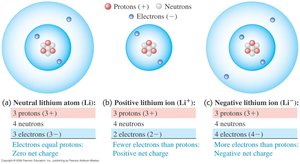
Ions: Atoms can gain or lose electrons, becoming negatively (anion) or positively (cation) charged ions, respectively.
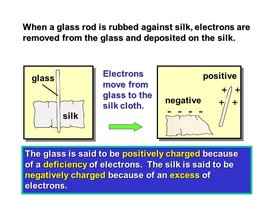
Example: Rubbing a glass rod with silk transfers electrons from the glass to the silk, making the glass positively charged and the silk negatively charged.
21.2 Charging Objects By Induction
Objects can be charged without direct contact through a process called induction. In this process, a charged object brought near a conductor causes a redistribution of charges within the conductor, which can then be separated by grounding.
Conductors: Materials (like metals) that allow free movement of electric charge.
Insulators: Materials (like rubber or glass) that do not allow free movement of charge.
Semiconductors: Materials with properties between conductors and insulators.
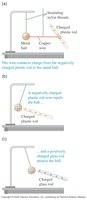
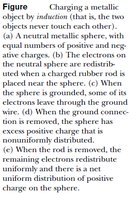
Charging by Induction: A negatively charged rod brought near a neutral metal sphere causes electrons in the sphere to move away, leaving a net positive charge near the rod. If the sphere is grounded, electrons leave the sphere, and when the ground is removed, the sphere is left with a net positive charge.
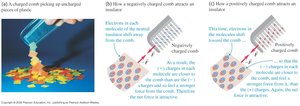
Polarization: Even in insulators, the charge distribution can shift slightly, causing neutral objects to be attracted to charged objects due to induced dipoles.
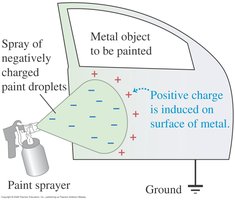
Application Example: Electrostatic painting uses induction to attract negatively charged paint droplets to a positively charged or grounded metal object, ensuring even coating and minimal waste.
21.3 Coulomb’s Law
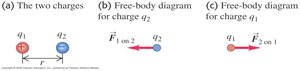
Coulomb’s Law quantifies the electric force between two point charges. The force is directly proportional to the product of the charges and inversely proportional to the square of the distance between them.
Mathematical Form:
where is Coulomb’s constant, and are the charges, and is the distance between them.
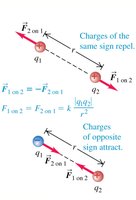
The force acts along the line joining the two charges.
Like charges repel; unlike charges attract.
Comparison with Gravitational Force: Both electric and gravitational forces are inverse-square laws, but electric forces are much stronger at atomic scales.
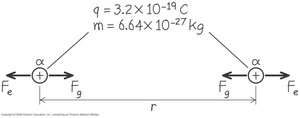
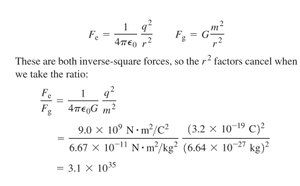
Example: The electric repulsion between two alpha particles is about times stronger than their gravitational attraction.
21.4 Superposition Principle and Resultant Force
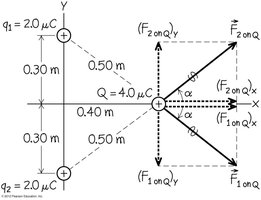
The superposition principle states that the net force on a charge due to a group of other charges is the vector sum of the individual forces exerted by each charge separately.
Forces are vectors and must be added using vector addition, not simple algebraic addition.
This principle applies to any number of charges in any configuration.
Example: Calculating the net force on a charge due to two or more other charges arranged in a line or in a plane.
Summary Table: Key Properties of Electric Charge
Property | Description |
|---|---|
Types | Positive (+), Negative (−) |
Conservation | Total charge in an isolated system is constant |
Quantization | Charge exists in integer multiples of C |
Force Law | Coulomb’s Law: |
Superposition | Net force is vector sum of individual forces |
Additional info:
Water’s polarity (due to its molecular structure) makes it an excellent solvent for ionic substances, which is crucial for biological processes and is related to the distribution of electric charge within the molecule.
Electrostatic phenomena are foundational for understanding more advanced topics such as electric fields, potential, and Gauss’s law.
