 Indietro
Electric Charge and Coulomb’s Law: Physics with Calculus Study Notes
Guida di studio - Note intelligenti
 Appunti personalizzati basati sui tuoi materiali, ampliati con definizioni chiave, esempi e contesto.
Units, Physical Quantities, and Vectors
Scalars and Vectors
In physics, quantities are classified as either scalars or vectors. Scalars have only magnitude, while vectors possess both magnitude and direction. Understanding the distinction is fundamental for analyzing physical phenomena.
Scalar: Examples include mass, temperature, and energy.
Vector: Examples include displacement, velocity, and force.
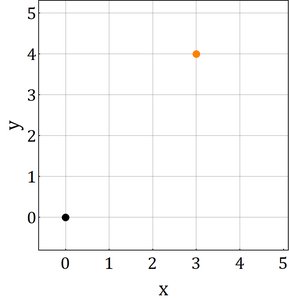
Vector notation: Vectors are often represented with arrows or boldface letters. The vector \( \vec{d} \) can be written in component form as \( \vec{d} = d_x \mathbf{i} + d_y \mathbf{j} \).
Magnitude: The length of a vector is given by \( |\vec{d}| = \sqrt{d_x^2 + d_y^2} \).
Direction: The angle \( \theta \) is found using \( \tan \theta = \frac{d_y}{d_x} \).
Vector Algebra
Vector operations are essential for solving physics problems. The main operations include addition, subtraction, dot product, and cross product.
Addition/Subtraction: Combine corresponding components.
Dot Product: Produces a scalar, \( \vec{A} \cdot \vec{B} = |A||B|\cos\theta \).
Cross Product: Produces a vector perpendicular to both, \( \vec{A} \times \vec{B} = |A||B|\sin\theta \mathbf{n} \).
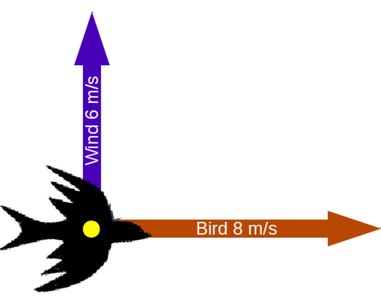
Example: If a bird flies east at 8 m/s and the wind blows north at 6 m/s, the resultant ground speed is found using vector addition.
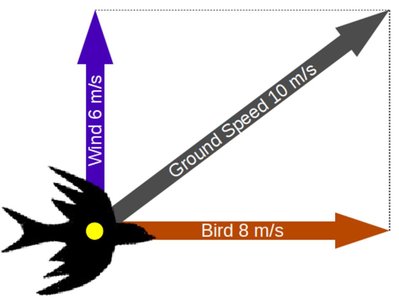
Resultant speed: \( v = \sqrt{8^2 + 6^2} = 10 \) m/s.
Electric Charge
Properties of Electric Charge
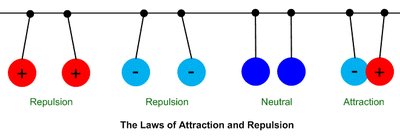
Electric charge is a fundamental property of matter that enables electromagnetic interactions. Charges can be positive or negative, and like charges repel while opposite charges attract.
Charge conservation: The net charge in an isolated system remains constant.
SI unit: The unit of charge is the Coulomb (C).
Symbol: Charge is denoted as \( Q \) or \( q \).
Historical Context
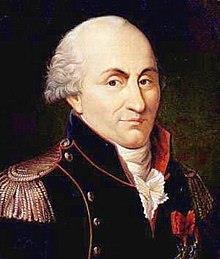
Charles-Augustin de Coulomb was a pioneer in the study of electric charge and formulated Coulomb's Law, which quantifies the force between charges.
Charge Transfer: Experiments
Different materials acquire charge through contact and friction. For example, rubbing fur with plastic or silk with glass results in charge transfer.
Fur and plastic: Fur becomes positively charged, plastic becomes negatively charged.
Silk and glass: Silk becomes negatively charged, glass becomes positively charged.
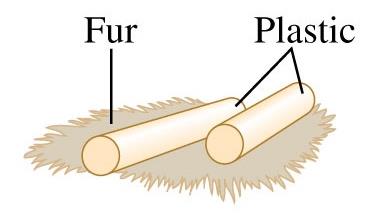
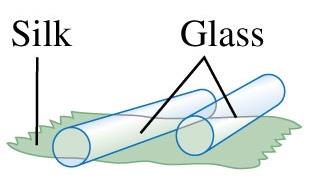
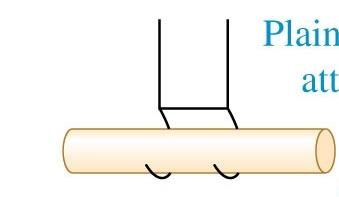
When two rods of the same material are rubbed and brought together, they repel due to like charges.
Microscopic Origin of Charge
Atomic Structure
Atoms consist of a nucleus (protons and neutrons) surrounded by electrons. Protons carry positive charge, electrons carry negative charge, and neutrons are neutral.
Electron: Mass \( m_e = 9.109 \times 10^{-31} \) kg, charge \( q_e = -1.602 \times 10^{-19} \) C.
Proton: Mass \( m_p = 1.673 \times 10^{-27} \) kg, charge \( q_p = +1.602 \times 10^{-19} \) C.
Neutron: Mass \( m_n \approx m_p \), charge = 0.
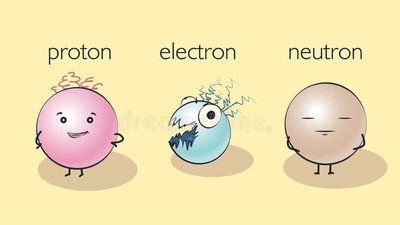
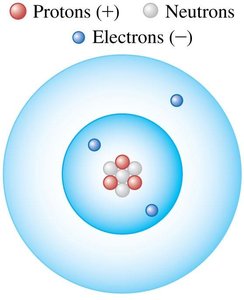
Atoms are electrically neutral when the number of protons equals the number of electrons.
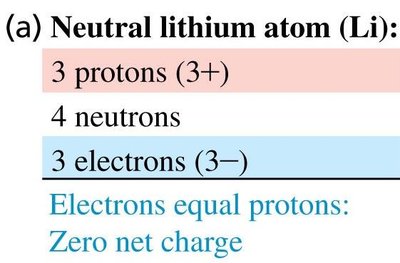
Ions
Atoms become ions by gaining or losing electrons:
Negative ion: Gains electrons (e.g., \( \text{Li}^- \)).
Positive ion: Loses electrons (e.g., \( \text{Li}^+ \)).
Conductors and Insulators
Definitions and Properties
Conductors allow easy movement of charge, while insulators do not. Metals are typical conductors; rubber and glass are common insulators.
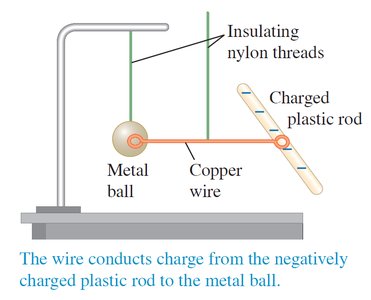
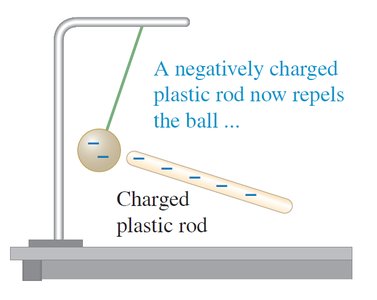
Conduction: Transfer of charge through direct contact.
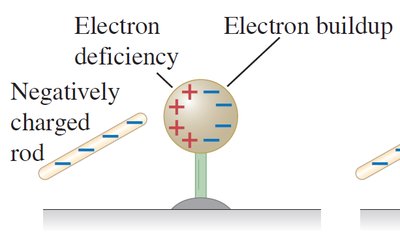
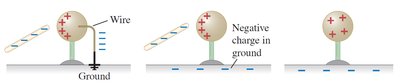
Induction: Redistribution of charge without direct contact.
Charging by Conduction
When a charged object touches a conductor, charge is transferred.
Charging by Induction
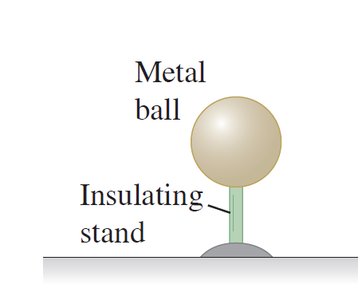
Induction involves bringing a charged object near a conductor, causing redistribution of charges within the conductor.
Zones of positive and negative charge form.
The conductor can attract the charged object.
Coulomb’s Law
Quantifying Electric Force
Coulomb’s Law describes the force between two point charges:
Formula:
Coulomb constant:
Electric constant:
Attractive force: Opposite signs of charge.
Repulsive force: Same signs of charge.
Steps for Calculating Coulomb Force
Identify \( r \) and \( \hat{r}_{12} \) (distance and unit vector).
Calculate magnitude:
Determine direction: if \( q_1 q_2 > 0 \), if \( q_1 q_2 < 0 \).
Example Problem
Given three charges at specified coordinates, calculate the net force on \( q_3 \):
\( q_1 = +1.5 \times 10^{-3} \) C at (0,0)
\( q_2 = -0.5 \times 10^{-3} \) C at (0,0.5)
\( q_3 = +0.2 \times 10^{-3} \) C at (-1.2,0)
Step 1: Find position vectors and unit vectors.
Step 2: Calculate force magnitudes:
Step 3: Assign directions based on charge signs.
Step 4: Use superposition principle:
Example: Calculating the net force on a charge using vector addition and Coulomb’s Law.
Quantity | Value |
|---|---|
Coulomb constant (k) | 8.988 × 10⁹ N·m2/C2 |
Elementary charge (e) | 1.602 × 10⁻¹⁹ C |
Electron mass (me) | 9.109 × 10⁻³¹ kg |
Proton mass (mp) | 1.673 × 10⁻²⁷ kg |
Additional info: The notes expand on vector operations, atomic structure, and charge transfer to provide a comprehensive overview suitable for exam preparation in Physics with Calculus.
