 Indietro
Electric Charge and Electric Field: Foundations and Applications
Guida di studio - Note intelligenti
 Appunti personalizzati basati sui tuoi materiali, ampliati con definizioni chiave, esempi e contesto.
Electric Charge
Nature of Electric Charge
Electric charge is a fundamental property of matter that gives rise to electric forces and fields. It is not a substance but a property that certain particles possess. There are two types of electric charge: positive and negative. A body is electrically neutral if the sum of all its charges is zero.
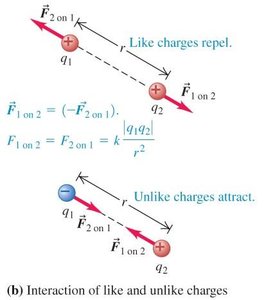
Like charges repel each other; opposite charges attract.
Charge is quantized: it exists in discrete amounts, with the elementary unit of charge being C.
Charge is conserved: it cannot be created or destroyed, only transferred.

Example: Static electricity can cause hair to stand on end due to the repulsion of like charges distributed along the hair strands.
Atomic Structure and Charge
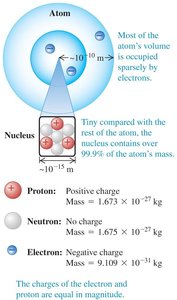
Atoms consist of a nucleus containing protons (positive charge) and neutrons (no charge), surrounded by electrons (negative charge). The charges of protons and electrons are equal in magnitude but opposite in sign.
Proton:
Electron:
Neutron: $0$
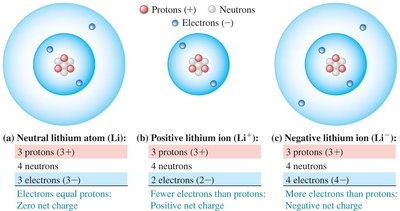
Example: In a neutral lithium atom, the number of protons equals the number of electrons, resulting in zero net charge.
Experiments with Electric Charge
Everyday materials such as plastic, silk, rubber, glass, and fur can be used to demonstrate the fundamental behaviors of electric charge. Rubbing these materials can transfer electrons, resulting in charged objects that attract or repel each other.
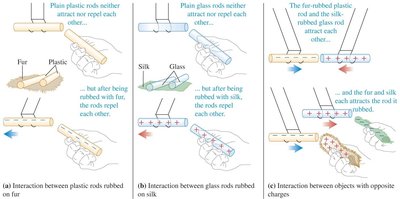
Example: Rubbing a plastic rod with fur transfers electrons to the rod, making it negatively charged.
Conductors, Insulators, and Semiconductors
Classification of Materials
Materials are classified based on their ability to allow the movement of electric charge:
Conductors: Allow free movement of charges (e.g., metals).
Insulators: Do not allow free movement of charges (e.g., rubber, glass).
Semiconductors: Have properties between conductors and insulators; their conductivity can be tuned.
Charge Movement by Conduction and Induction
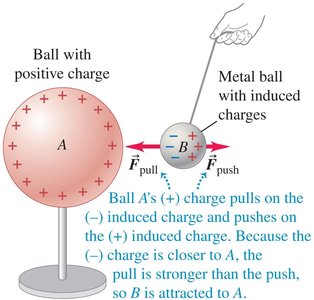
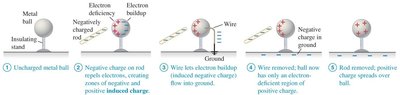
Charge can be transferred by direct contact (conduction) or by bringing a charged object near another object (induction), causing a redistribution of charges without direct contact.
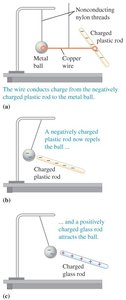
Example: A charged rod can induce a separation of charges in a nearby neutral object, leading to attraction or repulsion.
Polarization and Induced Charge
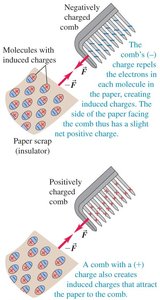
Polarization occurs when the charges within an object are redistributed due to the presence of a nearby charged object. This can result in induced charges that cause attraction even if the objects are overall neutral.
Example: A negatively charged comb can attract small pieces of paper by inducing a positive charge on the side of the paper closest to the comb.

Coulomb's Law
Electric Force Between Point Charges
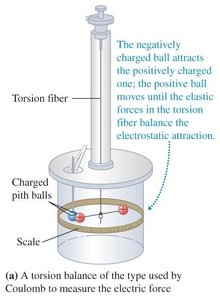
Coulomb's Law quantifies the force between two point charges:
is the magnitude of the force between charges and separated by distance .
N·m2/C2 is Coulomb's constant.
The force is attractive if the charges are opposite, repulsive if they are the same.
Superposition Principle
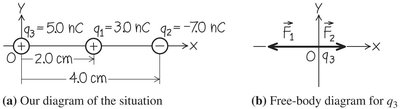
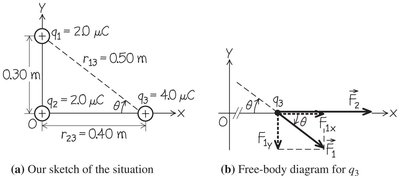
The net force on a charge due to multiple other charges is the vector sum of the individual forces exerted by each charge.
Electric Field
Definition and Properties
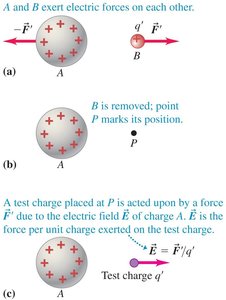
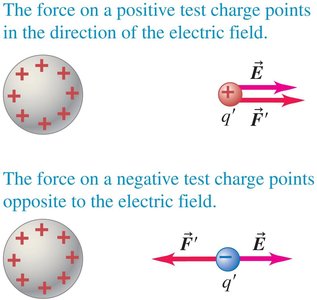
The electric field at a point in space is defined as the force per unit positive test charge placed at that point:
The direction of is the direction of the force on a positive test charge.
The electric field due to a point charge at a distance is:
Electric Field Lines
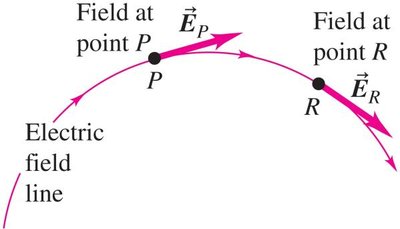
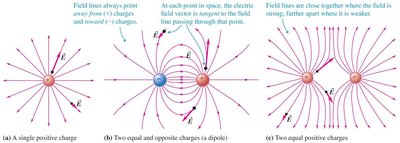
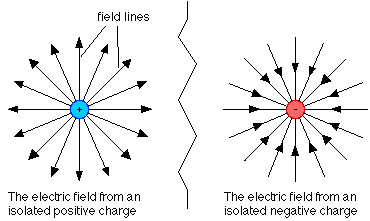
Electric field lines provide a visual representation of the direction and strength of the electric field. Field lines point away from positive charges and toward negative charges. The density of lines indicates the field's strength.
Electric Field Due to Multiple Charges and Continuous Distributions
The net electric field at a point is the vector sum of the fields due to all charges. For continuous charge distributions, calculus is used to integrate the contributions from each infinitesimal charge element.
Point charge:
Dipole (on axis): , where
Ring of charge (on axis):
Disc of charge (on axis):
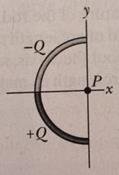
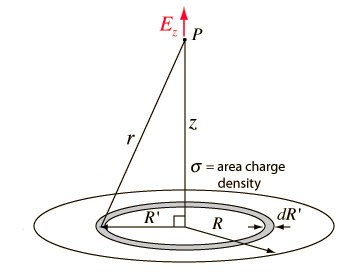
Force on a Charge in an Electric Field
Motion of Charges in Uniform Electric Fields
A charged particle in a uniform electric field experiences a constant force:
This force can cause the particle to accelerate, and its trajectory can be analyzed using Newton's laws and kinematics.
Electric Dipoles in Electric Fields
Torque and Potential Energy
An electric dipole in a uniform electric field experiences no net force but does experience a torque that tends to align the dipole with the field. The torque and potential energy are given by:
Summary Table: Key Concepts
Concept | Definition/Formula |
|---|---|
Electric Charge | Property of matter; quantized in units of |
Coulomb's Law | |
Electric Field (point charge) | |
Force on Charge | |
Dipole Moment | |
Torque on Dipole | |
Potential Energy (Dipole) |
Practice and Application
Estimate the number of electrons in a typical human body using Avogadro's number and the composition of water.
Calculate the force between two people with a 1% excess of electrons at arm's length using Coulomb's Law.
Analyze the motion of a charged particle in a uniform electric field between parallel plates.
Determine the electric field at various points due to different charge configurations using symmetry and calculus.
