 Indietro
Electric Charges and Fields: Structured Study Notes
Guida di studio - Note intelligenti
 Appunti personalizzati basati sui tuoi materiali, ampliati con definizioni chiave, esempi e contesto.
Electric Charges and Fields
Introduction to Electrostatics
Electrostatics is the branch of physics that studies forces, fields, and potentials arising from static (non-moving) electric charges. Everyday phenomena such as sparks from synthetic clothes, lightning, and shocks from touching metal objects are explained by the discharge of accumulated static electricity.
Static Electricity: Refers to electric charges at rest.
Electrostatics: The study of static electric charges and their interactions.
Example: Lightning during thunderstorms is a large-scale discharge of static electricity.
Electric Charge
Electric charge is a fundamental property of matter, discovered through experiments such as rubbing amber with wool. There are two types of charges: positive and negative. Like charges repel, unlike charges attract.
Polarity: The property distinguishing positive and negative charges.
Electrification: Objects acquire charge through rubbing, which can be neutralized by contact.
Conservation: Charges are transferred, not created or destroyed.
Example: Glass rod rubbed with silk becomes positively charged; silk becomes negatively charged.
Conductors, Insulators, and Semiconductors
Materials are classified based on their ability to allow electric charge to move:
Conductors: Allow free movement of charges (e.g., metals, human body).
Insulators: Resist charge movement (e.g., glass, plastic, wood).
Semiconductors: Intermediate behavior between conductors and insulators.
Basic Properties of Electric Charge
Additivity: Total charge is the algebraic sum of individual charges.
Conservation: Total charge in an isolated system remains constant.
Quantisation: Charge is always an integer multiple of the elementary charge C.
Example: The charge on a body is , where is an integer.
Coulomb’s Law
Coulomb’s law quantifies the force between two point charges:
Formula:
Vector Form:
Permittivity of Free Space:
Comparison: Electric forces are much stronger than gravitational forces between elementary particles.
Superposition Principle
The force on a charge due to multiple other charges is the vector sum of individual forces:
Formula:
Example: Forces in a system of three charges are added vectorially.
Electric Field
An electric field is produced by a charge and exerts a force on other charges placed in its vicinity:
Definition:
Force Relation:
Direction: Outward for positive charges, inward for negative charges.
Unit: Newton per Coulomb (N/C)
Electric Field Due to Multiple Charges
The electric field at a point due to a system of charges is the vector sum of fields due to each charge:
Formula:
Electric Field Lines
Electric field lines are a pictorial representation of the electric field:
Properties:
Start at positive charges, end at negative charges.
Never cross each other.
Density indicates field strength.
Do not form closed loops.
Example: Field lines around a dipole show attraction and repulsion.
Electric Flux
Electric flux measures the number of electric field lines passing through a surface:
Definition:
Total Flux:
Unit: N·m2/C
Electric Dipole
An electric dipole consists of two equal and opposite charges separated by a distance:
Dipole Moment:
Field on Axis:
Field on Equatorial Plane:
Physical Significance: Polar molecules have permanent dipole moments.
Dipole in a Uniform External Field
A dipole in a uniform electric field experiences a torque:
Torque:
Net Force: Zero in uniform field; nonzero in non-uniform field.
Continuous Charge Distribution
Charge can be distributed over a line, surface, or volume:
Linear Density:
Surface Density:
Volume Density:
Gauss’s Law
Gauss’s law relates the electric flux through a closed surface to the charge enclosed:
Statement:
Gaussian Surface: Any closed surface used to apply Gauss’s law.
Applications: Useful for symmetric charge distributions.
Applications of Gauss’s Law
Infinite Line Charge:
Infinite Plane Sheet:
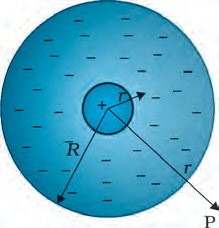
Thin Spherical Shell:
Outside:
Inside:
Summary Table: Key Physical Quantities
Physical Quantity | Symbol | Dimensions | Unit | Remarks |
|---|---|---|---|---|
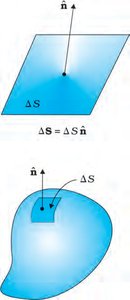
Vector area element | ΔS | [L2] | m2 | ΔS = ΔS ˆn |
Electric field | E | [MLT-3A-1] | V/m | Vector quantity |
Electric flux | φ | [ML3T-3A-1] | V·m | φ = E ΔS |
Dipole moment | p | [LTA] | C·m | Vector from -q to +q |
Linear charge density | λ | [L-1TA] | C/m | Charge/length |
Surface charge density | σ | [L-2TA] | C/m2 | Charge/area |
Volume charge density | ρ | [L-3TA] | C/m3 | Charge/volume |
Points to Ponder
Protons are held together in the nucleus by the strong force, not by electrostatic repulsion.
Coulomb force can be attractive or repulsive; gravity is always attractive.
Charge is a scalar and is conserved; quantisation is a fundamental law.
Superposition principle is not obvious; it excludes multi-body forces.
Electric field due to a charge configuration with total charge zero falls off faster than .
Practice Exercises
Calculate forces, fields, and flux for various charge configurations using the formulas above.
Apply Gauss’s law to symmetric distributions for efficient calculation of electric fields.
Relevant Images
Description: Illustrates the concept of vector area element and its normal direction, essential for understanding electric flux and Gauss's law.
Description: Shows a spherical charge distribution and the Gaussian surface used in applying Gauss's law to find the electric field inside and outside a sphere.
Additional info: The notes above expand on brief textbook points, providing full academic context, definitions, formulas, and examples for self-contained study. All equations are formatted in LaTeX for clarity. Only images directly relevant to the explanation of electric flux and Gauss's law are included.
