 Indietro
Electric Field Calculations for Continuous Charge Distributions
Guida di studio - Note intelligenti
 Appunti personalizzati basati sui tuoi materiali, ampliati con definizioni chiave, esempi e contesto.
Electric Field Calculations for Continuous Charge Distributions
Introduction to Continuous Charge Distributions
In electrostatics, the electric field produced by a continuous distribution of charge is calculated by dividing the distribution into infinitesimal elements, determining the field due to each element, and integrating over the entire distribution. This approach is essential for objects where charge is not concentrated at a single point but spread over a line, surface, or volume.
Point Charge: All charge is concentrated at a single location.
Continuous Distribution: Charge is spread over a region (line, surface, or volume).
Conductors: Charge resides on the surface.
Insulators: Charge is distributed throughout the volume.
Key Principle: The electric field at a point due to a charge distribution is the vector sum (integral) of the fields due to all infinitesimal charge elements.
Charge Density Concepts
To facilitate calculations, charge densities are defined:
Linear charge density (\( \lambda \)): Charge per unit length (C/m).
Surface charge density (\( \sigma \)): Charge per unit area (C/m2).
Volume charge density (\( \rho \)): Charge per unit volume (C/m3).
General Method for Calculating Electric Field
Divide the charge distribution into infinitesimal elements (\( dq \)).
Calculate the electric field \( d\vec{E} \) due to each element at the point of interest using Coulomb's Law:
Integrate \( d\vec{E} \) over the entire charge distribution to find the total electric field \( \vec{E} \).
Electric Field of a Charged Line Segment
Field on the Axis of a Uniformly Charged Rod
Consider a rod of length \( \ell \) with uniform linear charge density \( \lambda \) and total charge \( Q \). The electric field at a point \( P \) located a distance \( a \) from one end along the axis is found by integrating the contributions from each infinitesimal segment.
Charge element:
Distance from element to point:
Electric field due to element:
Total field:
Special Case: If \( a \gg \ell \), the rod appears as a point charge and .
Field of a Uniformly Charged Line Segment (2D)
For a line segment along the y-axis from \( y = -a \) to \( y = a \), the field at a point on the x-axis (distance \( x \) from the origin) is calculated by integrating the x- and y-components of the field from each segment.
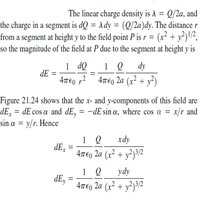
Special Case: For \( x \gg a \), the field again approximates that of a point charge.
Electric Field of a Ring of Charge
On-Axis Field of a Uniformly Charged Ring
A ring of radius \( R \) with total charge \( Q \) produces an electric field along its axis (z-axis). By symmetry, only the axial (z) components add; radial components cancel.
Charge element:
Distance to point:
Field at point on axis:
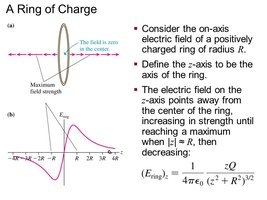
Special Cases:
At the center (\( z = 0 \)): (by symmetry).
For \( z \gg R \): (point charge behavior).
Electric Field of a Uniformly Charged Disk
On-Axis Field of a Uniformly Charged Disk
A disk of radius \( R \) with uniform surface charge density \( \sigma \) can be considered as a set of concentric rings. The field at a point on the axis (distance \( x \) from the center) is found by integrating the contributions from each ring.
Area of ring:
Charge on ring:
Field at point:
Total field: Integrate from to
Special Case: For \( R \gg x \), the disk behaves as an infinite sheet and (uniform field).
Electric Field of Two Oppositely Charged Infinite Sheets
Parallel Infinite Sheets
Two infinite sheets with surface charge densities \( +\sigma \) and \( -\sigma \) are placed parallel to each other, separated by distance \( d \). The electric field is calculated by superposing the fields from each sheet.
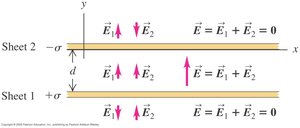
Between the sheets: (uniform and directed from + to - sheet)
Outside the sheets: (fields cancel)
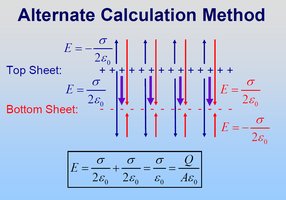
Alternate Calculation Method
The field from each sheet is , and the total field is the sum of contributions from both sheets.
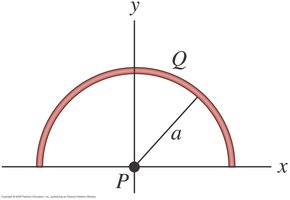
Electric Field of a Semicircular Arc of Charge
Field at the Center of Curvature
For a uniformly charged semicircular arc, the electric field at the center of curvature is found by integrating the contributions from each infinitesimal segment. By symmetry, the horizontal components cancel, and the field points along the y-axis.
Summary Table: Electric Field Expressions for Common Charge Distributions
Distribution | Field Expression | Special Case |
|---|---|---|
Point Charge | Radial field | |
Infinite Line | Perpendicular to line | |
Infinite Sheet | Uniform field | |
Parallel Sheets | Between sheets | |
Ring (on axis) | Zero at center |
Key Takeaways
Divide the charge distribution into small elements.
Calculate the field due to each element using Coulomb's Law.
Integrate (vector sum) over the entire distribution to find the total field.
Symmetry simplifies calculations for many geometries.
