Indietro
Electric Flux and Gauss’s Law: Concepts, Applications, and Conductors
Guida di studio - Note intelligenti
 Appunti personalizzati basati sui tuoi materiali, ampliati con definizioni chiave, esempi e contesto.
Chapter 22: Electric Flux and Gauss’s Law
The Basic Definition of Flux
Flux is a measure of how much of a field (such as electric or velocity field) passes through a given surface. In physics, the concept of flux is used to quantify the flow of a vector field through a surface, and it is foundational for understanding electric flux and Gauss’s Law.
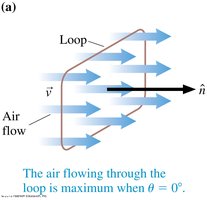
Physical Analogy: Imagine holding a rectangular wire loop of area A in front of a fan. The amount of air flowing through the loop each second depends on the angle between the loop and the direction of airflow.
Maximum Flux: The flow is maximum when the loop is perpendicular to the airflow (angle θ = 0°).
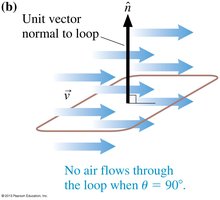
Zero Flux: No air passes through the loop if it is parallel to the flow (angle θ = 90°).
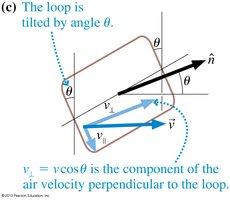
General Case: The volume of air flowing through the loop each second depends on the angle θ between the loop normal and the velocity of the air. The effective component is v⊥ = v \cos \theta.
Mathematical Expression: For a uniform field and flat surface, the flux Φ is given by:
The Electric Flux
Electric flux quantifies the number of electric field lines passing through a surface. It is a scalar quantity and is central to Gauss’s Law.
Definition: The electric flux through a surface of area A in a uniform electric field \vec{E} is:
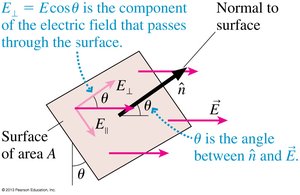
θ is the angle between the electric field and the normal to the surface.
Gauss’s Law
Statement and Physical Meaning
Gauss’s Law relates the electric flux through a closed surface to the net charge enclosed by that surface. It is a fundamental law in electrostatics and is especially powerful for calculating electric fields with high symmetry.
Gaussian Surface: An imaginary closed surface used to apply Gauss’s Law. For a point charge, this is often a sphere centered on the charge.
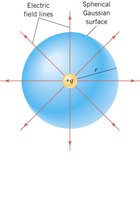
Generalization: The law holds for any closed surface, not just spheres. The total flux through any closed surface equals the net charge enclosed divided by the permittivity of free space \varepsilon_0.
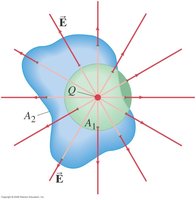
Mathematical Statement:
Superposition Principle: If multiple charges are enclosed, the total flux is proportional to the algebraic sum of the enclosed charges.
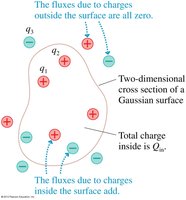
Electric Flux of Multiple Charges
For a group of charges, only those inside the Gaussian surface contribute to the net electric flux. Charges outside the surface do not affect the total flux through the surface.
Key Point: The flux due to charges outside the surface is zero; only enclosed charges matter.
Symmetry and Gauss’s Law
Gauss’s Law is most useful for charge distributions with high symmetry. The three most important symmetries are:
Spherical Symmetry: Charge distributed uniformly over a sphere.
Cylindrical Symmetry: Charge distributed along a long straight wire.
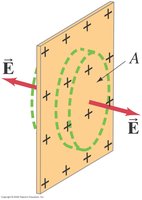
Planar Symmetry: Charge distributed over a large flat plane.
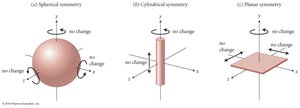
For these cases, the electric field can be calculated directly using Gauss’s Law.
Applications of Gauss’s Law
Infinite Plane: For a very large, thin, non-conducting plane with surface charge density σ, the electric field near the plane is:
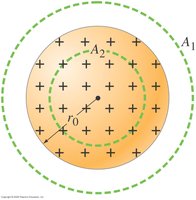
Uniformly Charged Sphere: For a sphere of radius r0 with total charge Q:
Outside the sphere (r > r0):
Inside the sphere (r < r0):
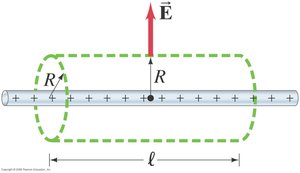
Long Straight Wire: For a wire with linear charge density λ, the electric field at distance R from the wire is:
Summary Table: Symmetry and Gaussian Surfaces
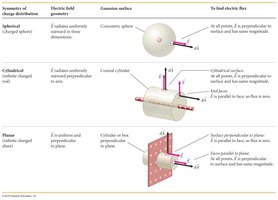
The following table summarizes the appropriate Gaussian surfaces and methods for common charge distributions:
Symmetry of Charge Distribution | Electric Field Geometry | Gaussian Surface | To Find Electric Flux |
|---|---|---|---|
Spherical (charged sphere) | E radiates outward, same in all directions | Concentric sphere | E is perpendicular to surface and has same magnitude |
Cylindrical (charged wire) | E radiates outward, same at given radius | Coaxial cylinder | E is perpendicular to surface, parallel to axis, flux is zero through ends |
Planar (charged sheet) | E is uniform and perpendicular to plane | Cylinder or box, perpendicular to plane | Flux passes through ends, not sides |
Conductors in Electrostatic Equilibrium
Properties of Conductors
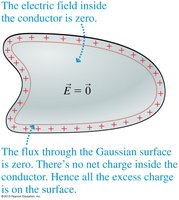
When a conductor is in electrostatic equilibrium, the electric field inside the conductor is zero. Any excess charge resides on the surface, and the field just outside the surface is perpendicular to it.
Key Point: The electric field inside a conductor is zero; otherwise, free charges would move.
Surface Charge: All excess charge is located on the surface.
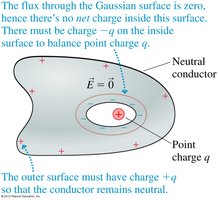
Charge Inside a Cavity: If a charge is placed inside a cavity within a conductor, an equal and opposite charge is induced on the inner surface, and the same amount of charge appears on the outer surface to keep the conductor neutral.
Faraday Cages
A Faraday cage is a conducting enclosure that blocks external static and non-static electric fields. It is used to shield sensitive equipment or people from electric fields.
Screening: The conducting box redistributes charges on its surface to cancel external fields inside the enclosure.
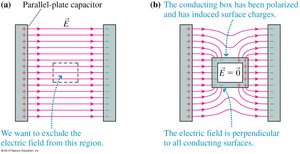
Application Example: Faraday cages are used in laboratories and for personal protection from high-voltage discharges.

Electric Fields and Conductors
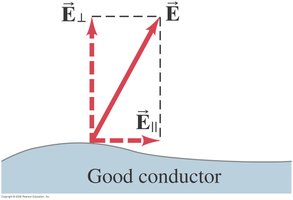
The electric field at the surface of a conductor is always perpendicular to the surface. If it were not, charges would move along the surface until equilibrium is reached.
Surface Field: The magnitude of the electric field just outside a conductor is given by:
where σ is the surface charge density.