 Indietro
Electric Potential and Electric Field: Chapter 26 Study Notes
Guida di studio - Note intelligenti
 Appunti personalizzati basati sui tuoi materiali, ampliati con definizioni chiave, esempi e contesto.
Electric Potential and Electric Field
Connecting Force, Field, Potential Energy, and Potential
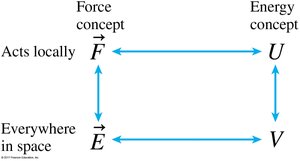
The concepts of force, field, potential energy, and electric potential are fundamental in understanding electrostatics. Force and potential energy are closely related, as are electric field and electric potential. The electric field acts everywhere in space, while force acts locally. Potential energy and electric potential are energy concepts, with potential energy acting locally and electric potential defined everywhere in space.
Force (\(\vec{F}\)): Acts locally on charges.
Electric Field (\(\vec{E}\)): Defined everywhere in space, describes the force per unit charge.
Potential Energy (\(U\)): Energy concept, acts locally.
Electric Potential (\(V\)): Energy per unit charge, defined everywhere in space.
Finding the Potential from the Electric Field
The electric potential difference between two points can be determined from the electric field. The potential difference \(\Delta V\) is given by the negative integral of the electric field along a path from the initial to the final point:
Equation:
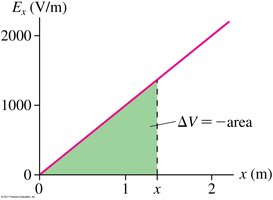
Graphical Interpretation: The area under the electric field curve (with respect to position) gives the negative of the potential difference.

Example 26.1: Finding the Potential
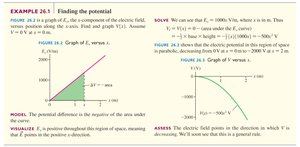
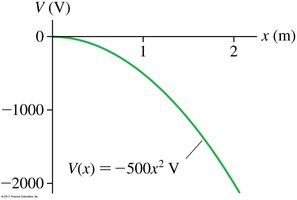
This example demonstrates how to find the electric potential from a given electric field graph. The potential difference is the negative of the area under the electric field curve.
Model: The potential difference is the negative of the area under the electric field curve.
Solution: Integrate the electric field over the region of interest.
Result: The electric field points in the direction in which the potential is decreasing.
Equation: For a linear electric field,
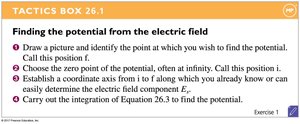
Tactics: Finding the Potential From the Electric Field
To find the potential from the electric field, follow these steps:
Draw a picture and identify the point at which you wish to find the potential (position f).
Choose the zero point of the potential, often at infinity (position i).
Establish a coordinate axis from i to f along which you know or can determine the electric field component \(E_s\).
Carry out the integration of the electric field to find the potential.
Finding the Potential of a Point Charge
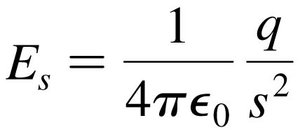
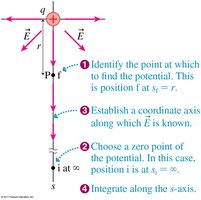
The electric field of a point charge is radial and given by:
Equation:
Potential:
Integration: The potential at a distance r from a point charge is found by integrating the electric field from infinity to r.


Example 26.2: The Potential of a Parallel-Plate Capacitor
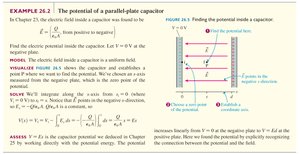
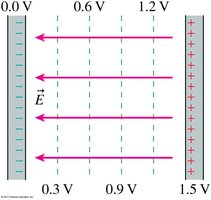
This example illustrates how to find the electric potential inside a parallel-plate capacitor. The electric field between the plates is uniform, and the potential difference is proportional to the plate separation.
Equation:
Potential Difference: where d is the plate separation.
Application: For a field of 1500 V/m and plate separation of 1 mm, the potential difference is 1.5 V.
Finding the Electric Field from the Potential
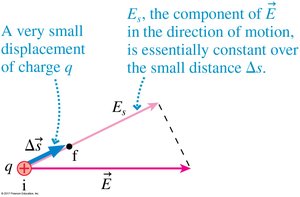
The electric field can be determined from the spatial variation (slope) of the electric potential. For two points separated by a small distance \(\Delta s\), the electric field in the s-direction is:
Equation:
In the limit \(\Delta s \to 0\):
Work:
Example 26.4: Finding E From the Slope of V
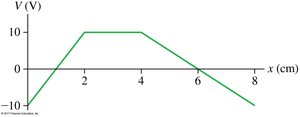
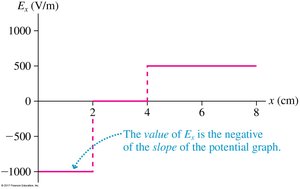
This example shows how to find the electric field from the slope of the potential graph. The electric field is the negative of the slope of the potential graph.
Model: The electric field is the negative of the slope of the potential graph.
Solution: Calculate the slope of the potential graph at different regions.
Result: The electric field points to the left if it is negative, and is zero in regions where the potential is not changing.
Summary Table: Relationships Between Electric Field and Potential
The following table summarizes the key relationships between electric field and electric potential:
Concept | Equation | Description |
|---|---|---|
Potential Difference | Negative integral of electric field along path | |
Electric Field from Potential | Negative spatial derivative of potential | |
Point Charge Potential | Potential at distance r from point charge | |
Parallel-Plate Capacitor | Potential difference across plates |
Key Takeaways
Electric potential is related to the electric field by integration.
Electric field is related to the spatial derivative of the potential.
For a point charge, the potential decreases with distance from the charge.
For a parallel-plate capacitor, the potential difference is proportional to the electric field and plate separation.
