 Indietro
Electrostatics: Electric Charges and Forces
Guida di studio - Note intelligenti
 Appunti personalizzati basati sui tuoi materiali, ampliati con definizioni chiave, esempi e contesto.
Chapter 22: Electric Charges and Forces
Introduction to Electrostatics
Electrostatics is the study of electric charges at rest, their interactions, and the forces they exert on each other. This chapter introduces the fundamental concepts of electric charge, the behavior of charged objects, and the basic laws governing their interactions.
Electric Charge: Basic Concepts
What is Electric Charge?
Electric charge is a fundamental property of matter responsible for electric phenomena. There are two types of charge: positive and negative. The basic charges of ordinary matter are carried by protons (positive) and electrons (negative). Charging is the process of transferring electrons from one object to another.
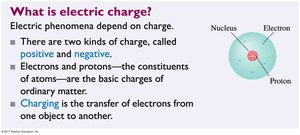
Positive charge: Conventionally assigned to objects like glass rods rubbed with silk.
Negative charge: Conventionally assigned to objects like plastic rods rubbed with wool.
Charging: The transfer of electrons, typically by friction, contact, or induction.
Why are Electric Charges Important?
Understanding electric charges is foundational for modern technology, including electronic devices and communications. The principles of how objects become charged and interact underpin much of electricity and magnetism.
Experimental Discovery of Electric Charge
Neutral Objects and Charging by Friction
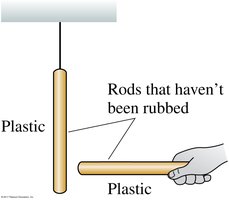
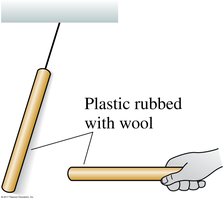
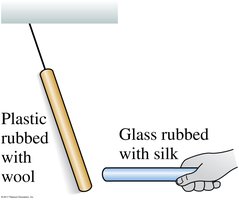
Experiments show that objects can be neutral (no net charge) or charged by friction. For example, rubbing a plastic rod with wool imparts a charge, causing it to interact with other objects.
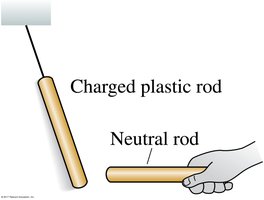
Neutral objects do not exert forces on each other.
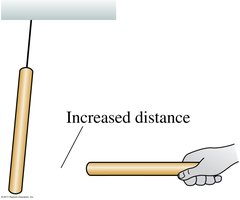
Charged objects can attract or repel each other depending on the type of charge.
Attraction and Repulsion
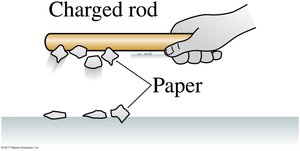
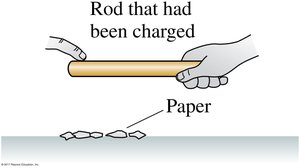
Like charges repel, and opposite charges attract. Charged objects can also attract neutral objects due to induced polarization.
Types of Charge
There are only two types of charge: one like plastic (negative) and one like glass (positive). No third type of charge exists.
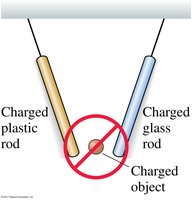
Charge Model
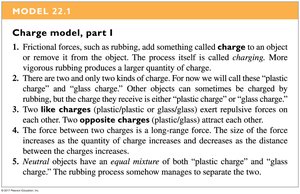
Charge Model, Part I
The charge model summarizes the behavior of electric charge:
Frictional forces can add or remove charge from objects.
There are two types of charge: positive and negative.
Like charges repel; opposite charges attract.
The force between charges is long-range and decreases with distance.
Neutral objects have equal amounts of both types of charge.
Charge Model, Part II
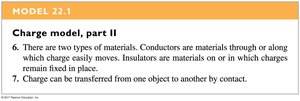
Materials are classified as conductors or insulators based on how easily charge moves through them. Charge can be transferred by contact.
Atomic Structure and Charge
Atoms and Electricity
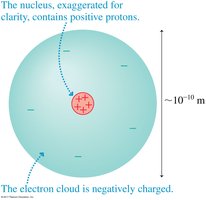
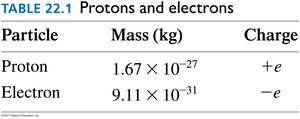
An atom consists of a dense nucleus (protons and neutrons) surrounded by electrons. The atom is held together by the electric force between the positive nucleus and negative electrons. The fundamental unit of charge is .
Ionization and Molecular Ions
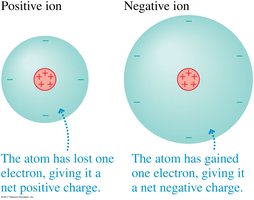
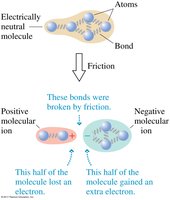
Ionization is the process of removing or adding electrons to an atom, creating ions. Molecular ions can be formed by breaking bonds in molecules, as occurs when charging objects by friction.
Conductors and Insulators
Definitions and Properties
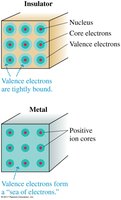
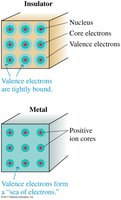
Conductors allow charge to move freely, while insulators do not. In metals, electrons are free to move, forming a 'sea of electrons.' In insulators, electrons are tightly bound to nuclei.
Transferring and Discharging Charge
Charging by Contact
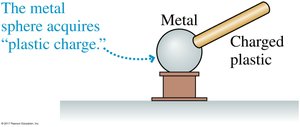
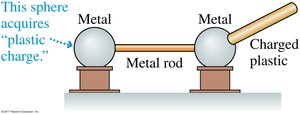
Charge can be transferred from one object to another by direct contact. For example, touching a charged rod to a metal sphere transfers charge to the sphere.
Discharging
Discharging is the removal of charge from an object, often by touching it with a finger, allowing charge to flow away.
Conductors and Charge Distribution
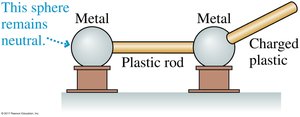
When two conductors are connected by a conductor, charge can move between them and distribute evenly. If connected by an insulator, charge does not move.
Summary Table: Protons and Electrons
Particle | Mass (kg) | Charge |
|---|---|---|
Proton | + | |
Electron | - |
Key Properties of Electric Charge
There are two types of charge: positive and negative.
Like charges repel; opposite charges attract.
Charge is quantized in units of .
Charge is conserved in all processes.
Practice and Application
Clicker Questions and Reasoning
A charged rod attracts neutral objects due to induced polarization.
When two conductors are touched together, charge redistributes based on their initial charges and sizes.
There is always an attractive force between a charged object and a neutral object.
Additional info:
This summary covers the foundational concepts of electrostatics, including experimental observations, the atomic model of charge, and the classification of materials. It is suitable for college-level Physics with Calculus students preparing for exams or seeking a concise review of Chapter 22: Electric Charges and Forces.
