 Indietro
Equilibrium and Newton’s Second Law: Inclined Planes and Pulley Systems
Guida di studio - Note intelligenti
 Appunti personalizzati basati sui tuoi materiali, ampliati con definizioni chiave, esempi e contesto.
Equilibrium and Newton’s Second Law
Introduction to Equilibrium and Newton’s Second Law
Understanding equilibrium and Newton’s Second Law is fundamental in analyzing the motion of objects, especially in systems involving inclined planes and pulleys. These concepts are essential for solving problems in classical mechanics, particularly when forces act in multiple directions.
Non-Equilibrium Example: Snowboarder on an Inclined Plane
Problem Setup and Free-Body Diagram
Consider a snowboarder with mass m = 72.9\ \mathrm{kg} gliding down a frictionless slope inclined at an angle \theta = 22^\circ from the horizontal. The goal is to determine the snowboarder’s acceleration.
Step 1: Draw a Picture and Free-Body Diagram – Visualizing the forces acting on the snowboarder helps identify the relevant components.
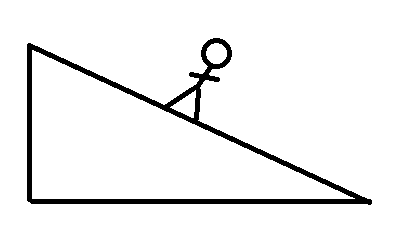
Step 2: Choose a Coordinate System – Align the axes so that one is parallel to the incline (x-axis) and the other is perpendicular (y-axis). This simplifies the analysis by keeping the motion in one dimension.
Step 3: Apply Newton’s Second Law to Each Dimension – Analyze forces in both the x and y directions.
Newton’s Second Law in Each Direction
y-direction (perpendicular to the incline): There is no acceleration, so the normal force balances the perpendicular component of gravity.
x-direction (parallel to the incline): The only force is the component of gravity down the slope, causing acceleration.
Key Equations:
Perpendicular:
Parallel:
Example Calculation: For \theta = 22^\circ,
Mass and Weight
Definitions and Distinctions
It is important to distinguish between mass and weight:
Mass is an intrinsic property of matter, representing the amount of substance and its resistance to acceleration (inertia).
Weight is the force exerted on an object due to gravity, which depends on the local gravitational field.
Weight is measured by a scale (e.g., a spring scale) and is given by .
Example: An object with mass 10 kg has a weight of on Earth.
Pulley and Inclined Plane System
Static Equilibrium with Two Masses
Consider a system where block 1 (mass m_1) rests on a frictionless inclined plane and is connected by a massless rope and pulley to block 2 (mass m_2), which hangs vertically. The goal is to find the value of m_2 that keeps the system in static equilibrium (no motion).
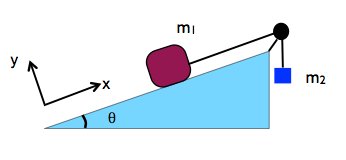
Step 1: Draw Free-Body Diagrams – Identify all forces acting on each block.
Step 2: Choose Coordinate Systems – Use axes parallel and perpendicular to the incline for block 1; vertical for block 2.
Step 3: Apply Newton’s Second Law – Write equations for the forces in each direction.
Force Analysis and Equilibrium Conditions
Block 2 (hanging):
Block 1 (perpendicular to incline):
Block 1 (parallel to incline):
Setting the tensions equal (since the rope is massless and frictionless):
Interpretation: The mass m_2 required to keep the system in equilibrium depends on the mass of block 1 and the angle of the incline. If \theta = 0^\circ, then m_2 = 0, meaning equilibrium is not possible and block 1 will slide.
Variable | Physical Meaning | Equation |
|---|---|---|
m_1 | Mass on the incline | Given |
m_2 | Hanging mass | |
\theta | Incline angle | Given |
T | Tension in the rope |
Summary
Equilibrium occurs when the net force on each object is zero in all directions.
Newton’s Second Law () is applied separately in each direction.
On an incline, decompose gravity into components parallel and perpendicular to the surface.
For pulley systems, relate the forces and tensions to maintain equilibrium.
