 Indietro
Fluids in Motion and Oscillations: Study Notes for Physics with Calculus
Guida di studio - Note intelligenti
 Appunti personalizzati basati sui tuoi materiali, ampliati con definizioni chiave, esempi e contesto.
Fluids in Motion
The Continuity Equation
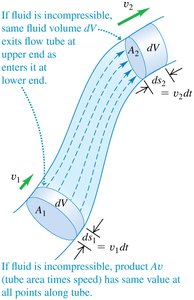
The continuity equation describes the conservation of mass for an incompressible fluid flowing through a tube with varying cross-sectional area. It states that the product of the cross-sectional area and the fluid velocity is constant along the tube.
Continuity Equation: For an incompressible fluid,
Volume Flow Rate: , where is the volume flow rate, is the cross-sectional area, and is the fluid velocity.
Physical Meaning: The same volume of fluid passes through every cross-section of the tube per unit time.
Application: If the diameter of a pipe decreases, the velocity of the fluid must increase to conserve mass.
Bernoulli’s Equation
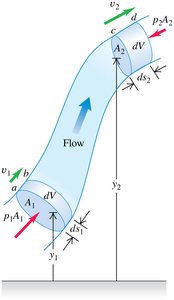
Bernoulli’s equation relates the pressure, velocity, and height at two points in a streamline flow of an ideal, incompressible fluid. It is a statement of conservation of energy for flowing fluids.
Bernoulli’s Equation:
Terms: is pressure, is fluid density, is velocity, is acceleration due to gravity, is height.
Physical Meaning: The sum of pressure energy, kinetic energy per unit volume, and potential energy per unit volume is constant along a streamline.
Applications: Used to solve for unknown pressures, velocities, or heights in fluid systems (e.g., pipes, valves, and open channels).
Oscillations
Equilibrium and Oscillation
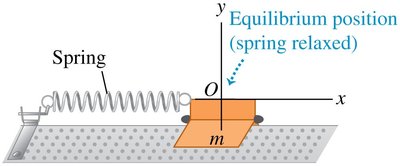
Oscillations occur when a system is displaced from equilibrium and experiences a restoring force that tends to return it to equilibrium. The interplay between this restoring force and the system's inertia leads to periodic motion.
Restoring Force: A force that acts to bring the system back to equilibrium (e.g., spring force).
Equilibrium Position: The position where the net force on the system is zero.
Example: A mass attached to a spring oscillates about its equilibrium position when displaced.
Periodic Motion and Hooke’s Law
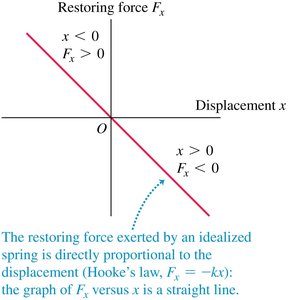
Periodic motion is motion that repeats itself at regular intervals. In the case of a mass-spring system, the restoring force is described by Hooke’s law.
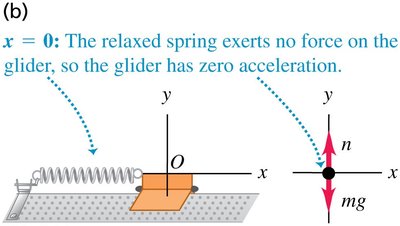
Hooke’s Law: , where is the restoring force, is the spring constant, and is the displacement from equilibrium.
Equilibrium Condition: At , the spring is relaxed and exerts no force.
Simple Harmonic Motion (SHM)
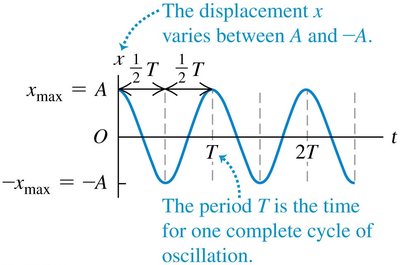
Simple harmonic motion occurs when the restoring force is directly proportional to displacement and directed toward equilibrium. The motion is sinusoidal in time and characterized by amplitude, period, and frequency.
Equation of Motion:
Angular Frequency:
Frequency:
Period:
Amplitude (A): Maximum displacement from equilibrium.
Displacement, Velocity, and Acceleration in SHM
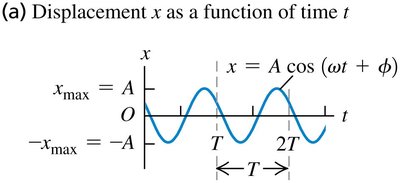
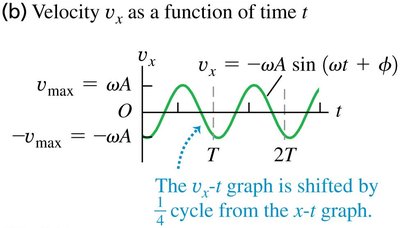
The displacement, velocity, and acceleration of a mass in SHM are given by sinusoidal functions of time, with velocity and acceleration shifted in phase relative to displacement.
Displacement:
Velocity:
Acceleration:
Maximum Values: ,
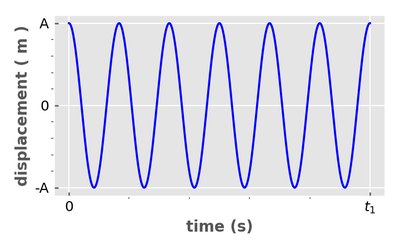
Determining Frequency from a Displacement-Time Graph
The frequency of oscillation can be determined by counting the number of complete cycles in a given time interval on a displacement-time graph.
Frequency Calculation:
Application: Useful for analyzing experimental data or graphical representations of oscillatory motion.
Key Formulas and Concepts Summary
Continuity Equation:
Bernoulli’s Equation:
Hooke’s Law:
SHM Displacement:
Angular Frequency:
Frequency:
Period:
Additional info: These notes cover the essential principles of fluid dynamics and oscillatory motion, including practical applications and graphical analysis, as relevant to introductory college physics with calculus.
