 Indietro
Force Applications II: Friction, Interacting Objects, and Tension
Guida di studio - Note intelligenti
 Appunti personalizzati basati sui tuoi materiali, ampliati con definizioni chiave, esempi e contesto.
Friction
Introduction to Friction Forces
When two surfaces are in contact, the surface can exert forces on an object: a normal force perpendicular to the surface and a friction force parallel to the surface. Friction always acts to oppose relative motion between surfaces.
Normal force (\(\vec{n}\)): Acts perpendicular to the contact surface.
Friction force (\(\vec{f}\)): Acts parallel to the contact surface, opposing motion or impending motion.
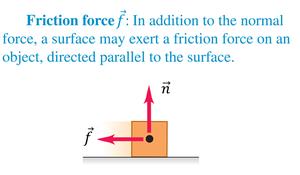
Friction is a contact force and only acts when objects are touching. It can be both beneficial (e.g., walking, fastening objects) and detrimental (e.g., mechanical wear).
Microscopic Origin of Friction
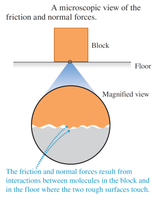
Even smooth surfaces are rough at the microscopic level. Friction and normal forces arise from intermolecular interactions at the points where these rough surfaces touch.
Static and Kinetic Friction
There are two main types of friction:
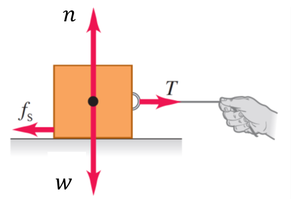
Static friction (\(f_s\)): The force that prevents an object from starting to move. It adjusts up to a maximum value to oppose applied forces.
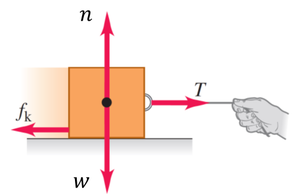
Kinetic friction (\(f_k\)): The force that opposes the motion of an object already sliding over a surface. It is usually less than the maximum static friction.
When pulling a stationary object, static friction balances the applied force until a threshold is reached. Once the object moves, kinetic friction takes over and remains approximately constant.
Mathematical Description of Friction
Magnitude of static friction force:
Magnitude of kinetic friction force:
Here, \(\mu_s\) and \(\mu_k\) are the coefficients of static and kinetic friction, respectively. They are unitless and depend on the materials in contact. Typically, \(\mu_k < \mu_s\).
The direction of friction is always opposite to the direction of motion (kinetic) or impending motion (static).
Coefficients of Friction for Common Materials
The coefficients of friction vary depending on the materials involved. Representative values are shown below:
Materials | \(\mu_s\) | \(\mu_k\) |
|---|---|---|
Steel on steel | 0.74 | 0.57 |
Aluminum on steel | 0.61 | 0.47 |
Copper on steel | 0.53 | 0.36 |
Brass on steel | 0.51 | 0.44 |
Zinc on cast iron | 0.85 | 0.21 |
Copper on cast iron | 1.05 | 0.29 |
Glass on glass | 0.94 | 0.40 |
Copper on glass | 0.68 | 0.53 |
Teflon on Teflon | 0.04 | 0.04 |
Teflon on steel | 0.04 | 0.04 |
Rubber on concrete (dry) | 1.0 | 0.8 |
Rubber on concrete (wet) | 0.30 | 0.25 |
Example Problems
Example 1: A 500 N crate requires a 230 N force to start moving and 200 N to keep moving at constant velocity. Find \(\mu_s\) and \(\mu_k\).
\(\mu_s = \frac{230}{500} = 0.46\)
\(\mu_k = \frac{200}{500} = 0.40\)
Example 2: If a 50 N force is applied to the crate at rest, the friction force is 50 N (since it is less than \(f_{s,\text{max}}\)).
Example 3: Pulling the crate at an angle reduces the normal force, thus reducing friction. The required pulling force can be found by resolving forces and using \(f_k = \mu_k n\).
Example 4: For a sled sliding down a hill at constant velocity, the angle \(\theta\) is found by balancing gravity and friction: .
Interacting Objects
Newton's Third Law and Contact Forces
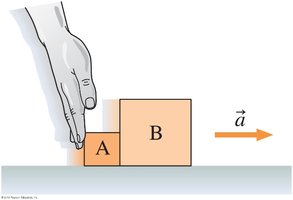
When objects interact by contact, they exert equal and opposite forces on each other (Newton's Third Law). These forces act on different objects and are always equal in magnitude and opposite in direction.
Forces between objects in contact:
Objects in contact move together with the same acceleration.
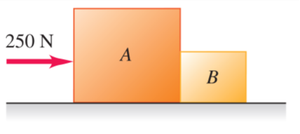
Example: Two Boxes in Contact
Box A (20.0 kg) and Box B (5.0 kg) are in contact on a frictionless surface. A 250 N force is applied to Box A. The force that A exerts on B can be found using Newton's second law for the system and for each box individually.
Ropes and Pulleys
Tension in Ropes
The force exerted by a rope, string, or cable is called tension (symbol: \(T\)). Tension always acts along the direction of the rope and can only pull, not push. The value of tension depends on the forces acting on the objects attached to the rope.
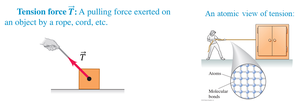
For a massless rope, the tension is the same at every point along the rope.
Pulleys
When a rope passes over a massless, frictionless pulley (an ideal pulley), the tension in the rope is the same on both sides of the pulley. This simplifies the analysis of systems involving pulleys.
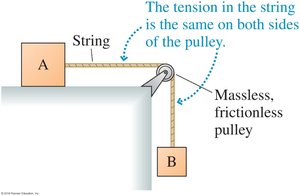
Example: Atwood Machine
Block A (45.0 N) rests on a frictionless table and is connected by a string over a pulley to Block B (25.0 N) hanging vertically. To find the acceleration of the blocks, apply Newton's second law to each block and solve the system of equations.
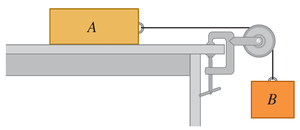
Example: Two Crates Connected by a Rope
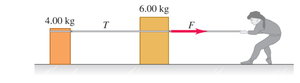
Two crates (4.00 kg and 6.00 kg) are connected by a rope on a frictionless surface. A force \(F\) pulls the 6.00 kg crate, giving both crates an acceleration of 2.50 m/s2. To find the pulling force and the tension in the rope, apply Newton's second law to each crate and the system as a whole.
Example: Vertical System with Tension
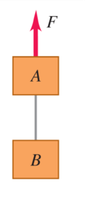
Boxes A and B are connected vertically by a rope. An upward force \(F = 80.0\) N is applied to box A. Box B descends 12.0 m in 4.00 s, and the tension in the rope is 36.0 N. The masses of the boxes can be found using kinematics and Newton's second law.
Equation Summary
Concept | Equation or Description |
|---|---|
Static friction (magnitude) | (Opposes impending motion) |
Kinetic friction (magnitude) | (Opposes motion) |
Tension force | Symbol: (No simple formula; solve using Newton's second law) |
