 Indietro
Forces and Newton’s Laws of Motion: Study Notes for Physics with Calculus
Guida di studio - Note intelligenti
 Appunti personalizzati basati sui tuoi materiali, ampliati con definizioni chiave, esempi e contesto.
Forces and Newton’s Laws of Motion
Introduction
This chapter establishes the connection between force and motion, introducing Newton’s Laws and the fundamental forces encountered in classical mechanics. Understanding these principles is essential for analyzing the motion of objects and solving dynamics problems in physics with calculus.
Motion and Forces
Projectile Motion
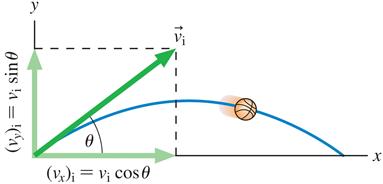
Projectile motion describes the path of an object moving under the influence of gravity alone, following a parabolic trajectory. The motion can be separated into horizontal and vertical components:
Vertical motion: Constant acceleration due to gravity, .
Horizontal motion: Constant velocity, .
Kinematic equations are used to analyze each component independently.
Relative Motion
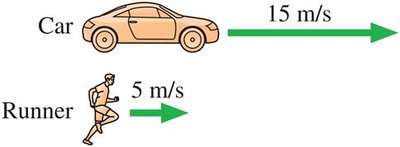
Velocities are always measured relative to a chosen reference frame. To convert between observers, relative velocities are added:
Example: If a car moves at 15 m/s and a runner at 5 m/s in the same direction, the car’s speed relative to the runner is 10 m/s.
Newton’s Laws of Motion
Newton’s First Law (Law of Inertia)
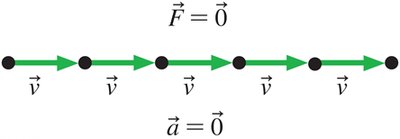
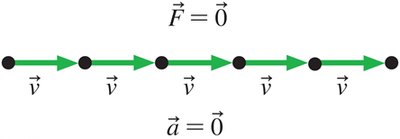
An object at rest remains at rest, and an object in motion continues in a straight line at constant speed unless acted upon by a net external force. This law introduces the concept of inertia.
No net force:
Force: Definition and Types
Force: A push or pull exerted on an object, characterized by magnitude and direction (vector).
Agent: The source that exerts the force.
Contact forces: Require physical contact (e.g., friction, tension).
Long-range forces: Act at a distance (e.g., gravity, electric, magnetic).
Catalog of Common Forces
Weight (Gravitational Force)
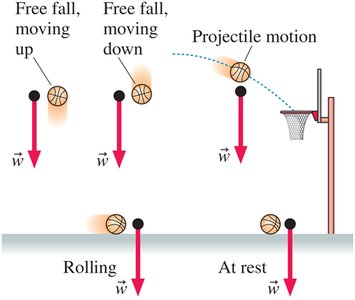
The gravitational pull of the Earth on an object is called its weight. It always points vertically downward.
Formula:
Agent: The entire Earth.
Spring Force
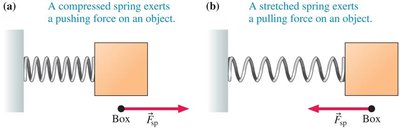
Springs exert a force when compressed or stretched, always parallel to the spring’s axis.
Hooke’s Law: (where is the spring constant, is displacement from equilibrium)
Tension Force
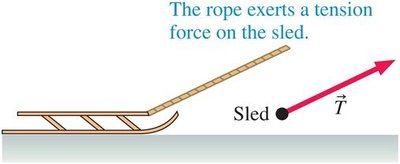
A string, rope, or wire exerts a pulling force called tension, directed along the string.
Symbol:
Normal Force
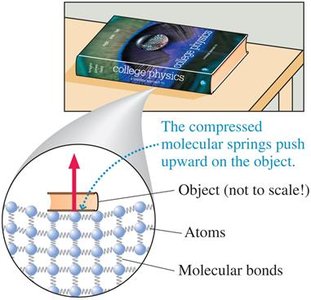
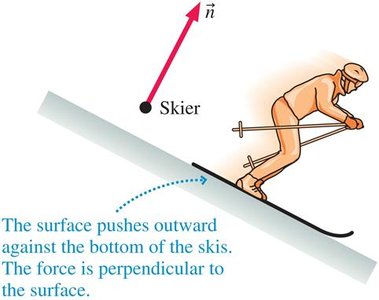
The force exerted by a surface perpendicular to an object pressing against it is the normal force.
Symbol:
Direction: Perpendicular (normal) to the surface.
Friction
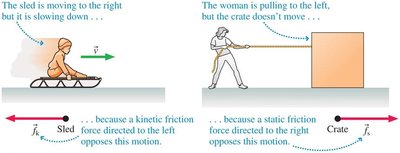
Friction is a contact force exerted by a surface, always parallel to the surface and opposing motion.
Kinetic friction (): Acts when objects slide past each other.
Static friction (): Prevents motion up to a maximum value.
Drag
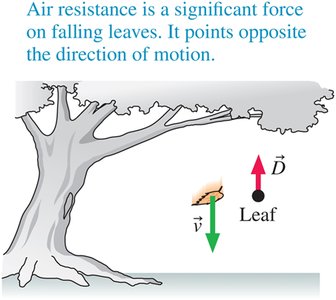
Drag is the resistive force of a fluid (air or water) on a moving object, always opposite to the direction of motion relative to the fluid.
Symbol:
Thrust
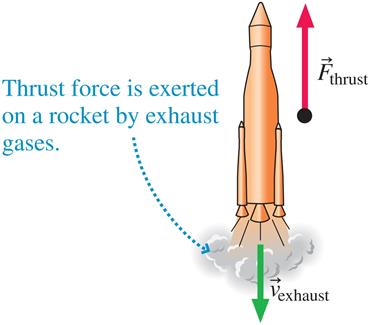
Thrust is the force produced when a jet or rocket expels gas molecules at high speed, acting opposite to the direction of exhaust.
Symbol:
Identifying Forces
Systematic Approach
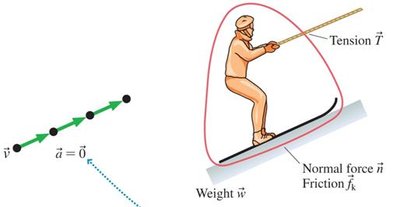
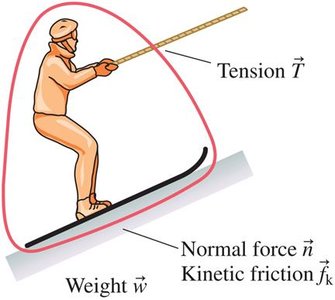
To analyze a problem, identify all forces acting on the object of interest:
Identify the object of interest.
Draw a picture of the situation, including all objects in contact.
Draw a closed curve around the object; only the object of interest is inside.
Locate all points of contact for contact forces.
Name and label each contact and long-range force.
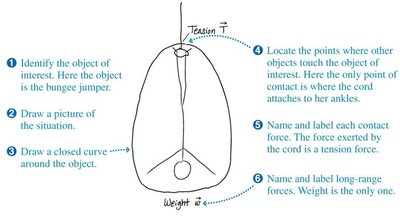
Table: Common Forces and Notation
Force | Notation |
|---|---|
General force | |
Weight | |
Spring force | |
Tension | |
Normal force | |
Static friction | |
Kinetic friction | |
Drag | |
Thrust |
What Do Forces Do?
Force and Acceleration
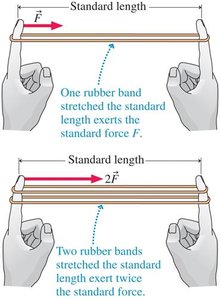
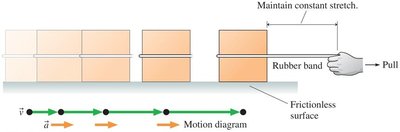
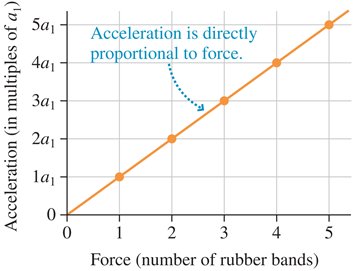
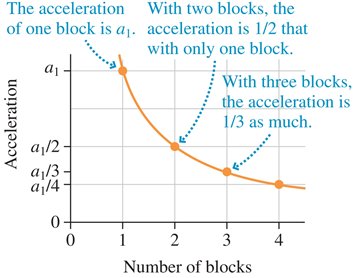
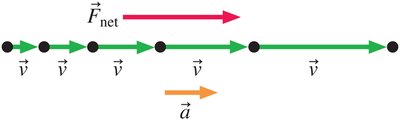
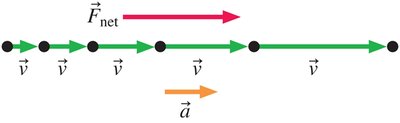
Experiments show that a constant force produces a constant acceleration. The acceleration is:
Directly proportional to the applied force.
Inversely proportional to the object’s mass.
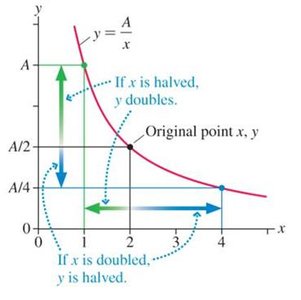
Inversely Proportional Relationships
Two quantities are inversely proportional if , where is a constant. If increases, decreases proportionally, and vice versa.
Newton’s Second Law
Statement and Equation
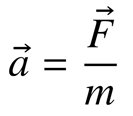
Newton’s Second Law quantitatively relates force, mass, and acceleration:
Equation:
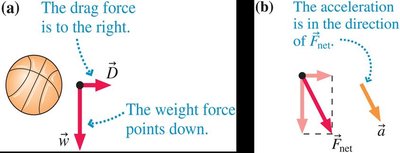
The acceleration vector points in the same direction as the net force vector.
Example: Wind-blown Basketball
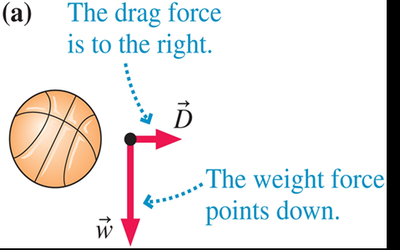
A basketball released in a breeze experiences two forces: weight (downward) and drag (to the right). The net force and acceleration point diagonally downward and to the right.
Units of Force
SI unit: Newton (N), where
English unit: 1 pound (lb) = 4.45 N
Free-Body Diagrams
Purpose and Construction
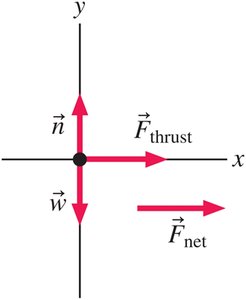
A free-body diagram (FBD) is a visual tool to represent all forces acting on an object, aiding in the analysis of dynamics problems.
Identify all forces acting on the object.
Draw a coordinate system (tilted if necessary).
Represent the object as a dot at the origin.
Draw and label vectors for each force.
Draw the net force vector beside the diagram.
Summary of Key Principles
Newton’s First Law: Objects maintain their state of motion unless acted on by a net force.
Newton’s Second Law: ; acceleration is proportional to net force and inversely proportional to mass.
Force: A vector quantity, either contact or long-range, requiring an agent.
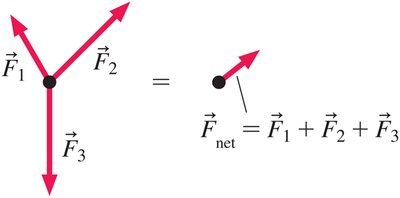
Net force: The vector sum of all forces acting on an object.
Mass: A measure of an object’s resistance to acceleration.
Free-body diagrams: Essential for visualizing and solving dynamics problems.
Additional info:
Practice drawing free-body diagrams for various scenarios to master force identification and vector addition.
Always check that the net force direction matches the observed acceleration in your motion diagram.
