Indietro
Forces in Mechanics: Hooke’s Law and Friction
Guida di studio - Note intelligenti
 Appunti personalizzati basati sui tuoi materiali, ampliati con definizioni chiave, esempi e contesto.
Hooke’s Law and Elastic Force
Introduction to Hooke’s Law
Hooke’s Law describes the relationship between the force exerted by a spring and its displacement from equilibrium. This law is fundamental in understanding elastic behavior in materials and is widely used in physics and engineering.
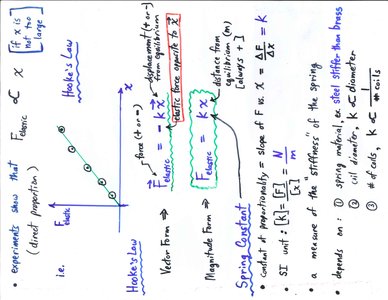
Direct Proportionality: Experiments show that the elastic force (Felastic) is directly proportional to the displacement (x) from the equilibrium position.
Mathematical Form:
Vector Form:
Magnitude Form:
Displacement: , where is the equilibrium position.
Spring Constant (k):
Represents the stiffness of the spring.
SI Unit:
Determined by the slope of the force vs. displacement graph:
Depends on material, diameter, and number of coils of the spring.
Stiffer springs have larger k values.
Applications: Used in measuring forces, designing suspension systems, and understanding oscillatory motion.
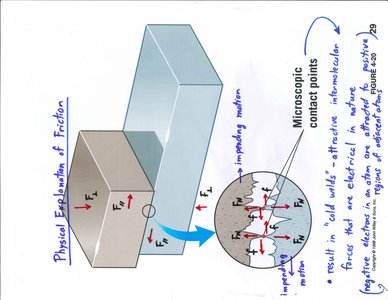
Physical Explanation of Friction
Microscopic Origin of Friction
Friction is a resistive force that opposes the relative motion of two surfaces in contact. Its origin can be explained by examining the microscopic interactions at the contact points between surfaces.
Contact Points: Surfaces are rough at the microscopic level, leading to multiple points of contact.
Microscopic Forces: At these contact points, attractive and repulsive forces arise due to electrical interactions between atoms and molecules.
Direction: Frictional force (Ffr) acts opposite to the direction of impending or actual motion.
Physical Effects: Friction results in energy dissipation as heat and is essential for walking, driving, and many mechanical processes.
Example: When a block slides over a surface, friction arises from the microscopic contact points, resisting the motion and depending on the nature of the surfaces.