 Indietro
Fundamental Concepts in Mechanics: Motion, Forces, Energy, and Rotational Dynamics
Guida di studio - Note intelligenti
 Appunti personalizzati basati sui tuoi materiali, ampliati con definizioni chiave, esempi e contesto.
Representing Motion
Displacement, Velocity, and Acceleration
Understanding motion begins with the concepts of displacement, velocity, and acceleration. These quantities describe how an object's position changes over time.
Displacement (Δx, Δy): The change in position of an object.
Time Interval (Δt): The difference between the final and initial time.
Constant Velocity: If velocity is constant, displacement is given by:
Motion in One and Two Dimensions
Kinematic Equations for Constant Acceleration
When acceleration is constant, the following kinematic equations describe the motion:
Similarly for the y-direction:
Acceleration due to gravity:
Vectors and Trigonometry in Physics
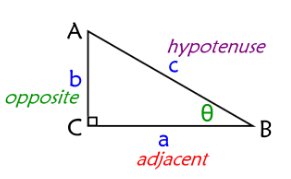
Right Triangle Relationships
Trigonometric functions relate the sides of a right triangle to its angles, which is essential for resolving vectors into components.
Pythagoras Theorem:
Sine:
Cosine:
Tangent:
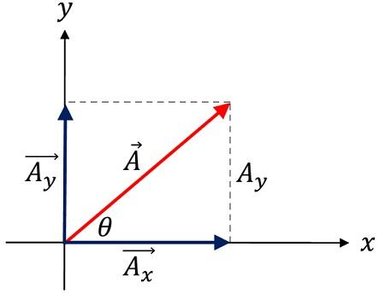
Vector Components
Any vector can be broken into perpendicular components, typically along the x and y axes.
Forces and Newton's Laws of Motion
Net Force and Free Body Diagrams
Forces are vector quantities that can be combined to produce a net force. Newton's Second Law relates net force to acceleration:
Net Force:
Newton's Second Law:
Free Body Diagrams: Diagrams that show all forces acting on an object, represented as a point.
Action-Reaction Pairs: Forces always come in pairs, equal in magnitude and opposite in direction, but act on different bodies.
Friction
Static friction:
Kinetic friction:
Rolling friction:
Circular Motion, Orbits, and Gravity
Circular Motion
Centripetal Acceleration:
Centripetal Force:
Period:
Frequency:
Speed in terms of frequency:
Universal Gravitation
Gravitational acceleration at a planet's surface:
For satellites in circular orbits:
Orbital period:
Rotational Motion
Angular Quantities and Kinematics
Rotational motion is described using angular displacement, velocity, and acceleration, analogous to linear motion.
Arc length: (θ in radians)
Angular velocity:
Angular acceleration:
Linear velocity:
Linear acceleration:
Rotational kinematic equations: Same as linear, with and
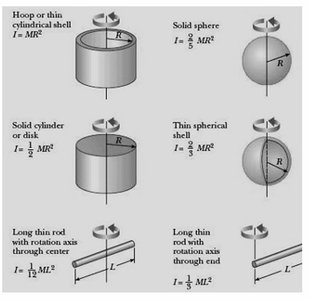
Torque and Moment of Inertia
Torque:
Newton's Second Law (Rotational):
Moment of Inertia:
Equilibrium and Elasticity
Conditions for Equilibrium
(no net force in x-direction)
(no net force in y-direction)
(no net torque)
Hooke's Law and Young's Modulus
Hooke's Law:
Stress:
Strain:
Young's Modulus:
Momentum
Impulse and Conservation of Momentum
Impulse: (also area under F vs. t curve)
Linear momentum:
Angular momentum:
Conservation of momentum: or
In 2D: and
Energy and Work
Work, Energy, and Power
Work:
Gravitational potential energy:
Spring potential energy:
Kinetic energy (translation):
Kinetic energy (rotation):
Energy conservation:
For an isolated system:
Thermal energy (friction):
Thermal energy (drag):
Work-energy theorem:
Elastic collisions (object 2 initially at rest):
Power: (energy transformed), (work done)
