 Indietro
Heat Engines, Entropy, and the Second Law of Thermodynamics
Guida di studio - Note intelligenti
 Appunti personalizzati basati sui tuoi materiali, ampliati con definizioni chiave, esempi e contesto.
Heat Engines and the Second Law of Thermodynamics
Introduction to Heat Engines
Heat engines are devices that convert thermal energy into mechanical work by exploiting the flow of heat from a high-temperature reservoir to a low-temperature reservoir. The study of heat engines is central to understanding the laws of thermodynamics and the limitations imposed by nature on energy conversion processes.
Heat Engine: A system that absorbs heat energy Q_H from a hot reservoir at temperature T_H, does work W_{out}, and expels heat Q_C to a cold reservoir at temperature T_C.
Reservoir: An idealized body with a large thermal capacity that can absorb or supply heat without changing temperature.
Work Output: The useful energy extracted from the engine, typically used to drive mechanical processes.
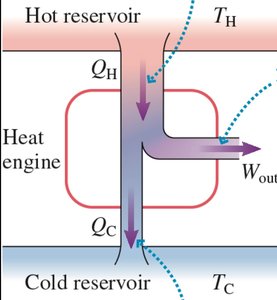
Efficiency of Heat Engines
The efficiency of a heat engine quantifies how effectively it converts absorbed heat into useful work. It is always less than 100% due to the second law of thermodynamics.
Efficiency Formula:
Maximum Theoretical Efficiency (Carnot Efficiency): The upper limit on efficiency is given by the Carnot cycle, which depends only on the temperatures of the hot and cold reservoirs (in Kelvin):
Example Calculation: If a heat engine absorbs 100 J from the hot reservoir and does 40 J of work, its efficiency is:
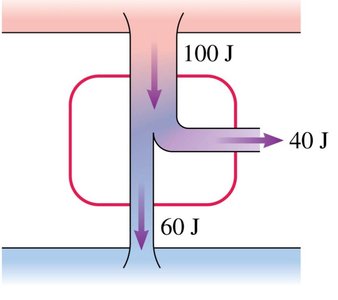
Impossibility of 100% Efficiency
No heat engine operating between two reservoirs can be 100% efficient, as some energy must always be expelled to the cold reservoir. This is a direct consequence of the second law of thermodynamics.
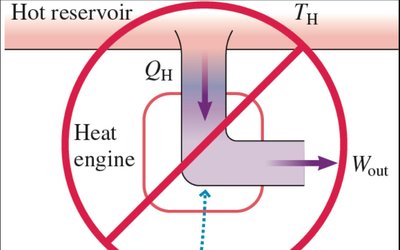
Second Law of Thermodynamics: It is impossible for any process to have as its sole result the transfer of heat from a cooler to a hotter body or the complete conversion of heat into work.
Factors Affecting Maximum Efficiency
The maximum theoretical efficiency of a heat engine can be increased by raising the temperature of the hot reservoir or lowering the temperature of the cold reservoir.
To increase efficiency:
Increase T_H (hot reservoir temperature)
Decrease T_C (cold reservoir temperature)
Real vs. Theoretical Efficiency
Actual heat engines are less efficient than the Carnot limit due to irreversibilities such as friction, heat losses, and non-ideal processes.
Sources of Inefficiency: Friction, non-reversible processes, heat leaks, and material limitations.
Entropy and Probability in Thermodynamics
Microstates, Macrostates, and Entropy
Entropy is a measure of the number of possible microscopic arrangements (microstates) corresponding to a macroscopic state (macrostate) of a system. Systems tend to evolve toward macrostates with the highest probability, i.e., the greatest number of microstates.
Microstate: A specific detailed configuration of a system (e.g., positions and velocities of all molecules).
Macrostate: A description of a system in terms of macroscopic quantities (e.g., pressure, volume, temperature).
Boltzmann's Entropy Formula:
Where S is entropy, k_B is Boltzmann's constant, and W is the number of microstates.
Probability and Entropy Examples
When a box of ideal gas molecules is divided in half, the most probable macrostate is the one with the greatest number of possible microstates. For example, if there are more ways to arrange molecules with some on each side than all on one side, the mixed state is more probable and has higher entropy.
Example: If all molecules are on one side, W = 1 and S = 0. If molecules are distributed, W > 1 and S > 0.
Entropy, Reversibility, and the Second Law
Processes that increase entropy are generally irreversible. The second law of thermodynamics states that the total entropy of an isolated system can never decrease over time.
Reversible Process: A process that can be reversed without leaving any net change in either system or surroundings; these are idealizations.
Irreversible Process: Real processes that increase the total entropy of the universe.
Force and Potential Energy
The force on a particle in a potential energy field is related to the slope (derivative) of the potential energy function. The force is largest where the slope is steepest and zero where the potential energy curve is flat (i.e., at local maxima or minima).
Force from Potential Energy:
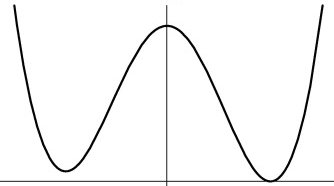
Statistical Probability in Simple Systems
In random processes such as flipping coins, the most probable state is the one with the greatest number of microstates (ways to achieve it). For example, getting a mix of heads and tails is more probable than all heads or all tails.
Example: Flipping a coin 5 times, the sequence with a mix (e.g., 2 heads, 3 tails) is more likely than all heads or all tails.
Processes and Entropy Change
Not all physical processes involve a change in entropy. For example, purely mechanical processes without energy dissipation (like a ball rolling up a ramp) may not involve entropy change, while processes involving heat transfer or mixing generally do.
Examples of Entropy Change: Heating water, mixing gases, energy dissipation.
Examples without Entropy Change: Idealized, reversible mechanical processes.
