Indietro
Kinematics and Projectile Motion: Study Notes
Guida di studio - Note intelligenti
 Appunti personalizzati basati sui tuoi materiali, ampliati con definizioni chiave, esempi e contesto.
1D Kinematics Basics
Displacement, Position, and Time
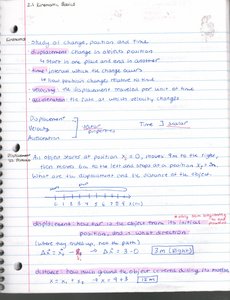
Kinematics is the study of change, position, and time. It focuses on describing how objects move without considering the forces causing the motion.
Displacement: Change in position; a vector quantity indicating how far and in what direction an object has moved.
Position: The location of an object at a given time.
Time: The duration over which motion occurs.
Velocity: The rate of change of displacement; a vector quantity.
Acceleration: The rate at which velocity changes with time.
Example: If an object moves from position m to m, the displacement is m.
Distance vs. Displacement
Distance is the total length of the path traveled, regardless of direction, while displacement is the straight-line change in position.
Distance: Scalar quantity; always positive.
Displacement: Vector quantity; can be positive or negative.
Velocity and Speed
Definitions and Formulas
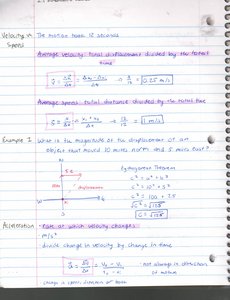
Velocity and speed are both measures of how fast an object moves, but velocity includes direction.
Average velocity:
Average speed:
Example: If an object moves 10 m north and 5 m east, the magnitude of displacement is found using the Pythagorean theorem: m.
Acceleration
Definition and Calculation
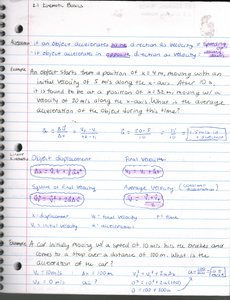
Acceleration is the rate at which velocity changes. It is a vector quantity and can be positive (speeding up) or negative (slowing down).
Average acceleration:
Where is the change in velocity and is the change in time.
Object Displacement and Velocity Equations
Key kinematic equations relate displacement, velocity, acceleration, and time:
Graphical Analysis of Motion
Displacement vs. Time and Velocity vs. Time Graphs
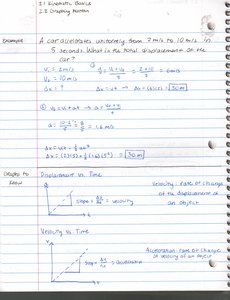
Graphs are essential tools for visualizing motion. The slope of a displacement vs. time graph gives velocity, while the slope of a velocity vs. time graph gives acceleration.
Displacement vs. Time: Slope = velocity
Velocity vs. Time: Slope = acceleration
Area Under Graphs
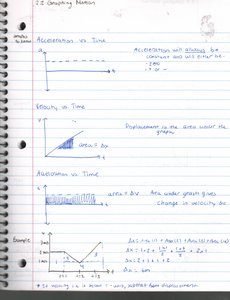
The area under a velocity vs. time graph represents displacement, and the area under an acceleration vs. time graph represents change in velocity.
For constant acceleration, area is a rectangle or triangle.
For variable acceleration, area can be calculated using integration or summing smaller areas.
Motion Scenarios
Common Graph Shapes
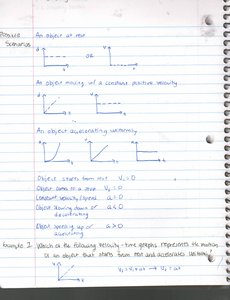
Different motion scenarios produce characteristic graph shapes:
Object at rest: Flat line on velocity vs. time graph.
Object moving at constant velocity: Horizontal line above zero.
Object accelerating uniformly: Straight line with positive or negative slope.
Free Fall
Motion Under Gravity
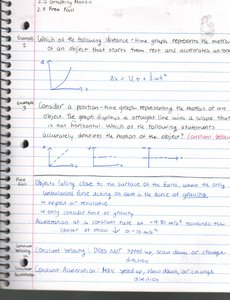
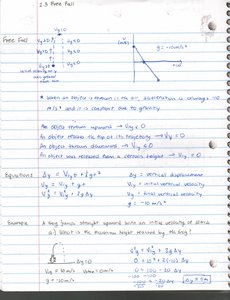
Objects in free fall experience constant acceleration due to gravity ( m/s2 downward). The equations of motion for free fall are:
Examples and Graphs
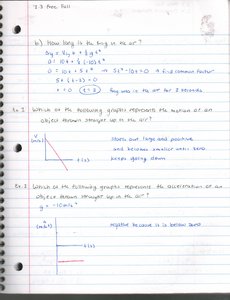
Example: A ball thrown upward with initial velocity will reach a maximum height where , then fall back down.
Time in air, maximum height, and velocity at different points can be calculated using kinematic equations.
Projectile Motion
Two-Dimensional Motion
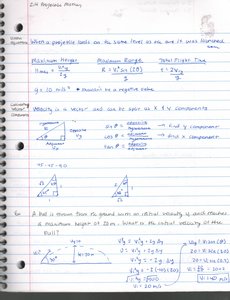
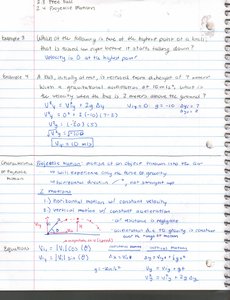
Projectile motion involves both horizontal and vertical components. The horizontal motion has constant velocity, while the vertical motion has constant acceleration due to gravity.
Horizontal displacement:
Vertical displacement:
Maximum height:
Range: (for symmetric projectile motion)
Velocity Components and Example Problems
Velocity is resolved into x and y components using trigonometry:
Example: A ball thrown at an angle with initial velocity will have both horizontal and vertical motion, and its trajectory can be analyzed using the above equations.
Summary Table: Kinematic Equations
Equation | Variables | Application |
|---|---|---|
Displacement, initial velocity, acceleration, time | General motion with constant acceleration | |
Final velocity, initial velocity, acceleration, time | Finding velocity after time with constant acceleration | |
Final velocity, initial velocity, acceleration, displacement | Finding velocity or displacement without time | |
Horizontal displacement, horizontal velocity, time | Projectile motion (horizontal) | |
Vertical displacement, vertical velocity, gravity, time | Projectile motion (vertical) |