Indietro
Kinematics in One Dimension and Vectors: Study Notes
Guida di studio - Note intelligenti
 Appunti personalizzati basati sui tuoi materiali, ampliati con definizioni chiave, esempi e contesto.
Kinematics in One Dimension
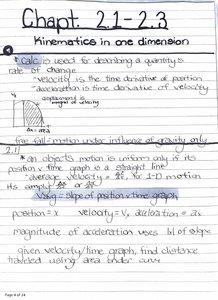
Calculus in Kinematics
Kinematics describes the motion of objects using calculus to define quantities such as velocity and acceleration as rates of change. These concepts are foundational for understanding motion in physics.
Velocity: The time derivative of position, defined as .
Acceleration: The time derivative of velocity, defined as .
Graphical Interpretation: The slope of a position vs. time graph gives velocity, and the slope of a velocity vs. time graph gives acceleration.
Area Under Curve: The area under a velocity vs. time graph represents displacement.
Uniform Motion
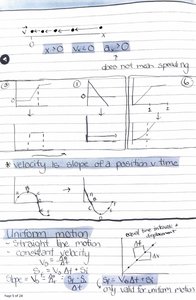
Uniform motion refers to motion with constant velocity, meaning equal displacements occur in equal time intervals. The position changes linearly with time.
Straight Line Motion: The object moves in a straight path with constant speed.
Equation:
Displacement:
Velocity from Graph: The slope of the position vs. time graph gives the velocity.
Non-Uniform Motion
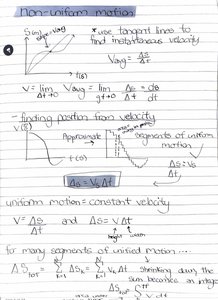
Non-uniform motion involves changing velocity, requiring calculus to analyze instantaneous velocity and displacement over time. Tangent lines on position-time graphs are used to find instantaneous velocity.
Instantaneous Velocity:
Finding Position from Velocity: Integrate velocity over time to find displacement:
Piecewise Motion: For motion with segments of different velocities, sum the displacements for each segment.
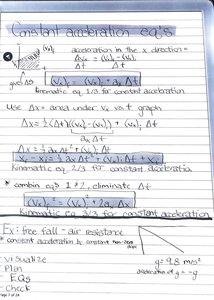
Constant Acceleration Equations
When acceleration is constant, kinematic equations can be used to relate position, velocity, acceleration, and time. These equations are essential for solving problems involving uniformly accelerated motion, such as free fall.
Acceleration:
Velocity:
Displacement:
Velocity-Displacement Relation:
Free Fall: For objects under gravity, downward.
Vectors and Their Components
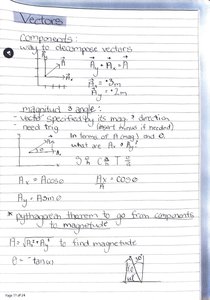
Vector Decomposition
Vectors are quantities with both magnitude and direction. They can be decomposed into components along coordinate axes, which simplifies calculations in physics.
Component Form:
Magnitude:
Angle:
Finding Components: ,
Accelerated Motion on a Ramp
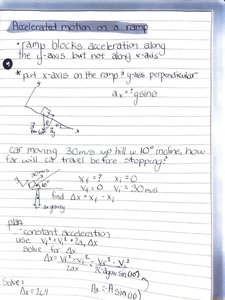
When analyzing motion on an inclined plane, the acceleration along the ramp is a component of gravity. The axes are often rotated to align with the ramp for easier calculation.
Acceleration Along Ramp:
Example Problem: Calculating how far a car travels up a ramp before stopping, using kinematic equations and the component of gravity along the incline.
Unit Vectors and Notation
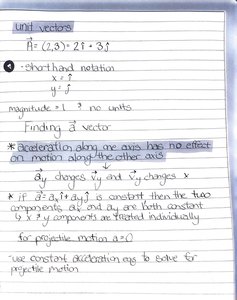
Unit vectors provide a concise way to express vectors in component form. Each unit vector has a magnitude of one and points along a coordinate axis.
Unit Vector Notation:
Magnitude:
Independence of Axes: Acceleration along one axis does not affect motion along the other axis.
Projectile Motion: Use constant acceleration equations for each axis independently when solving projectile motion problems.