 Indietro
Kinematics in One Dimension: Describing Motion with Calculus
Guida di studio - Note intelligenti
 Appunti personalizzati basati sui tuoi materiali, ampliati con definizioni chiave, esempi e contesto.
Describing Motion: Kinematics in One Dimension
Reference Frames and Displacement
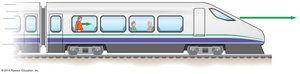
Understanding motion requires specifying a reference frame, which is the perspective from which position, distance, and speed are measured. The choice of reference frame affects the observed values of these quantities.
Reference Frame: The coordinate system or viewpoint from which measurements are made.
Displacement (\(\Delta x\)): The straight-line distance from the initial to the final position, including direction.
Distance: The total length of the path traveled, regardless of direction.
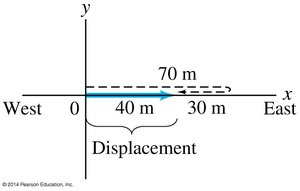
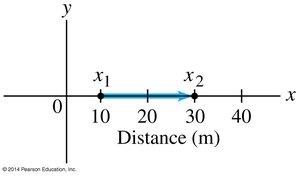
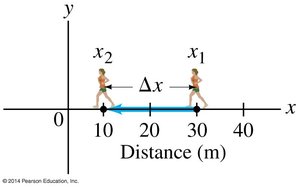
Displacement is calculated as \(\Delta x = x_2 - x_1\).
Displacement can be positive or negative, depending on direction.
Average Speed and Velocity
Speed is a scalar quantity representing how far an object travels in a given time interval, while velocity is a vector that includes both magnitude and direction.
Average Speed:
Average Velocity:


Instantaneous Velocity
The instantaneous velocity is the velocity at a specific moment in time, defined as the limit of the average velocity as the time interval approaches zero.
Instantaneous Velocity:
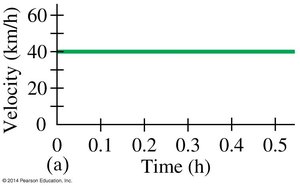
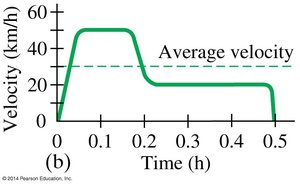
Graphically, constant velocity is represented by a straight, horizontal line on a velocity-time graph, while varying velocity shows changes in the slope.

Acceleration
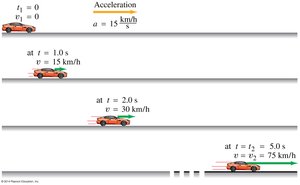
Acceleration is the rate at which velocity changes with time. It is a vector quantity, but in one-dimensional motion, its sign indicates direction.
Average Acceleration:
Acceleration can be positive or negative, depending on the direction of velocity change.

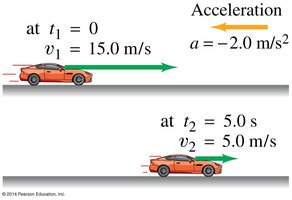
Negative acceleration is not always deceleration; it depends on the chosen coordinate system.
Deceleration: Occurs when acceleration is opposite to the direction of velocity.
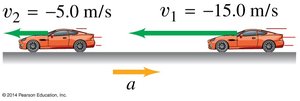
Instantaneous Acceleration:

Motion at Constant Acceleration
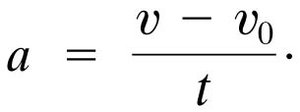
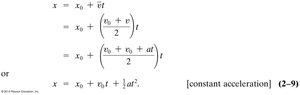
When acceleration is constant, several useful equations describe the motion of an object. These equations relate displacement, velocity, acceleration, and time.
Average Velocity (constant acceleration):
Position as a function of time:
Velocity as a function of time:
Velocity as a function of displacement:




Solving Kinematics Problems
To solve problems involving motion in one dimension, follow a systematic approach:
Read and understand the problem statement.
Identify the objects and time intervals involved.
Draw a diagram and choose coordinate axes.
List known and unknown quantities.
Determine which equations apply and solve algebraically.
Calculate the answer, check units, and assess reasonableness.
Freely Falling Objects
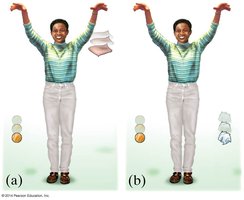
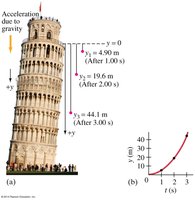
Objects near Earth's surface experience a nearly constant acceleration due to gravity, denoted as g. In the absence of air resistance, all objects fall with the same acceleration regardless of mass.
Acceleration due to gravity: downward
Equations for constant acceleration apply, with if upward is positive.

Graphical Analysis of Linear Motion
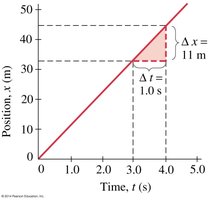
Graphs are useful tools for analyzing motion. The slope of a position-time (x-t) graph gives the velocity, while the area under a velocity-time (v-t) graph gives the displacement.
Constant velocity: Straight line on x-t graph; slope equals velocity.
Changing velocity: Curved line on x-t graph; slope at a point gives instantaneous velocity.
Example Problems
Problem 1: A runner moves from to in . Find the average velocity.
Solution: (negative sign indicates direction).
Problem 2: How far can a cyclist travel in at ?
Solution:
Problem 3: A car accelerates from rest to in . Find the average acceleration.
Convert to :
Problem 4: Airplane must reach with on a runway. Can it take off?
Use :
Runway is too short; minimum length needed is .
Problem 5: Car accelerates from rest at across . How long does it take?
Use :
Problem 6: Ball dropped from rest. How far after ?
Use :
