 Indietro
Kinematics in Two Dimensions and Vectors: Study Notes
Guida di studio - Note intelligenti
 Appunti personalizzati basati sui tuoi materiali, ampliati con definizioni chiave, esempi e contesto.
Vectors and Scalars
Definitions and Examples
In physics, quantities are classified as either vectors or scalars. Understanding the distinction is essential for analyzing motion in two dimensions.
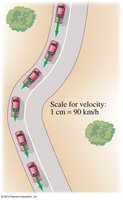
Vector: A quantity with both magnitude and direction. Examples include displacement, velocity, force, and momentum.
Scalar: A quantity with only magnitude (no direction). Examples include mass, time, and temperature.
Addition of Vectors—Graphical Methods
One-Dimensional Vector Addition
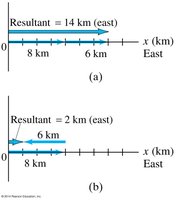
In one dimension, vectors can be added or subtracted using simple arithmetic, but attention must be paid to their signs (directions).
Adding vectors in the same direction increases the resultant magnitude.
Adding vectors in opposite directions subtracts their magnitudes.
Two-Dimensional Vector Addition: Right Angles
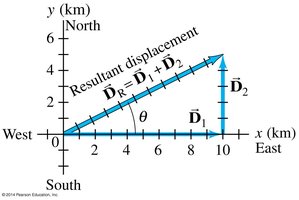
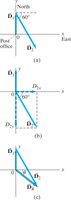
When vectors are at right angles, the resultant can be found using the Pythagorean theorem. The vectors are drawn tail-to-tip to form a right triangle.
The resultant displacement is the vector sum of the components.
Direction can be found using trigonometric functions.
Order of Addition
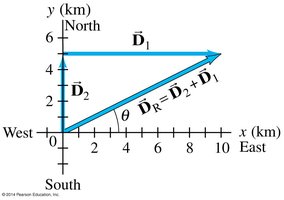
Vector addition is commutative: adding vectors in any order yields the same resultant.
General Graphical Methods
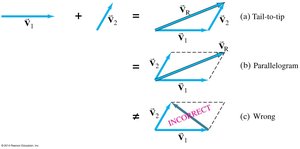
For vectors not at right angles, the tail-to-tip method or the parallelogram method can be used. Both methods require careful placement of vectors.
Tail-to-tip: Place the tail of each subsequent vector at the tip of the previous one.
Parallelogram: Place vectors tail-to-tail and complete the parallelogram; the diagonal is the resultant.
Incorrect methods (e.g., not aligning tails/tips properly) yield wrong results.
Subtraction of Vectors and Multiplication by a Scalar
Vector Subtraction
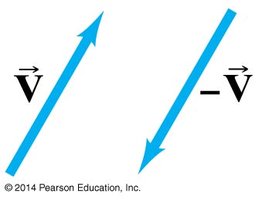
To subtract vectors, define the negative of a vector (same magnitude, opposite direction) and add it to the original vector.

Multiplication by a Scalar
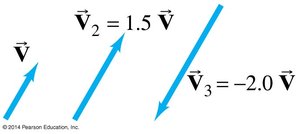
Multiplying a vector by a scalar changes its magnitude but not its direction (unless the scalar is negative, which reverses the direction).
If c is positive, the direction remains the same.
If c is negative, the direction is reversed.
Adding Vectors by Components
Component Method
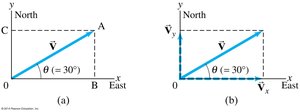
Any vector can be expressed as the sum of two perpendicular components, usually along the x and y axes. This simplifies calculations, especially when adding multiple vectors.
Resolve each vector into x and y components using trigonometric functions.
Add the components in each direction separately.
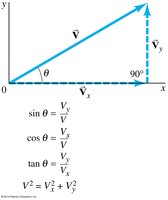
Arithmetic Addition of Components
Once vectors are resolved into components, the components can be added algebraically as one-dimensional quantities.
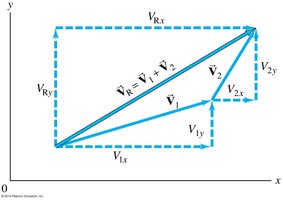
Procedure for Adding Vectors by Components
Follow these steps to add vectors by components:
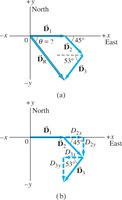
Draw a diagram and add the vectors graphically.
Choose x and y axes.
Resolve each vector into x and y components using sines and cosines.
Add the components in each direction.
Find the magnitude and direction of the resultant vector using:

Projectile Motion
Definition and Path
A projectile is an object moving in two dimensions under the influence of gravity alone. Its path is a parabola.
Examples: thrown balls, cannonballs, diver leaping off a cliff.
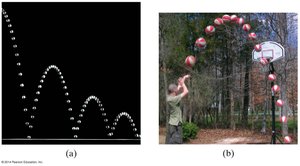
Analysis of Motion
Projectile motion can be analyzed by separating the horizontal and vertical components:
Horizontal motion: constant velocity (no acceleration).
Vertical motion: constant acceleration due to gravity (g).
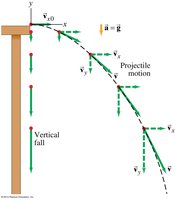
Independence of Motions
The horizontal and vertical motions are independent. For example, two balls dropped from the same height (one with horizontal velocity, one without) will hit the ground at the same time.
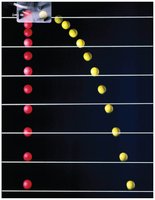
Projectile Launched at an Angle
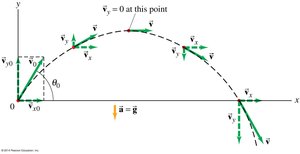
If a projectile is launched at an initial angle with the horizontal, the initial velocity has both horizontal and vertical components:
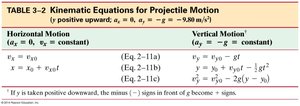
Kinematic Equations for Projectile Motion
The following equations describe projectile motion (assuming upward is positive and ):
Horizontal Motion | Vertical Motion |
|---|---|
Solving Projectile Motion Problems
To solve projectile motion problems:
Read the problem carefully and identify the object(s) to analyze.
Draw a diagram and choose a coordinate system.
Decide on the time interval (same for both directions).
Examine x and y motions separately.
List known and unknown quantities.
Remember: is constant; at the highest point.
Use appropriate equations and combine as needed.
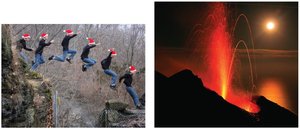
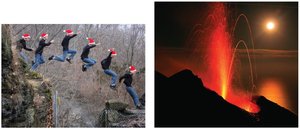
Projectile Motion Is Parabolic
By eliminating time from the equations, the path of a projectile can be shown to be a parabola:
(where A and B are constants depending on initial velocity and angle)
Relative Velocity
Concept and Notation
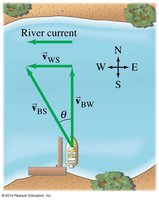
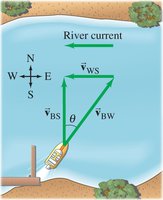
Relative velocity in two dimensions requires vector addition or subtraction. Each velocity is labeled with the object and the reference frame.
Example: is the velocity of water relative to the shore.
Example: is the velocity of the boat relative to the water.
Example: is the velocity of the boat relative to the shore.
Relative Velocity Equation
The relationship between velocities is:
Worked Examples
Example 1: Displacement with Two Legs
A mail carrier drives 22.0 km north, then 47.0 km at 60.0° south of east. Find the total displacement.
Example 2: Airplane Trip with Three Legs
An airplane travels three legs: 620 km east, 440 km southeast (45°), and 550 km at 53° south of west. Find the total displacement.
Example 3: Boat Crossing a River
A boat with speed 1.85 m/s in still water must cross a river with a 1.20 m/s current. At what angle must the boat head to travel directly north?
Additional Problems
Projectile launched horizontally from a cliff: Find initial speed to reach a certain distance.
Football kicked at an angle: Find maximum height, time of flight, and range.
Cannon aimed to hit a target: Find required angle.
Boat crossing a river: Find resultant velocity, time to cross, and downstream distance.
Tiger leaping from a rock: Find landing distance.
Diver jumping from a cliff: Find height and distance from base.
Projectile fired at an angle: Find maximum height, time in air, range, and speed after a given time.
Additional info: For all projectile and relative velocity problems, always resolve vectors into components, apply kinematic equations, and use vector addition for resultant quantities.
